
Keep raw materials, control formulations, modified stages and working hypotheses in one project instead of rebuilding the comparison for every iteration.
R&D & FORMULATION
Follow spectral evidence across formulation changes.
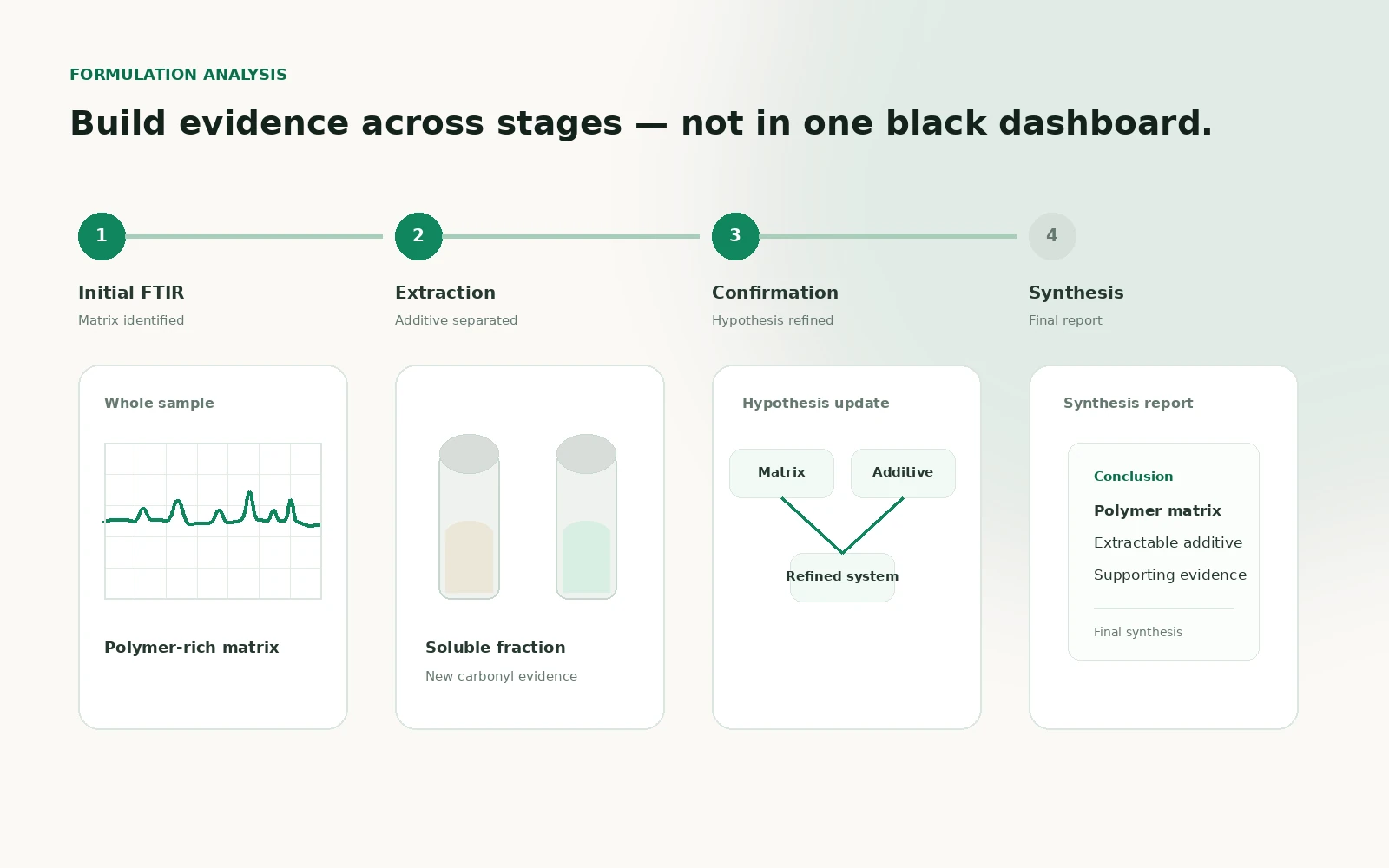
Compare formulation stages, track concentration changes and preserve component hypotheses as new experimental data arrives.
Where it fits
For formulation programmes that evolve through many small experimental changes.
Use it when an R&D project moves through ingredient substitutions, concentration changes, process conditions or staged prototypes and you need the spectral evidence to remain connected to the experiment that produced it.
Compare stages and concentration series, inspect changed bands and retain component hypotheses without presenting FTIR as proof of every ingredient.
Preserve why each experiment was run, what changed spectrally and what the next analytical step should be, so later project decisions do not depend on scattered files or memory.
Typical use cases
- Control versus modified formulation
- Concentration and treatment series
- Peak evolution and next analytical step
What you provide
- Stage spectra and sample context
- Known ingredients and working hypotheses
- Notes on the formulation question
Evidence / reproducibility
Keep the path that produced the result.
Inputs, methods, releases, deterministic metrics and interpretation can remain linked to the assessment so another reviewer can understand what was used, what changed and what remains uncertain.
EingabeMethodBeweisDecision