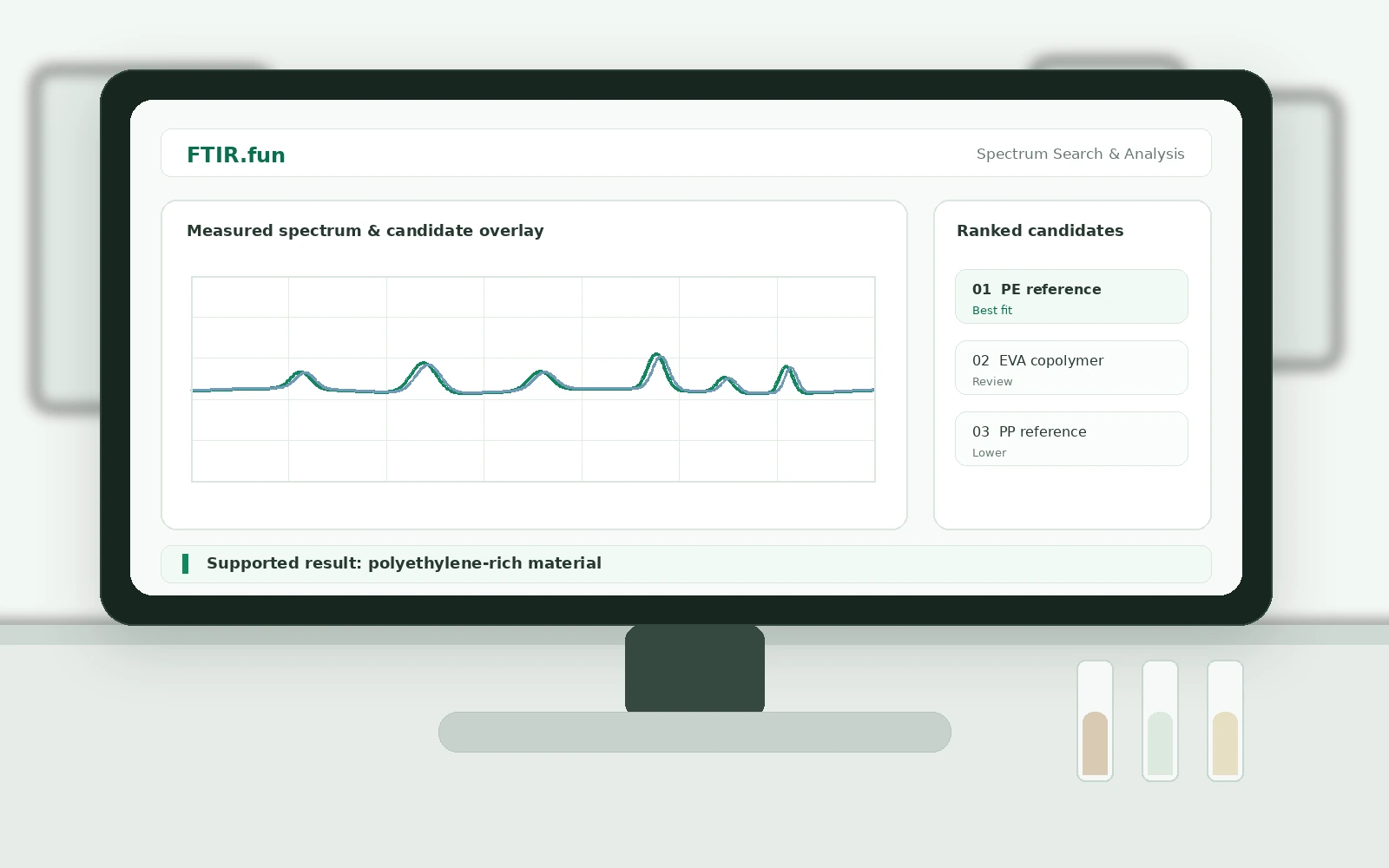
Use it for mixtures, contamination, degradation, low-quality or unusual spectra, and unknowns where a single top library hit would overstate what the data actually shows.
Specialist investigation
When an unknown or mixture does not resolve cleanly, narrow the problem instead of forcing a match.
For ambiguous unknowns, mixtures, contaminants, degraded materials and unusual spectra, a specialist reviews the spectrum together with sample history and the analytical question. Targeted library search, overlapping spectral contributions, literature and chemical context are combined to reach the most defensible interpretation the evidence supports.

Tell us what happened to the sample, what materials or processes may be involved, and what decision the analysis should inform so competing interpretations can be evaluated in context.
Receive a reasoned interpretation of the strongest candidates or component classes, the evidence and limitations, plus targeted follow-up suggestions when FTIR alone cannot close the case.
01 · Suitable cases
Deeper review for spectra that resist a simple answer
The service is most useful when sample context can help distinguish among several spectrally plausible explanations.
Difficult unknowns
Low match scores, several plausible candidate families or no clear result from ordinary automated search.
Mixtures and contaminants
Multi-component samples where overlapping contributions need to be separated conceptually and plausible component hypotheses compared.
Degradation and unusual spectra
Unexpected features that may relate to ageing, contamination, processing, reaction products or an unusual matrix.
02 · How the case is investigated
Use the method that fits the question instead of applying one fixed recipe
The investigation combines different evidence sources according to what the sample and the decision require.
Targeted reference search
Inspect plausible candidates and related material classes rather than accepting the highest automated hit without context.
Overlapping spectral contributions
Examine important bands and test plausible component combinations where the spectral evidence supports doing so.
Sample history and literature
Use process history, known ingredients, contamination routes, chemical knowledge and literature to evaluate competing explanations.
03 · Deliverable
What you receive
A written investigation that separates what the spectrum supports from what remains a hypothesis.
Findings summary
Key spectral features, candidate materials or component classes considered, and the main reasoning behind them.
Most supported interpretation
The strongest conclusion supported by the spectrum and context, with confidence and important alternative explanations stated.
Evidence and limitations
Relevant spectral and literature support together with the reasons a stronger identification may not be justified.
Next analytical step
Targeted follow-up or orthogonal confirmation suggestions when another method would resolve the remaining uncertainty more efficiently.
Scope
The conclusion stops where the evidence stops
Complex-sample conclusions depend on spectrum quality, reference coverage and sample context. FTIR may narrow the possibilities or support a material class without uniquely identifying every component; critical conclusions may require another analytical method.
Send the context, not only the file
Submit the spectrum and explain what is unusual about the case
Include what you know about the sample, process, suspected materials or failure history and the question the analysis should help answer.