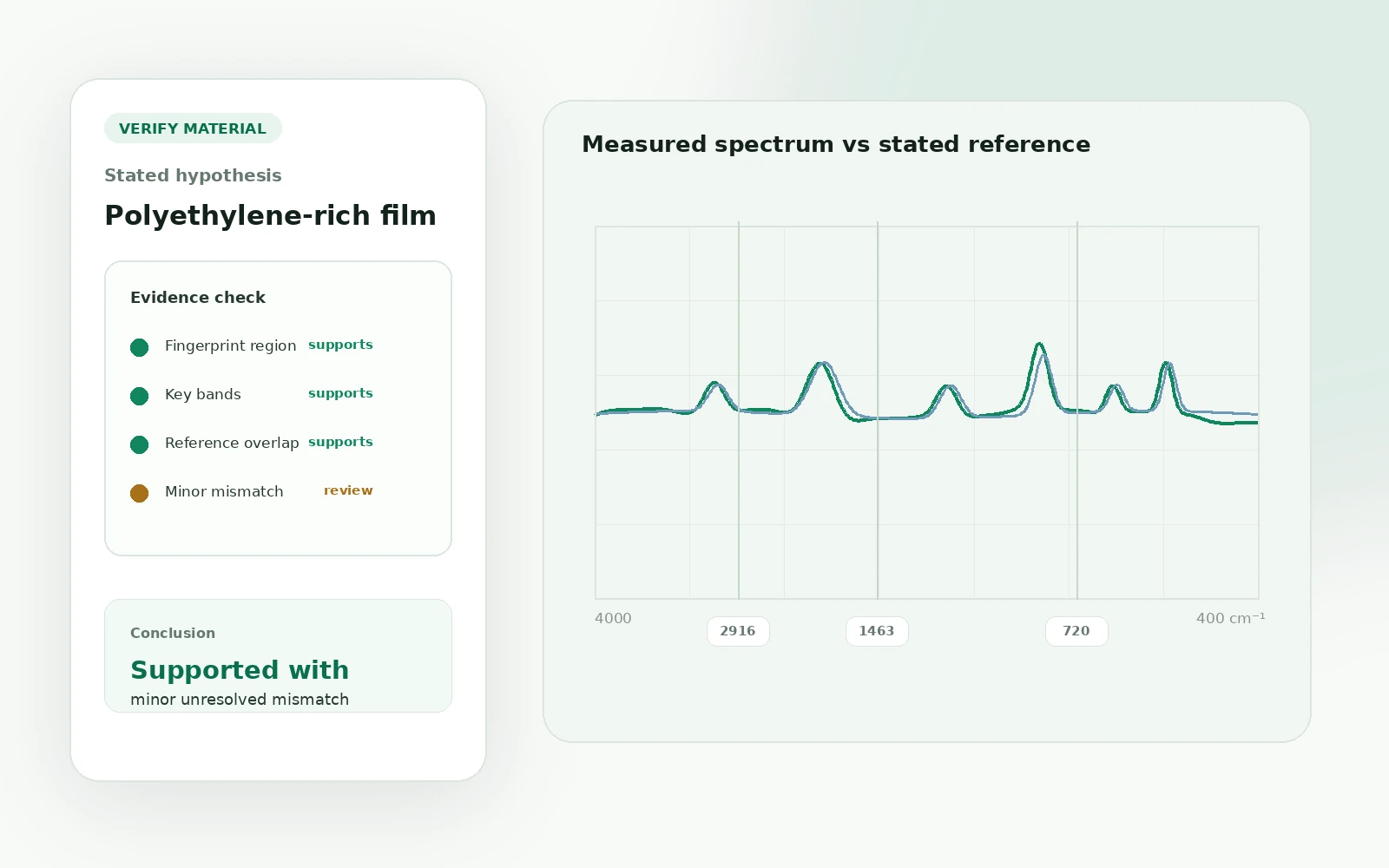
Use it when a generic similarity score is not enough and the practical decision depends on understanding where the two spectra agree, where they differ and how meaningful those differences are.
Professional comparison
When two FTIR spectra look different, find out which differences actually matter.
Submit two spectra and the question you need answered — for example incoming versus qualified reference, failed versus known-good sample, before versus after treatment, or a suspected material versus reference. Receive a focused comparison and written conclusion tied to that question.
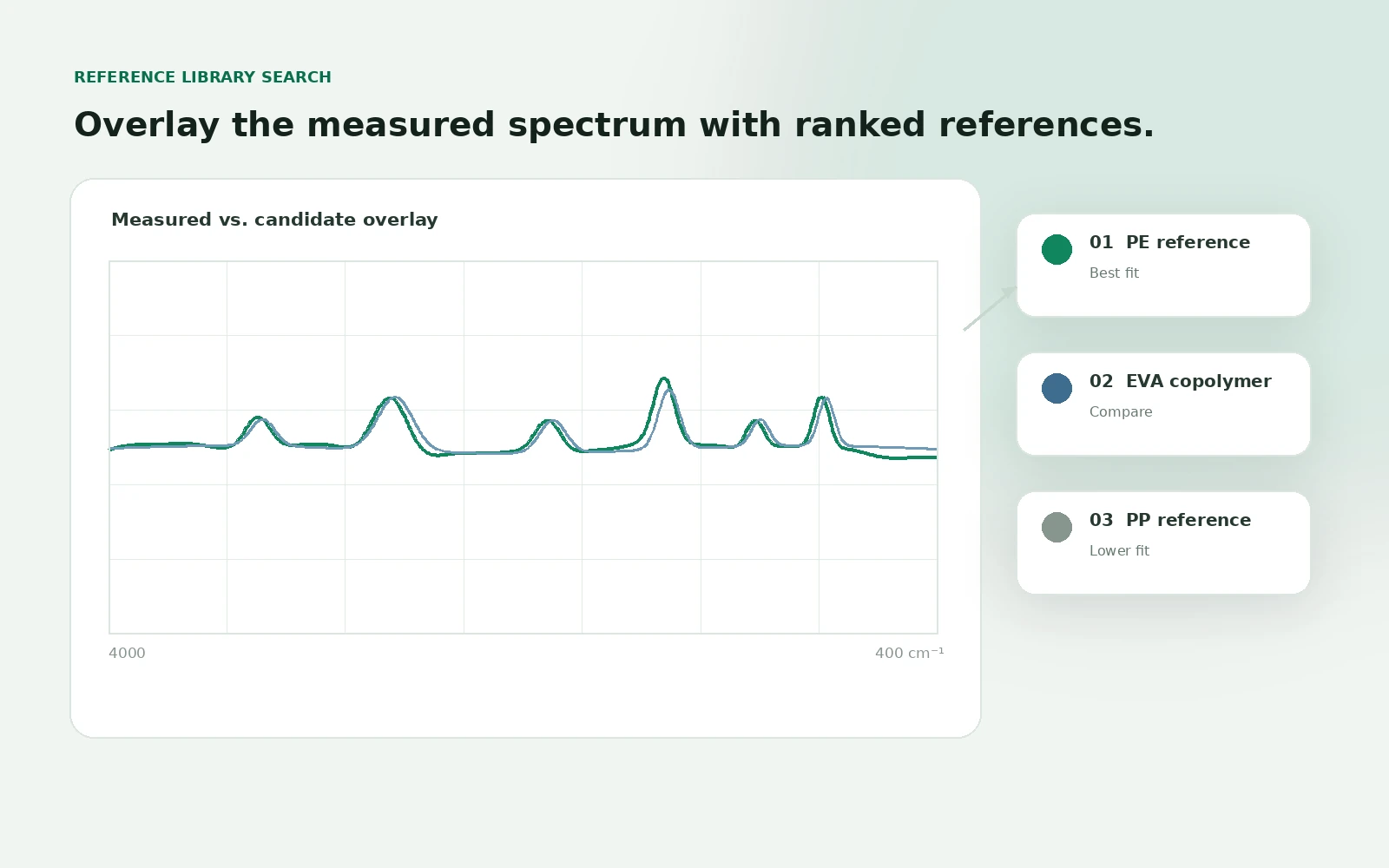
The service can support QC investigation, material verification, treatment comparison, ageing or failure review when the two samples and the comparison question are well defined.
Receive the overlay, important regions and peak-level changes together with a written interpretation, confidence and limitations that can be shared internally or with a customer.
01 · Define the question
The comparison starts with what you need to decide
Two spectra can differ for many reasons. Tell us the relationship between the samples so the review focuses on the differences relevant to your problem.
Your comparison question
Describe whether this is a consistency check, reference comparison, failure investigation, treatment comparison or another two-sample question.
Sample context
Provide material, process, batch or treatment information that helps distinguish expected variation from an analytically important change.
Comparable spectra
Where possible, use spectra collected under comparable sampling and acquisition conditions; method differences can otherwise create apparent spectral changes.
02 · Deliverable
What you receive
A written assessment with the comparison evidence organized around the question you submitted.
Spectral overlay
The two spectra shown together with important regions of agreement and difference.
Peak and region differences
Relevant wavenumber shifts, intensity or shape changes, new or missing bands where the data supports those observations.
Written conclusion
A direct answer to the stated comparison question, with the supporting evidence, confidence and limitations explained.
03 · Scope
What two-spectrum comparison can and cannot establish
FTIR can provide strong evidence of spectral similarity and meaningful band differences, but two spectra alone do not prove that every component, concentration or cause is identical or uniquely determined. Orthogonal testing may be needed when the decision requires information outside the FTIR evidence.
Submit the comparison
Upload both spectra and tell us what decision they need to support
The clearer the relationship between the two samples and the question, the more focused the comparison can be.