
Choose the FTIR workflow that fits your organization.
Routine spectrum search runs on the shared platform. These workflows are built for a specific organizational context — qualified QC history, formulation series, research study groups, teaching cases, laboratory software, or published literature figures.
Turn a match score into a traceable QC investigation
Compare incoming material against qualified historical reference sets, locate the abnormal spectral regions, and investigate likely causes instead of returning only PASS or FAIL.
Qualified reference set, controlled method release, deterministic assessment and cause hypotheses with retained evidence.
→ QC GuideThe five-step path from one new lot to a documented spectral investigation.
→ Halal Origin Pre-screeningCompare samples with qualified porcine and non-porcine reference batches.
→Follow spectral evidence across formulation changes
Keep experimental stages and ingredient changes tied to the spectra they produced, then move from overlay to a working explanation and the next useful experiment.
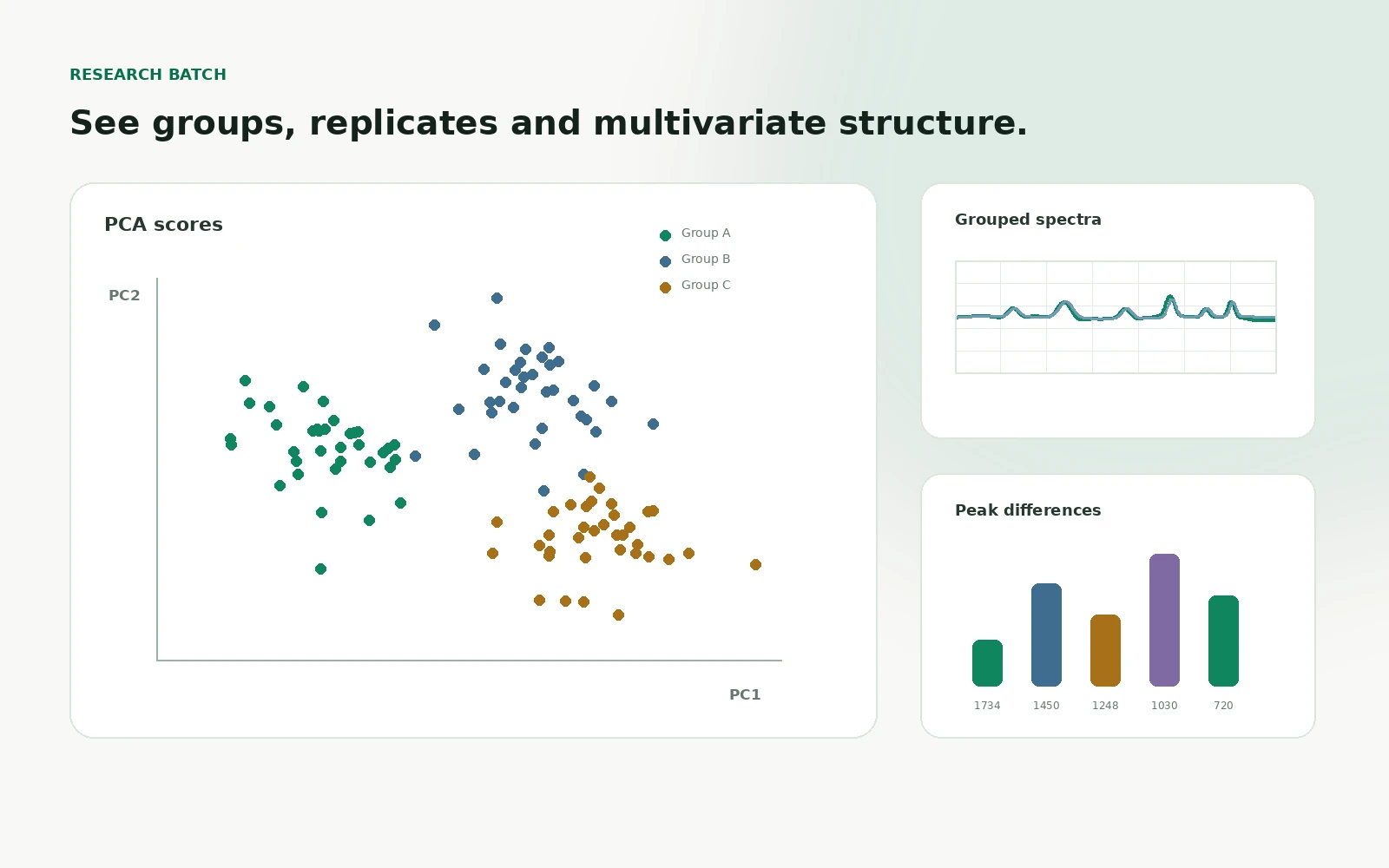
Go beyond the PCA plot to changed bands and evidence
Connect grouped study spectra and replicates to the bands that changed, material-specific interpretation and publication-ready outputs.
Teach FTIR with real spectra and guided decisions
Turn lectures into hands-on practice: learners inspect spectra, commit to a conclusion, then reveal the reference interpretation and evidence.
Add FTIR workflows inside LIMS, ELN or analytical software
Call FTIR search, QC evidence and research batch capabilities through REST and MCP with shared identifiers and structured results.
Turn published FTIR figures into comparable spectra
Digitize figures from papers with DOI and figure provenance retained, then compare them against experimental spectra.
Test one real workflow before adopting it
Bring one material, study or course with real data and judge the output against your existing process.