
aliphatic hydrocarbon-type material with possible inorganic or weakly IR-active contribution
View the report above. Use the comments below if you need follow-up discussion.
aliphatic hydrocarbon-type material with possible inorganic or weakly IR-active contribution
Sample & Measurement Parameters
Identification Result
0%The current FTIR evidence does not support a firm material identification. Although the nearest library entry is Iron, the reference library comparison is non-discriminating because the top candidates all have zero similarity and show no consistent supported functional groups. The sample spectrum is instead characterized by bands at 2924 and 2856 cm-1, consistent with aliphatic C-H stretching, plus bands near 1459 cm-1 and 1012 cm-1, which can occur in hydrocarbon-containing materials but are not sufficiently specific to assign a unique compound. On the present evidence, the most defensible conclusion is a broad aliphatic hydrocarbon-type material, potentially mixed with an inorganic component or another weakly IR-active phase
Detailed interpretation
- Top library match: Iron #129
- The leading library assignment to Iron is not directly supported by characteristic organic-group matching and cannot explain the observed alkyl C-H bands by itself.
- All listed library candidates have zero similarity, S-O the library ranking does not provide meaningful discrimination among specific materials.
- The spectrum lacks sufficient identifying bands to support narrow assignments such as phosphine, amide, alcohol, nitrile, or specific aromatic compounds from the candidate list.
- The 1012 cm-1 band remains insufficiently constrained and could arise from more than one chemical source.
- A mixture is possible, especially if an inorganic phase is present alongside an organic hydrocarbon-like component.
- Without stronger fingerprint-region agreement or corroborating reference evidence, neither Iron nor any other specific library name can be confirmed from this FTIR result alone.
Library Comparison
Library Search Results — Top 15 Candidates
| Rank | Match % | Compound | SMILES | Spectrum No. | Action |
|---|---|---|---|---|---|
| Loading library candidates... | |||||
Peak Analysis
★ = Literature-supported assignmentAppendix — Raw Spectrum

Comments and follow-up evidence
Use this area to continue the interpretation, ask questions, or add extra verification evidence.
The above shows the FTIR analysis results of a tif file uploaded by a user from China. The original image and extracted CSV file are displayed below.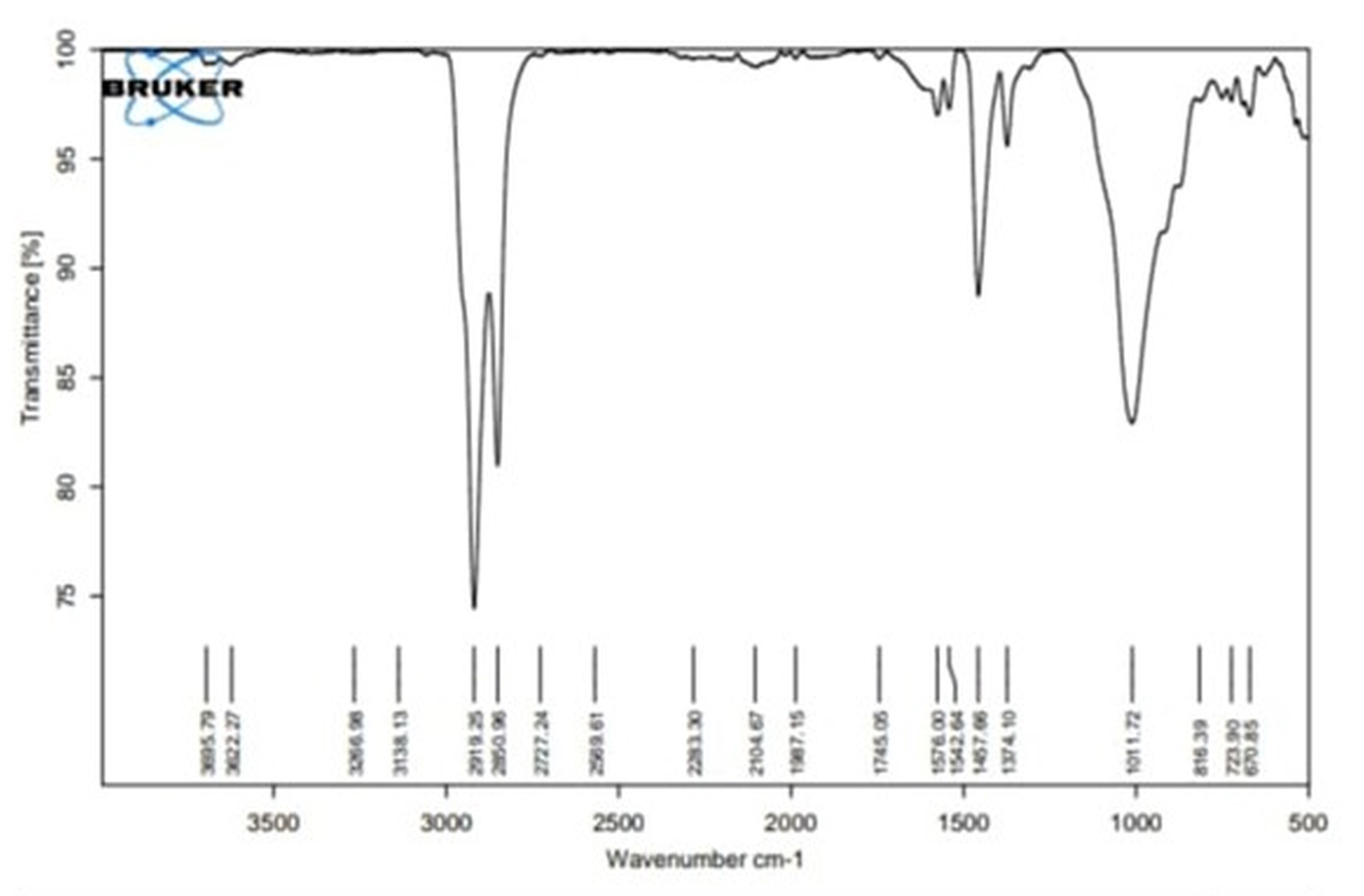 tem.csv
en&2