
Página de resultados
methyl-substituted heteroatom-containing organic material with C-O and possible N-H functionality
Consulte el informe que aparece arriba. Utilice los comentarios a continuación si requiere una discusión de seguimiento.
Informe de análisis FTIR
methyl-substituted heteroatom-containing organic material with C-O and possible N-H functionality
Parámetros de muestra y medición
Informe n.º
20250505143412888309899
Fecha
2025-05-06 01:09:14
Rango espectral (cm⁻¹)
[(650, 4000)]
Línea base
Corrección de línea base AsLS
Coincidencia de biblioteca
0%
Resultado de Identificación
0%La evidencia FTIR no respalda una identificación firme de la muestra como 4-methylbenzene-1,3-diamine. La búsqueda en la biblioteca efectivamente no coincide, ya que todos los candidatos principales informan similitud cero, y ninguna literatura directa o relacionada reduce la asignación. Las bandas observadas son más consistentes con un material orgánico amplio con heteroátomos sustituido con metilo que muestra absorción C-O y posible funcionalidad N-H que con un compuesto específico nombrado.
Interpretación detallada
- Mejor coincidencia de biblioteca: 4-methylbenzene-1,3-diamine #69466 | match 0.0%
- La evidencia FTIR no respalda una identificación firme de la muestra como 4-methylbenzene-1,3-diamine. La búsqueda en la biblioteca efectivamente no coincide, ya que todos los candidatos principales informan similitud cero, y ninguna literatura directa o relacionada reduce la asignación. Las bandas observadas son más consistentes con un material orgánico amplio con heteroátomos sustituido con metilo que muestra absorción C-O y posible funcionalidad N-H que con un compuesto específico nombrado.
- La muestra contiene una banda a 2927 cm-1 consistente con el estiramiento C-H alifático, lo que respalda una sustitución metilo u otra alquítica.
- Las bandas a 1226 y 1057 cm-1 apoyan la presencia de estiramiento de enlace simple C-O o relacionado con heteroátomos.
- La absorción a 3277 cm-1 es compatible con el estiramiento N-H y/o O-H, por lo que una funcionalidad que contenga heteroátomos es plausible.
- La dirección de consenso de la biblioteca informada en el paquete de búsqueda apunta ampliamente hacia la química de metilo / heterociclo de oxígeno, que es más consistente con la región C-O observada que con una afirmación específica de diamina aromática.
- Las absorciones observadas a 3277 y 1632 cm-1 son compatibles con el estiramiento N-H/O-H y una flexión o característica de región de anillo insaturado, pero no son lo suficientemente específicas por sí solas para una asignación única.
- Las bandas a 1226 y 1057 cm-1 apoyan el estiramiento C-O de enlace simple o relacionado con heteroátomos, lo que se alinea mejor con una dirección orgánica amplia que contiene oxígeno que con una diamina aromática estrechamente definida sola.
- La banda a 2927 cm-1 apoya el estiramiento C-H alifático, consistente con una sustitución metilo.
- La característica a 1528 cm-1 puede surgir de vibraciones del anillo aromático o deformación N-H, pero sin evidencia de referencia corroborante no puede distinguir de manera segura entre aminas aromáticas, sistemas de anillos oxigenados u otros compuestos orgánicos que contienen heteroátomos.
- El patrón de las 15 principales bibliotecas incluye candidatos mixtos que abarcan aminas aromáticas, sistemas de anillos que contienen oxígeno, compuestos carbonílicos, compuestos nitro y poliamidas, lo que indica una recuperación débil y químicamente inconsistente en lugar de una coincidencia coherente de un solo material.
- El principal acierto de la biblioteca, 4-methylbenzene-1,3-diamine, no está respaldado por una coincidencia espectral significativa porque la similitud informada es 0.000.
- El conjunto de picos observado no proporciona evidencia clara de identificación de amina aromática suficiente para justificar una asignación específica de diamina.
- Los 15 candidatos principales son químicamente diversos e incluyen clases mutuamente inconsistentes, lo que limita la confianza en cualquier conclusión de material estrecha.
- Sigue siendo incierto si la banda a 3277 cm-1 está dominada por absorción de N-H, O-H o mixta con enlace de hidrógeno.
- La lista de picos actual es demasiado escasa para distinguir de manera confiable entre amina aromática, heterociclo de oxígeno, material que contiene amida u otros materiales orgánicos con heteroátomos.
- Debido a que no se recuperó ninguna coincidencia de referencia respaldada por literatura, la conclusión presente debe tratarse como una dirección de material amplia en lugar de una identificación de compuesto específico.
Comparación de bibliotecas
El espectro de la biblioteca aparecerá aquí.
Resultados de Búsqueda en Biblioteca — Los 15 Principales Candidatos
| Rango | Coincidencia % | Compuesto | SMILES | N.º de espectro | Acción |
|---|---|---|---|---|---|
| Cargando candidatos de la biblioteca... | |||||
Análisis de picos
★ = Asignación respaldada por literaturaApéndice — Espectro sin procesar

Discusión
Comentarios y evidencia de seguimiento
Usa esta área para continuar la interpretación, hacer preguntas o agregar evidencia de verificación adicional.
The above shows the FTIR analysis results of a png file uploaded by a user (IP: 192.XX.XX.253). The original image is displayed below.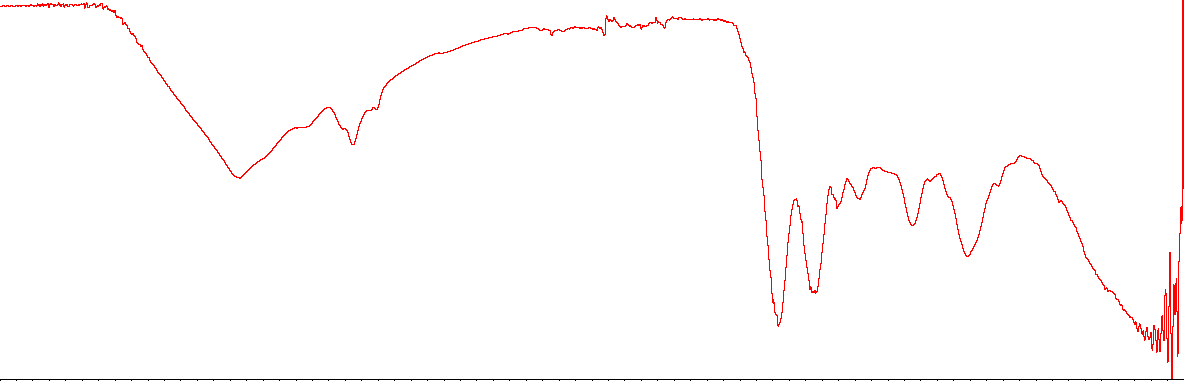 Switch result modes to compare curve similarity, characteristic peaks, or the fingerprint region. The system's conclusion may be inaccurate—refer to Spectrum No. 15532 through 'find spectrum' mode
en&2sample csv tem.csv
en&2