
PUBLIC SPECTRUM SEARCH
4-methylbenzene-1,3-diamine
Free public result — the submitted spectrum with its top library candidates, not an AI identification.
SPECTRUM & LIBRARY MATCHES
Submitted spectrum and top library candidates

Top 15 library matches
| # | Reference | CAS | Similarity |
|---|---|---|---|
| 1 | 4-methylbenzene-1,3-diamine | 95-80-7 | - |
| 2 | POTASSIUM FORMATE | 590-29-4 | - |
| 3 | 2,3-dihydro-1,4-benzodioxine-7-carbaldehyde | 29668-44-8 | - |
| 4 | 2,6-Dimethylhepta-2,5-dien-4-one | 504-20-1 | - |
| 5 | 2,6-Dimethylhepta-2,5-dien-4-one | 504-20-1 | - |
| 6 | Tetranitromethane | 509-14-8 | - |
| 7 | Tetranitromethane | 509-14-8 | - |
| 8 | Tetranitromethane | 509-14-8 | - |
| 9 | 3-Phenylpropanal | 104-53-0 | - |
| 10 | Poly(hexamethylene adipamide) | 32131-17-2 | - |
| 11 | POLYCAPROLACTAM | none | - |
| 12 | Polyamide-4,6 | none | - |
| 13 | 2-phenylbenzo[h]chromen-4-one | 604-59-1 | - |
| 14 | Polycaprolactam | 25038-54-4 | - |
| 15 | 2-Chloro-4-methylaniline | 615-65-6 | - |
Discussion
Comments and follow-up evidence
Use this area to continue the interpretation, ask questions, or add extra verification evidence.
The above shows the FTIR analysis results of a png file uploaded by a user (IP: 192.XX.XX.253). The original image is displayed below.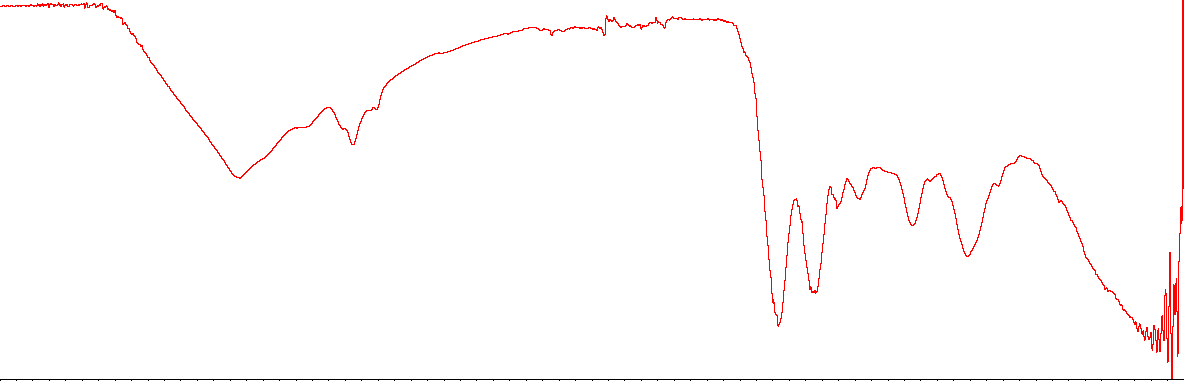 Switch result modes to compare curve similarity, characteristic peaks, or the fingerprint region. The system's conclusion may be inaccurate—refer to Spectrum No. 15532 through 'find spectrum' mode
en&2sample csv tem.csv
en&2