결과 페이지

aromatic / methacrylate polymer with ether, hydroxyl, and unsaturated groups

위의 보고서를 보세요. 후속 논의가 필요하면 아래 댓글을 사용하세요.

결과 번호: 20260115141725008390493 소유자: till 댓글: 1
  • Translating report into 한국어. English is shown for now.
FTIR ANALYSIS REPORT

FTIR Spectrum Analysis Report

No.: 20260115141725008390493 Date: Reported by: FTIR.fun Contact: [email protected]

Download a professional, formatted PDF of this analysis.

Top15

Similarity-ranked Top-15 library comparison

Library spectrum will appear here.
Library spectrum Interactive sample curve Move the pointer to show the vertical guide line.
Top 15 candidates

Reference library candidates

Rank Match % Compound Name Formula / SMILES Library preview Action
Reference candidates load with this Top-15 workbench.

Based on the library matches and evidence above.

Conclusion

aromatic / methacrylate polymer with ether, hydroxyl, and unsaturated groups

전체 신뢰도
Conclusion
  1. Library consensus points strongly to aromatic/methacrylate chemistry, with top entries including poly(ethylene glycol) methacrylate, siloxane‑containing materials, and methacrylate‑based polymers.
  2. Multiple independent literature sources support the presence of hydroxyl, ether, and alkyl functionalities, all of which are compatible with a methacrylate‑rich polymer bearing polyethylene glycol or aliphatic ether segments.
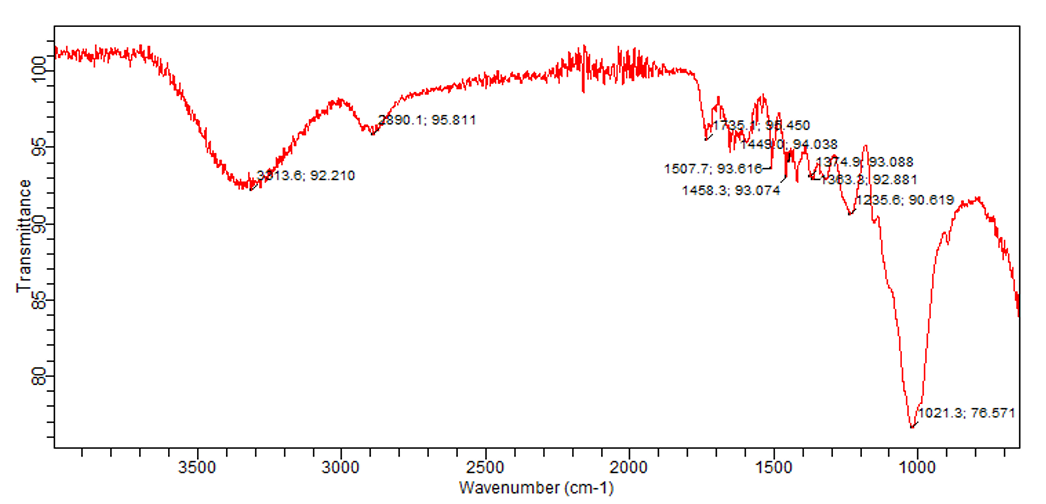
  3. The band at 3336 cm⁻¹ is attributed to O–H stretching of hydroxyl groups [2].
Evidence & interpretation
Evidence

Key evidence

라이브러리 최우선 일치
2,2,3,3-Tetrafluoropropan-1-ol #65316
Limitations

Evidence that limits the conclusion

  • No bands characteristic of C–F stretching (1000–1400 cm⁻¹) are observed, making the top library hit (2,2,3,3‑tetrafluoropropan‑1‑ol) chemically unlikely.
  • The expected strong ester carbonyl absorption near 1720 cm⁻¹, a key marker of conventional methacrylate polymers, is absent from the set of prominent peaks, challenging a simple methacrylate homopolymer identification.
  • Without additional spectral data, the exact balance between aromatic, methacrylate, ether, and siloxane components remains undetermined.
Recommendation

Suggested next verification

  • Acquire the full FTIR spectrum over 4000–400 cm⁻¹, particularly the 1800–1650 cm⁻¹ (carbonyl) and 1400–600 cm⁻¹ (C–F, aromatic C–H, Si–O) regions, to confirm or rule out carbonyl, aromatic ring, and halogenated species.
  • Compare the spectrum with reference spectra of known methacrylate polymers, fluorinated alcohols, and siloxane‑containing copolymers to resolve the ambiguity.
  • If possible, perform complementary analysis (e.g., Raman spectroscopy, NMR, or XPS) to identify the presence of fluorine, silicon, or specific functional groups.
Peak analysis

Detected peaks and interpretation

★ = Literature-supported peak assignment.

Index Characteristic Wavenumber Absorbance Evidence One-line interpretation Citation Confidence
1 · 1099 1.00 - - - -
2 · 953 0.30 - - - -
3 797 0.27 문헌 지원 할당 The band at 797 cm-1 is assigned to carboxyl. [1] LLM 신뢰도
4 3336 0.20 문헌 지원 할당 The band at 3336 cm-1 is assigned to O-H stretching. [4] LLM 신뢰도
5 1635 0.13 문헌 지원 할당 The band at 1635 cm-1 is assigned to methacrylate. [3] LLM 신뢰도
Literature

References

Appendix

Sample information and raw spectrum

Original uploaded spectrum for reference and verification.

Baseline correction method: Asymmetric Least Squares Smoothing

The wavelength range for analysis(cm-1): N/A

Raw spectrum without baseline correction or other processing:

Sample spectrum image
토론

댓글 및 후속 증거

이 영역을 사용하여 해석을 계속하거나 질문을 하거나 추가 검증 증거를 추가하십시오.

요청 제출 양식