
aromatic / methacrylate polymer with ether, hydroxyl, and unsaturated groups
Consultez le rapport ci-dessus. Utilisez les commentaires ci-dessous si vous avez besoin d'une discussion de suivi.
aromatic / methacrylate polymer with ether, hydroxyl, and unsaturated groups
Paramètres d'échantillon et de mesure
Résultat d'identification
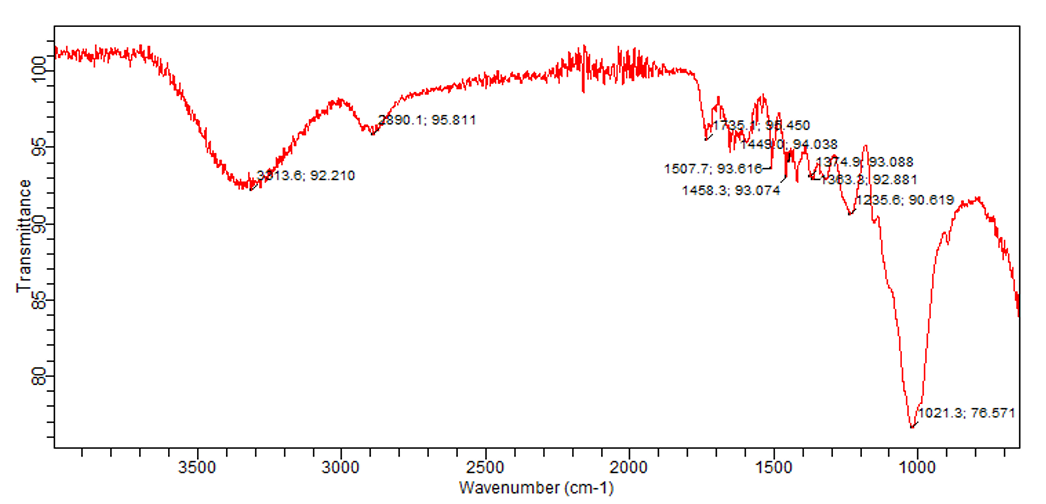
78%Le spectre FTIR suggère un matériau à base d'aromatique/méthacrylate contenant des liaisons éther, des groupes hydroxyle, des liaisons carbone-carbone insaturées, des chaînes alkyle et des fragments carboxylate. Une identification définitive comme un seul composé pur n'est pas soutenue car l'absorption forte attendue du carbonyle d'ester (~1720 cm⁻¹) est absente, et les bandes d'étirement C–F caractéristiques du meilleur résultat de la bibliothèque ne sont pas observées. La direction la plus défendable est une résine polymère ou un oligomère riche en méthacrylate avec un caractère aromatique et des fonctionnalités oxygénées, cohérent avec le consensus de la bibliothèque mais restant large.
Interprétation détaillée
- Meilleure correspondance de bibliothèque: 2,2,3,3-Tetrafluoropropan-1-ol #65316
- Aucune bande caractéristique de l'étirement C–F (1000–1400 cm⁻¹) n'est observée, rendant le meilleur résultat de la bibliothèque (2,2,3,3‑tétrafluoropropan‑1‑ol) chimiquement peu probable.
- L'absorption forte attendue du carbonyle d'ester près de 1720 cm⁻¹, un marqueur clé des polymères méthacrylate conventionnels, est absente de l'ensemble des pics proéminents, remettant en question une simple identification d'homopolymère méthacrylate.
- Sans données spectrales supplémentaires, l'équilibre exact entre les composants aromatiques, méthacrylate, éther et siloxane reste indéterminé.
Comparaison de bibliothèques
Résultats de recherche dans la bibliothèque — Top 15 des candidats
| Rang | Correspondance % | Composé | SMILES | N° de spectre | Action |
|---|---|---|---|---|---|
| Chargement des candidats de la bibliothèque... | |||||
Analyse des pics
★ = Attribution soutenue par la littérature| # | Nombre d'onde (cm⁻¹) | Absorbance | Attribution | Citation | État de l'attribution | |
|---|---|---|---|---|---|---|
| 1 | · | 1099 | 1.00 | - | - | - |
| 2 | · | 953 | 0.30 | - | - | - |
| 3 | · | 797 | 0.27 | La bande à 797 cm-1 est attribuée au carboxyle. | - | Haute confiance |
| 4 | · | 3336 | 0.20 | La bande à 3336 cm-1 est attribuée à l'étirement O-H. | - | Haute confiance |
| 5 | · | 1635 | 0.13 | La bande à 1635 cm-1 est attribuée au méthacrylate. | - | Haute confiance |
Annexe — Spectre brut

Commentaires et preuves de suivi
Utilisez cette zone pour poursuivre l'interprétation, poser des questions ou ajouter des preuves de vérification supplémentaires.
raw image:
en&2