
aromatic / methacrylate polymer with ether, hydroxyl, and unsaturated groups
Sehen Sie sich den Bericht oben an. Nutzen Sie die Kommentare unten, wenn Sie eine Folgediskussion benötigen.
aromatic / methacrylate polymer with ether, hydroxyl, and unsaturated groups
Proben- und Messparameter
Identifikationsergebnis
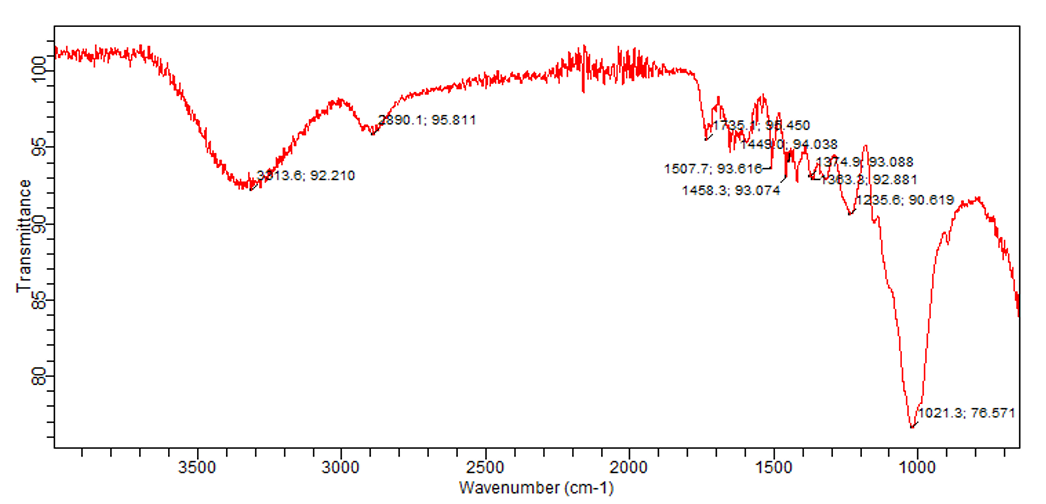
78%Das FTIR-Spektrum deutet auf ein aromatisches/methacrylatbasiertes Material hin, das Etherbrücken, Hydroxylgruppen, ungesättigte Kohlenstoff-Kohlenstoff-Bindungen, Alkylketten und Carboxylatgruppen enthält. Eine eindeutige Identifizierung als einzelne reine Verbindung wird nicht unterstützt, da die erwartete starke Ester-Carbonyl-Absorption (~1720 cm⁻¹) fehlt und die charakteristischen C–F-Streckungsbanden der besten Bibliotheksübereinstimmung nicht beobachtet werden. Die vertretbarste Richtung ist ein methacrylatreiches Polymerharz oder Oligomer mit aromatischem Charakter und sauerstoffhaltigen Funktionalitäten, konsistent mit dem Bibliothekskonsens, aber breit.
Detailinterpretation
- Beste Bibliotheksübereinstimmung: 2,2,3,3-Tetrafluoropropan-1-ol #65316
- Es werden keine für die C–F-Streckung charakteristischen Banden (1000–1400 cm⁻¹) beobachtet, was den besten Bibliothekstreffer (2,2,3,3‑Tetrafluorpropan‑1‑ol) chemisch unwahrscheinlich macht.
- Die erwartete starke Ester-Carbonyl-Absorption bei etwa 1720 cm⁻¹, ein Hauptmerkmal konventioneller Methacrylat-Polymere, fehlt im Satz der prominenten Peaks, was eine einfache Identifizierung als Methacrylat-Homopolymer in Frage stellt.
- Ohne zusätzliche spektrale Daten bleibt das genaue Verhältnis zwischen aromatischen, Methacrylat-, Ether- und Siloxankomponenten unbestimmt.
Bibliotheksvergleich
Bibliothekssuchergebnisse – Top 15 Kandidaten
| Rang | Übereinstimmung % | Zusammensetzung | SMILES | Spektrum-Nr. | Aktion |
|---|---|---|---|---|---|
| Bibliothekskandidaten werden geladen... | |||||
Peak-Analyse
★ = Literaturgestützte Zuordnung| # | Wellenzahl (cm⁻¹) | Absorbanz | Zuordnung | Zitat | Zuordnungsstatus | |
|---|---|---|---|---|---|---|
| 1 | · | 1099 | 1.00 | - | - | - |
| 2 | · | 953 | 0.30 | - | - | - |
| 3 | · | 797 | 0.27 | Die Bande bei 797 cm-1 wird der Carboxylgruppe zugeordnet. | - | Hohe Konfidenz |
| 4 | · | 3336 | 0.20 | Die Bande bei 3336 cm-1 wird der O-H-Streckung zugeordnet. | - | Hohe Konfidenz |
| 5 | · | 1635 | 0.13 | Die Bande bei 1635 cm-1 wird dem Methacrylat zugeordnet. | - | Hohe Konfidenz |
Anhang – Rohspektrum

Kommentare und Folgebeweise
Nutzen Sie diesen Bereich, um die Interpretation fortzusetzen, Fragen zu stellen oder zusätzliche Überprüfungsbeweise hinzuzufügen.
raw image:
en&2