결과 페이지

aromatic / methoxy

위의 보고서를 보세요. 후속 논의가 필요하면 아래 댓글을 사용하세요.

결과 번호: 20260115084818565722866 소유자: DrB 댓글: 1
  • Translating report into 한국어. English is shown for now.
FTIR ANALYSIS REPORT

FTIR Spectrum Analysis Report

No.: 20260115084818565722866 Date: Reported by: FTIR.fun Contact: [email protected]

Download a professional, formatted PDF of this analysis.

Top15

Similarity-ranked Top-15 library comparison

Library spectrum will appear here.
Library spectrum Interactive sample curve Move the pointer to show the vertical guide line.
Top 15 candidates

Reference library candidates

Rank Match % Compound Name Formula / SMILES Library preview Action
Reference candidates load with this Top-15 workbench.

Based on the library matches and evidence above.

Conclusion

aromatic / methoxy

Library direction
전체 신뢰도
#22510 Current rank 1 Library lead match 87.6%
Conclusion
  1. Trchová & Stejskal (2011) directly assigns the 828 and 1042 cm⁻¹ bands of sulfonated polyaniline to 1,4‑disubstituted aromatic C–H out‑of‑plane deformation and HSO₃⁻ stretching, respectively [1].
  2. D’Amico et al. (2021) report aromatic C=C ring stretching at 1558 cm⁻¹ in polyfurfuryl alcohol [4], matching the observed band exactly.
  3. Gouda et al. (2022) associate a 1334 cm⁻¹ band with C–N stretching in chitosan nanofibers [1].
Main limitation

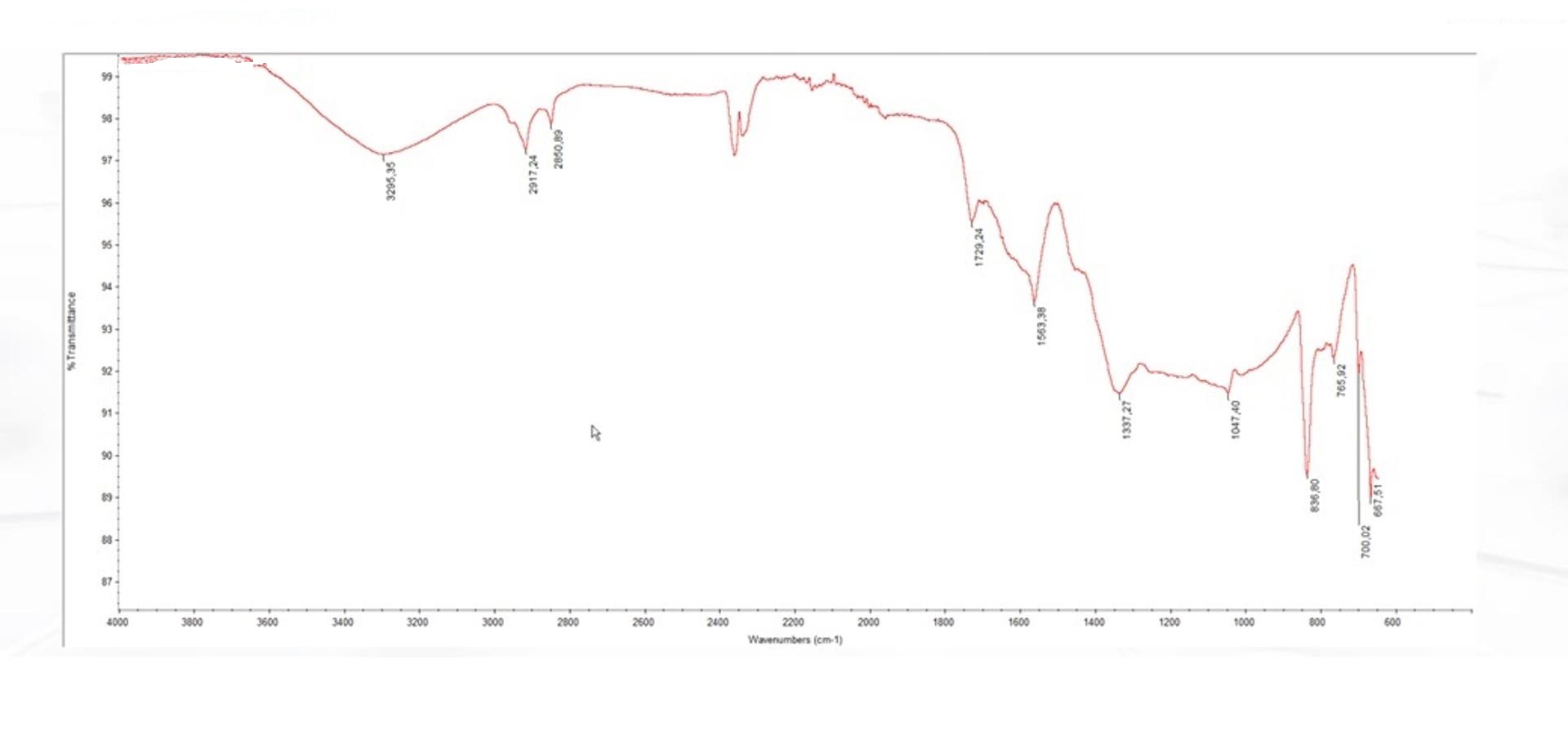
No strong carbonyl stretching band is observed in the 1700–1750 cm⁻¹ region, which would be required for a free carboxylic acid, ester, or ketone; this argues against the library‑top candidate 2‑pyridin‑4‑ylsulfanylacetic acid in its neutral form.

Evidence & interpretation
Evidence

Key evidence

라이브러리 최우선 일치
2-pyridin-4-ylsulfanylacetic acid #22510 | match 87.6%
재료 방향
aromatic / methoxy The sample is best categorized as an aromatic, methoxy‑containing compound. Spectral features are consistent with a substituted aromatic system bearing oxygen‑based functionalities. The library search returned 2‑pyridin‑4‑ylsulfanylacetic acid as the top match, but key carbonyl and broad O–H absorptions expected for a carboxylic acid are absent; therefore the identification is broadened to an aromatic/methoxy material.
Supporting peaks
655 cm-1 828 cm-1 942 cm-1 1042 cm-1 1334 cm-1 1558 cm-1
Supporting groups
aromatic ring vibration methyl group vibration halogen amide ring 6m C-O single-bond vibration sulfonic acid/sulfonate (hso3^ ) 1,4 disubstituted aromatic C-H out of plane bending
Support

Evidence supporting the conclusion

Only sample-relevant statements that support the present conclusion are shown here.

  1. The sample is best categorized as an aromatic, methoxy‑containing compound. Spectral features are consistent with a substituted aromatic system bearing oxygen‑based functionalities. The library search returned 2‑pyridin‑4‑ylsulfanylacetic acid as the top match, but key carbonyl and broad O–H absorptions expected for a carboxylic acid are absent; therefore the identification is broadened to an aromatic/methoxy material.
  2. Trchová & Stejskal (2011) directly assigns the 828 and 1042 cm⁻¹ bands of sulfonated polyaniline to 1,4‑disubstituted aromatic C–H out‑of‑plane deformation and HSO₃⁻ stretching, respectively [1].
  3. D’Amico et al. (2021) report aromatic C=C ring stretching at 1558 cm⁻¹ in polyfurfuryl alcohol [4], matching the observed band exactly.
  4. Gouda et al. (2022) associate a 1334 cm⁻¹ band with C–N stretching in chitosan nanofibers [1].
  5. Armenta et al. (2004) attribute a band near 945 cm⁻¹ to carboxylic acid C–O–H bending in aspartame/acesulfame‑K [2].
  6. The band at 1558 cm⁻¹ is attributed to aromatic ring C=C stretching based on a direct match to a published polyfurfuryl alcohol band table [4]; this is the strongest indicator of an aromatic core.
  7. The medium‑intensity peaks at 828 and 1042 cm⁻¹ align precisely with the Trchová & Stejskal (2011) assignment table for sulfonated aromatic rings: the 828 cm⁻¹ band is assigned to γ(C–H) of 1,4‑disubstituted rings and quinoid ring deformation, and the 1042 cm⁻¹ band to the HSO₃⁻ group on a sulfonated aromatic ring [1]. This suggests the presence of a sulfonated or strongly electrophilic substituted aromatic moiety.
  8. The 1334 cm⁻¹ band is assigned to a C–N single bond stretch, supported by direct literature evidence in chitosan nanofibers [1]; a pyridine or aromatic amine structure would account for this feature and is consistent with the nitrogen‑containing library candidates.
  9. The weak absorption at 942 cm⁻¹ is tentatively assigned to carboxyl O–H out‑of‑plane bending, as reported for acesulfame‑K [2]; this may indicate a carboxylic acid or carboxylate group, although the missing C=O band near 1700 cm⁻¹ suggests the acid group is either minor, hydrogen‑bonded, or present as a salt.
  10. The low‑wavenumber band at 655 cm⁻¹ remains ambiguous; literature attributions range from metal‑oxygen [5] to C–O out‑of‑plane bending, but no assignment is uniquely supported given the limited data.
  11. Major peak assignments include 655: Direct reference: ring; ring 6m | Quality: The spectrum edges look truncated or baseline-shifted; 828: Related literature: sulfonated aromatic ring and 1,4-disubstituted ring deformation | Direct reference: ring; ring 6m | Quality: The spectrum edges look truncated or baseline-shifted; 1334: Direct reference: ring; ring 6m | Quality: The spectrum edges look truncated or baseline-shifted; 1042: Related literature: sulfonated aromatic ring and 1,4-disubstituted ring deformation | Direct reference: ring; ring 6m | Quality: The spectrum edges look truncated or baseline-shifted.
Limitations

Evidence that limits the conclusion

  • No strong carbonyl stretching band is observed in the 1700–1750 cm⁻¹ region, which would be required for a free carboxylic acid, ester, or ketone; this argues against the library‑top candidate 2‑pyridin‑4‑ylsulfanylacetic acid in its neutral form.
  • A broad O–H stretch envelope expected for a carboxylic acid (~2500–3300 cm⁻¹) is not visibly developed in the truncated spectrum, further cautioning against assigning the carboxylic acid entity.
  • The most specific library candidate, 2‑pyridin‑4‑ylsulfanylacetic acid, lacks confirmatory C=O and O–H bands, S-O the interpretation must remain at the broad aromatic/methoxy level.
  • The sulfonated aromatic ring interpretation at 828 and 1042 cm⁻¹ comes from an analogical literature system (polyaniline derivatives) and may over‑speculate the functionalization if the sample is not truly sulfonated; these bands could alternatively arise from alkoxy or other ring‑substituted aromatics.
  • The 942 cm⁻¹ carboxyl assignment is plausible but low assurance due to missing companion C=O stretch; alternative assignments such as ring breathing or C–O are possible.
  • Only six peaks are available, and the low‑wavenumber truncation may hide important fingerprint modes that could better distinguish aromatic substitution patterns.
Recommendation

Suggested next verification

  • Acquire a high‑quality spectrum over the full 4000–400 cm⁻¹ range to assess the O–H, C–H, and C=O regions; a broad O–H stretch or sharp C=O would help resolve the carboxylic acid question.
  • Compare the sample with an authentic spectrum of 2‑pyridin‑4‑ylsulfanylacetic acid, if available, focusing on carbonyl and fingerprint region bands.
  • If the presence of sulfur is suspected, perform elemental analysis (EDS or XPS) to confirm the sulfonate or thioether functional groups suggested by the 1042 and 828 cm⁻¹ bands.
  • Use Raman spectroscopy to complement the IR data; the aromatic C=C and sulfonate vibrations often give clearer, complementary signals.
Peak analysis

Detected peaks and interpretation

★ = Literature-supported peak assignment.

Index Characteristic Wavenumber Absorbance Evidence One-line interpretation Citation Confidence
1 · 655 1.00 - - - -
2 828 0.76 문헌 지원 할당 828 cm-1의 밴드는 sulfonated aromatic ring and 1,4-disubstituted ring deformation[1]에 할당됩니다. [1] LLM 신뢰도
3 1334 0.41 문헌 지원 할당 1334 cm-1의 밴드는 c n single bond[1]에 할당됩니다. [1] LLM 신뢰도
4 1042 0.41 문헌 지원 할당 1042 cm-1의 밴드는 sulfonated aromatic ring and 1,4-disubstituted ring deformation[1]에 할당됩니다. [1] LLM 신뢰도
5 942 0.36 문헌 지원 할당 942 cm-1의 밴드는 carboxyl[2]에 할당됩니다. [2] LLM 신뢰도
6 1558 0.23 문헌 지원 할당 1558 cm-1의 밴드는 aromatic C=C ring stretching[4]에 할당됩니다. [4] LLM 신뢰도
Literature

References

Appendix

Sample information and raw spectrum

Original uploaded spectrum for reference and verification.

Baseline correction method: Asymmetric Least Squares Smoothing

The wavelength range for analysis(cm-1): N/A

Raw spectrum without baseline correction or other processing:

Sample spectrum image
토론

댓글 및 후속 증거

이 영역을 사용하여 해석을 계속하거나 질문을 하거나 추가 검증 증거를 추가하십시오.

요청 제출 양식