
RESULT PAGE
aromatic / methoxy
View the report above. Use the comments below if you need follow-up discussion.
FTIR Analysis Report
Moderate confidence
aromatic / methoxy
Sample & Measurement Parameters
Report No.
20260115084818565722866
Date
Spectral Range (cm⁻¹)
N/A
Baseline
AsLS baseline correction
Library match
77%
Identification Result
77%The sample is best categorized as an aromatic, methoxy‑containing compound. Spectral features are consistent with a substituted aromatic system bearing oxygen‑based functionalities. The library search returned 2‑pyridin‑4‑ylsulfanylacetic acid as the top match, but key carbonyl and broad O–H absorptions expected for a carboxylic acid are absent; therefore the identification is broadened to an aromatic/methoxy material FTIR In-Depth Interpretation was not selected for this task, so this section shows the library-search result only and no deep AI interpretation was run.
Detailed interpretation
- Top library match: 2-pyridin-4-ylsulfanylacetic acid #22510
- No strong carbonyl stretching band is observed in the 1700–1750 cm⁻¹ region, which would be required for a free carboxylic acid, ester, or ketone; this argues against the library‑top candidate 2‑pyridin‑4‑ylsulfanylacetic acid in its neutral form.
- A broad O–H stretch envelope expected for a carboxylic acid (~2500–3300 cm⁻¹) is not visibly developed in the truncated spectrum, further cautioning against assigning the carboxylic acid entity.
- The most specific library candidate, 2‑pyridin‑4‑ylsulfanylacetic acid, lacks confirmatory C=O and O–H bands, S-O the interpretation must remain at the broad aromatic/methoxy level.
- The sulfonated aromatic ring interpretation at 828 and 1042 cm⁻¹ comes from an analogical literature system (polyaniline derivatives) and may over‑speculate the functionalization if the sample is not truly sulfonated; these bands could alternatively arise from alkoxy or other ring‑substituted aromatics.
- The 942 cm⁻¹ carboxyl assignment is plausible but low assurance due to missing companion C=O stretch; alternative assignments such as ring breathing or C–O are possible.
- Only six peaks are available, and the low‑wavenumber truncation may hide important fingerprint modes that could better distinguish aromatic substitution patterns.
Library Comparison
Library spectrum will appear here.
Library Search Results — Top 15 Candidates
| Rank | Match % | Compound | SMILES | Spectrum No. | Action |
|---|---|---|---|---|---|
| Loading library candidates... | |||||
Peak Analysis
★ = Literature-supported assignmentAppendix — Raw Spectrum

Discussion
Comments and follow-up evidence
Use this area to continue the interpretation, ask questions, or add extra verification evidence.
raw image: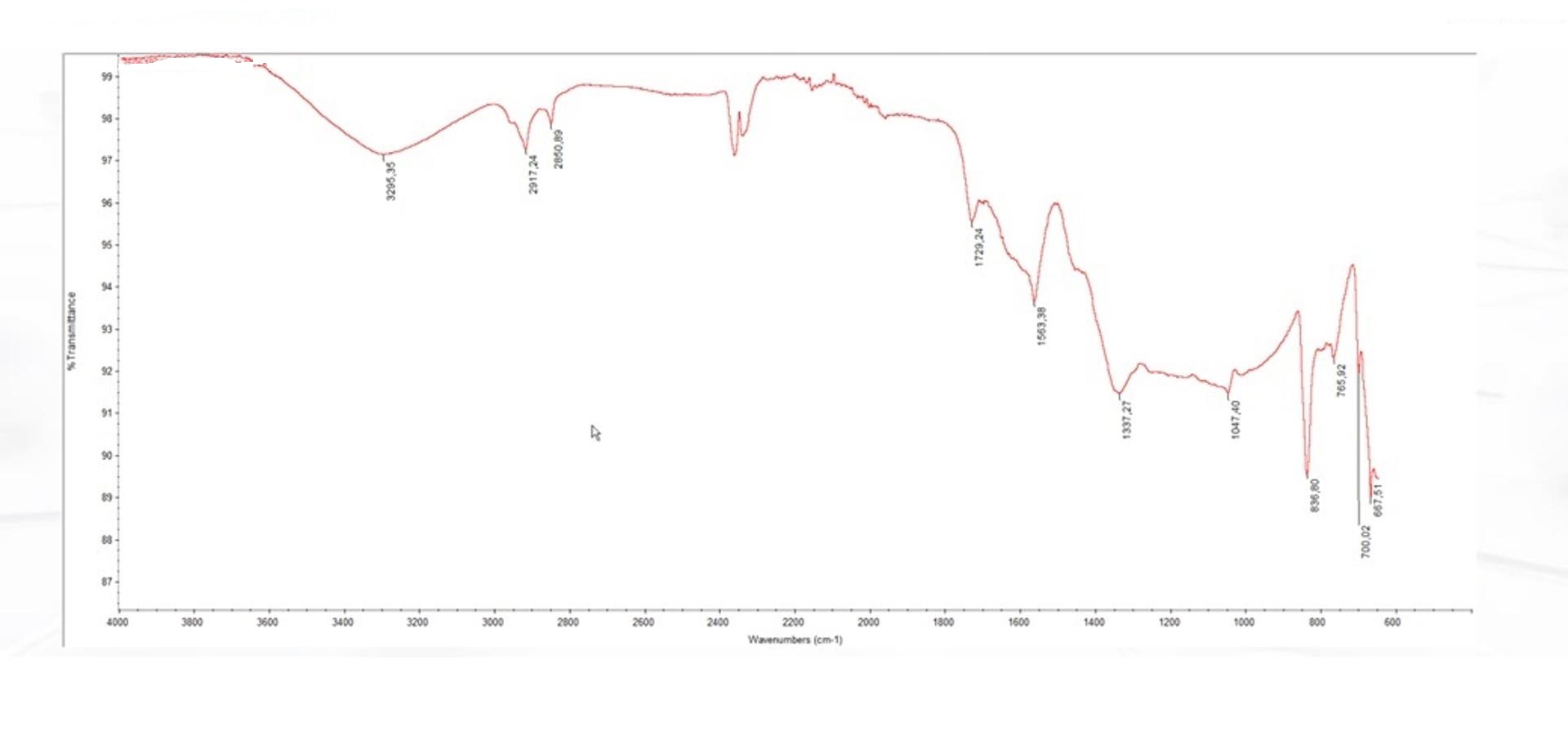 tem.csv
en&2