RESULT PAGE

chlorinated aromatic amine or nitrogen-containing heterocyclic compound

View the report above. Use the comments below if you need follow-up discussion.

Result No.: 20260112232157050557439 Owner: durgashini Comments: 1
FTIR Analysis Report Moderate confidence

chlorinated aromatic amine or nitrogen-containing heterocyclic compound

Sample & Measurement Parameters

Report No. 20260112232157050557439
Date
Spectral Range (cm⁻¹) N/A
Baseline AsLS baseline correction
Library match 76%

Identification Result

76%

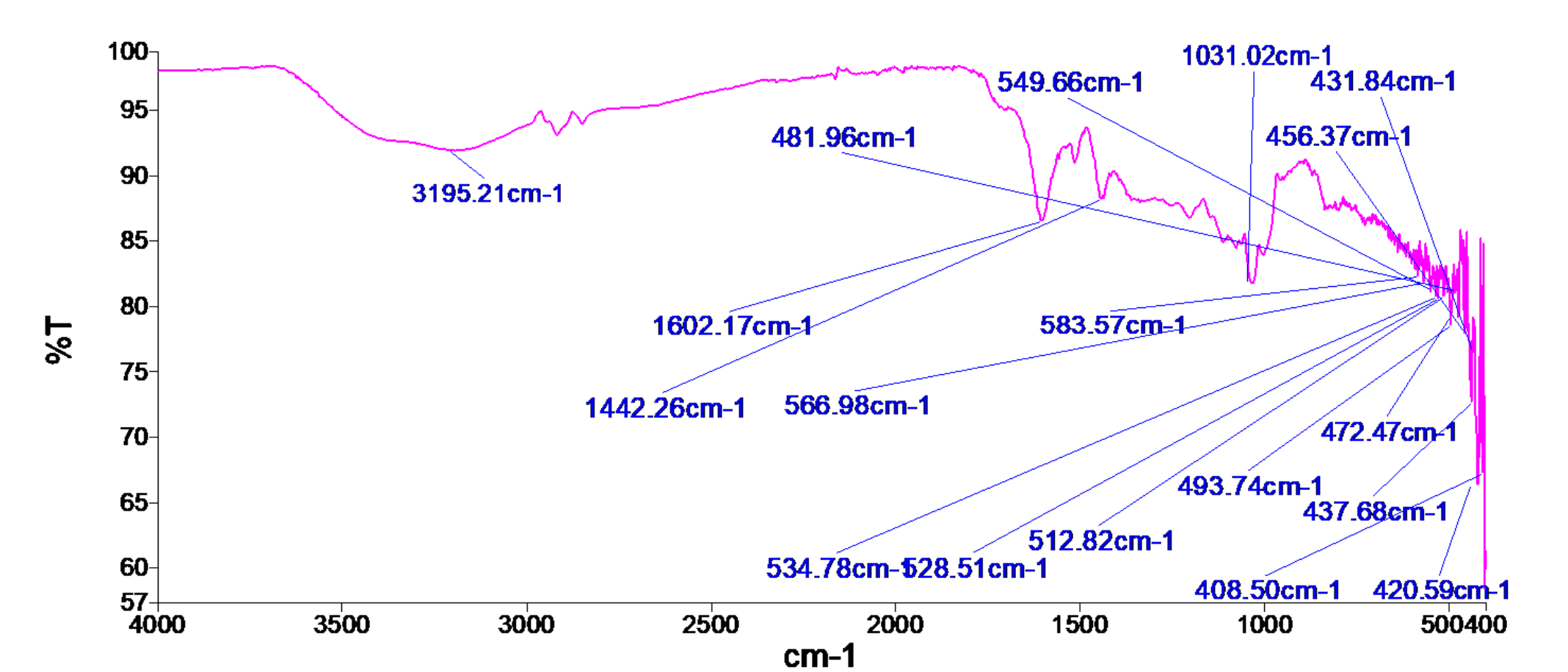
The FTIR spectrum of the unknown material is most consistent with a chlorinated aromatic amine or a nitrogen-containing heterocyclic compound. The spectral pattern features strong evidence for aromatic rings, amine or C–N bonds, and aliphatic hydrocarbon chains, with tentative indications of chlorine substitution FTIR In-Depth Interpretation was not selected for this task, so this section shows the library-search result only and no deep AI interpretation was run.

Detailed interpretation

  • Top library match: 2,3,4,5,6-pentahydroxyhexanal #3872
  • The top library match is 2,3,4,5,6‑pentahydroxyhexanal (a sugar), which lacks aromaticity; however, the strong aromatic and amine bands observed in the sample are incompatible with a pure sugar and indicate that the library hit is misleading.
  • Some direct‑evidence peak assignments (e.g., Ti–O–Ti at 661 cm⁻¹, siloxane at 800 cm⁻¹) invoke inorganic species that are not reconcilable with the dominant organic aromatic/amine character; these may be artefacts or represent minor inorganic contaminants.
  • The exact molecular identity could not be resolved to a single compound or polymer class; the spectrum likely represents either a small‑molecule chlorinated aromatic amine or a nitrogen‑containing heterocycle, possibly polymeric or oligomeric.
  • The chlorine‑related assignments are based on analogy with a structurally similar compound [S2] and should be verified with elemental analysis or complementary spectroscopic techniques.
  • The broad band at 3209 cm⁻¹ could arise from N–H, O–H, or even adsorbed water, preventing a definitive assignment.

Recommended next steps: Confirm the presence and nature of chlorine by energy‑dispersive X‑ray spectroscopy (EDS) or elemental analysis. Perform ¹H and ¹³C NMR spectroscopy to resolve the aromatic substitution pattern and identify the amine/ammonium groups. Compare the spectrum with reference libraries of chlorinated anilines, pyridines, or related heterocycles, and consider direct comparison with porphyrin or triazine standards if the hypothesis of a macrocyclic or cross‑linked structure is pursued.

Library Comparison

Library spectrum will appear here.

Library Search Results — Top 15 Candidates

Rank Match % Compound SMILES Spectrum No. Action
Loading library candidates...

Peak Analysis

★ = Literature-supported assignment
# Wavenumber (cm⁻¹) Absorbance Assignment Citation Assignment status
1 · 1030 1.00 - - -
2 · 661 0.94 - - -
3 · 1004 0.83 - - -
4 · 1054 0.81 - - -
5 · 1071 0.78 - - -
6 · 1110 0.77 - - -
7 · 772 0.74 - - -
8 · 747 0.70 - - -
9 · 709 0.65 - - -
10 · 723 0.65 - - -
11 · 1606 0.64 - - -
12 · 1205 0.62 - - -
13 · 800 0.59 - - -
14 · 828 0.57 - - -
15 · 1441 0.52 - - -
16 · 1515 0.36 - - -
17 · 3209 0.34 - - -
18 · 2927 0.26 - - -
19 · 2852 0.22 - - -

Appendix — Raw Spectrum

Raw sample spectrum
Generated by FTIR.fun — Report #20260112232157050557439
Discussion

Comments and follow-up evidence

Use this area to continue the interpretation, ask questions, or add extra verification evidence.

Submit Requirement Form