
aromatic / amide-containing organic material with hydroxyl groups
Consultez le rapport ci-dessus. Utilisez les commentaires ci-dessous si vous avez besoin d'une discussion de suivi.
aromatic / amide-containing organic material with hydroxyl groups
Paramètres d'échantillon et de mesure
Résultat d'identification
36%L'échantillon présente trois bandes infrarouges bien résolues à 3284, 1373 et 1012 cm⁻¹, qui indiquent collectivement un matériau organique contenant des fonctionnalités N-H/O-H, méthyle et C-O alcoolique. La recherche dans la bibliothèque a renvoyé le trichlorophosphane comme la correspondance la plus proche avec une similarité extrêmement faible (0,00), et le consensus des 15 premières bibliothèques pointe vers des caractéristiques aromatiques et amides, cohérentes avec le motif spectral observé. Les preuves ne soutiennent pas une identité moléculaire spécifique ; les données sont plutôt mieux décrites comme une substance aromatique contenant des amides/hydroxyles, probablement une petite molécule ou un mélange plutôt que le composé inorganique phosphoré suggéré par la première correspondance
Interprétation détaillée
- Meilleure correspondance de bibliothèque: trichlorophosphane #14759 | match 0.0%
- L'échantillon présente trois bandes infrarouges bien résolues à 3284, 1373 et 1012 cm⁻¹, qui indiquent collectivement un matériau organique contenant des fonctionnalités N-H/O-H, méthyle et C-O alcoolique. La recherche dans la bibliothèque a renvoyé le trichlorophosphane comme la correspondance la plus proche avec une similarité extrêmement faible (0,00), et le consensus des 15 premières bibliothèques pointe vers des caractéristiques aromatiques et amides, cohérentes avec le motif spectral observé. Les preuves ne soutiennent pas une identité moléculaire spécifique ; les données sont plutôt mieux décrites comme une substance aromatique contenant des amides/hydroxyles, probablement une petite molécule ou un mélange plutôt que le composé inorganique phosphoré suggéré par la première correspondance.
- Les preuves directes de N–H à 3284 cm⁻¹ [2] et le consensus de la bibliothèque sur les groupes fonctionnels amides dans les 15 premiers candidats soutiennent conjointement la présence d'espèces contenant des amides.
- L'élongation C–O alcoolique à 1012 cm⁻¹ est corroborée par la littérature connexe sur les matériaux phénoliques, où la même absorption est observée et explicitement attribuée au C–O des groupes méthylol.
- L'attribution de la déformation en parapluie du CH₃ est renforcée par une correspondance directe de pic dans la littérature à 1372–1374 cm⁻¹ dans une molécule organique apparentée, ce qui renforce la confiance dans la présence de substituants méthyle.
- L'absorption large à 3284 cm⁻¹ se situe dans la région caractéristique des vibrations d'élongation N-H et O-H. La littérature directe attribue cette bande à N-H dans les systèmes d'hydrogel [2], tandis que des rapports connexes l'associent à O-H dans le 4‑hydroxybenzonitrile et la biomasse fongique, indiquant que les contributions des amides et des hydroxyles sont plausibles.
- Un pic net à 1373 cm⁻¹ est attribué à la déformation en parapluie du CH₃, comme explicitement assigné dans une étude de complexes de cuivre (Tunc et al. 2018). Bien que la littérature cite également la flexion CH de la cellulose et de l'hémicellulose à cette position [3], l'absence d'autres bandes marqueurs des polysaccharides (par exemple, de fortes élongations C–O se chevauchant au-dessus de 1100 cm⁻¹) rend l'attribution de la déformation méthyle plus cohérente avec le profil spectral global.
- La bande à 1012 cm⁻¹ est mieux interprétée comme une vibration d'élongation C–O alcoolique, correspondant à une attribution publiée dans la mousse phénol‑formaldéhyde (Pintus et al. 2021). Une attribution phosphate [1] est moins probable car l'échantillon ne présente pas les absorptions P=O ou P–O–C d'accompagnement typiquement observées dans les organophosphates.
- Les attributions majeures des pics incluent 1012 : Littérature connexe : Élongation C-O alcoolique (1012 cm⁻¹) | Référence directe : alkyl c h; oxygène; 1373 : Littérature connexe : Déformation en parapluie du CH3 (1373 cm⁻¹) | Référence directe : alkyl c h; oxygène; 3284 : Littérature connexe : Élongation O-H (3284 cm⁻¹) | Référence directe : alkyl c h; oxygène.
- La première correspondance de la bibliothèque, le trichlorophosphane (PCl₃), est chimiquement incompatible avec le spectre observé : elle nécessiterait de fortes absorptions P–Cl près de 500 cm⁻¹ et manquerait de toute élongation N–H/O–H au-dessus de 3000 cm⁻¹. La correspondance de similarité nulle de la bibliothèque contredit en outre une identification fiable de ce composé.
- L'attribution phosphate pour 1012 cm⁻¹ [1] entre en conflit avec l'absence de bandes caractéristiques d'ester phosphate (par exemple, élongation P=O près de 1250–1150 cm⁻¹ et P–O–C autour de 1050–970 cm⁻¹) qui seraient attendues si un organophosphate était présent.
- La bande à 3284 cm⁻¹ ne peut pas être résolue sans ambiguïté en N–H ou O–H pur ; les deux groupes fonctionnels peuvent coexister, et leurs profils larges et se chevauchant empêchent une distinction définitive par FTIR seule.
- Étant donné que la correspondance de la bibliothèque est à un niveau de similarité de 0,00, le nom du premier candidat « trichlorophosphane » n'est pas fiable ; la véritable identité chimique reste inconnue et pourrait englober une gamme de composés aromatiques contenant des amides/amines ou des hydroxyles.
Comparaison de bibliothèques
Résultats de recherche dans la bibliothèque — Top 15 des candidats
| Rang | Correspondance % | Composé | SMILES | N° de spectre | Action |
|---|---|---|---|---|---|
| Chargement des candidats de la bibliothèque... | |||||
Analyse des pics
★ = Attribution soutenue par la littérature| # | Nombre d'onde (cm⁻¹) | Absorbance | Attribution | Citation | État de l'attribution | |
|---|---|---|---|---|---|---|
| 1 | · | 1012 | 1.00 | La bande à 1012 cm⁻¹ est attribuée à l'élongation C-O alcoolique (1012 cm⁻¹)[S3]. | - | Confiance modérée |
| 2 | · | 1373 | 0.10 | La bande à 1373 cm⁻¹ est attribuée à la déformation en parapluie du CH3 (1373 cm⁻¹)[S4][S5]. | - | Haute confiance |
| 3 | · | 3284 | 0.10 | La bande à 3284 cm⁻¹ est attribuée à l'amide[RC579]. | - | Confiance modérée |
Annexe — Spectre brut

Commentaires et preuves de suivi
Utilisez cette zone pour poursuivre l'interprétation, poser des questions ou ajouter des preuves de vérification supplémentaires.
The above shows the FTIR analysis results of a PDF file uploaded by a user from Malaysia. The original image and extracted CSV file are displayed below.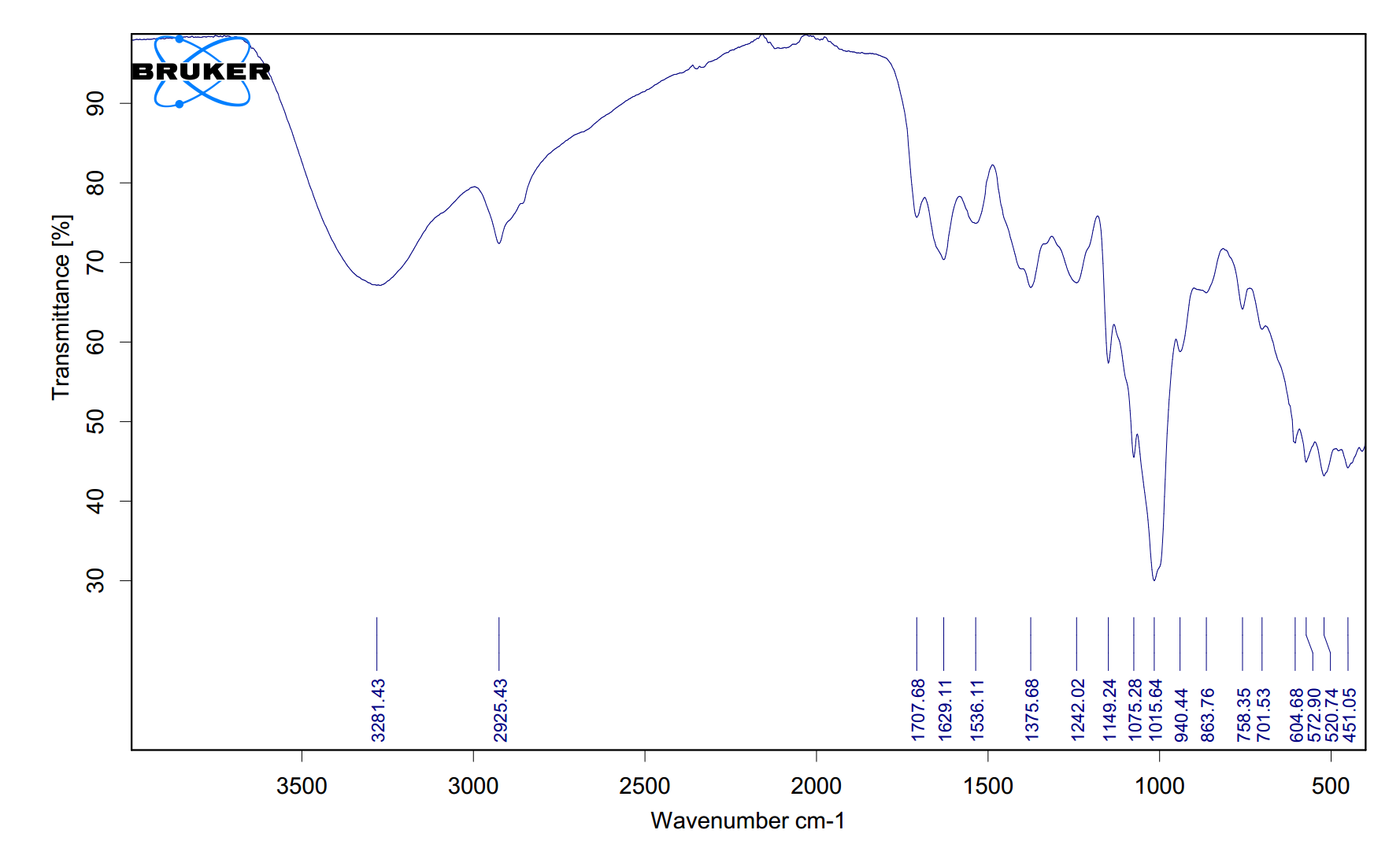 tem.csv
en&2