
aromatic / amide-containing organic material with hydroxyl groups
View the report above. Use the comments below if you need follow-up discussion.
aromatic / amide-containing organic material with hydroxyl groups
Sample & Measurement Parameters
Identification Result
36%The sample exhibits three well-resolved infrared bands at 3284, 1373, and 1012 cm⁻¹, which collectively indicate an organic material containing N-H/O-H, methyl, and alcoholic C-O functionalities. The library search returned trichlorophosphane as the nearest match with vanishingly low similarity (0.00), and the Top-15 library consensus points to aromatic and amide features, consistent with the observed spectral pattern. The evidence does not support a specific molecular identity; instead, the data are best described as an aromatic amide/hydroxyl-bearing substance, likely a small molecule or mixture rather than the inorganic phosphorus compound suggested by the top hit FTIR In-Depth Interpretation was not selected for this task, so this section shows the library-search result only and no deep AI interpretation was run.
Detailed interpretation
- Top library match: trichlorophosphane #14759
- The library top hit, trichlorophosphane (PCl₃), is chemically incompatible with the observed spectrum: it would require strong P–Cl absorptions near 500 cm⁻¹ and lack any N–H/O–H stretching above 3000 cm⁻¹. The zero‑similarity library match further contradicts a reliable identification as this compound.
- Phosphate assignment for 1012 cm⁻¹ [1] conflicts with the absence of characteristic phosphate ester bands (e.g., P=O stretching near 1250–1150 cm⁻¹ and P–O–C around 1050–970 cm⁻¹) that would be expected if organophosphate were present.
- The 3284 cm⁻¹ band cannot be unambiguously resolved into pure N–H or O–H; both functional groups may coexist, and their broad overlapping profiles prevent a definitive distinction using FTIR alone.
- Because the library match is at the 0.00 similarity level, the Top‑1 candidate name “trichlorophosphane” is unreliable; the true chemical identity remains unknown and could encompass a range of aromatic amide/amine or hydroxyl‑containing compounds.
Library Comparison
Library Search Results — Top 15 Candidates
| Rank | Match % | Compound | SMILES | Spectrum No. | Action |
|---|---|---|---|---|---|
| Loading library candidates... | |||||
Peak Analysis
★ = Literature-supported assignmentAppendix — Raw Spectrum

Comments and follow-up evidence
Use this area to continue the interpretation, ask questions, or add extra verification evidence.
The above shows the FTIR analysis results of a PDF file uploaded by a user from Malaysia. The original image and extracted CSV file are displayed below.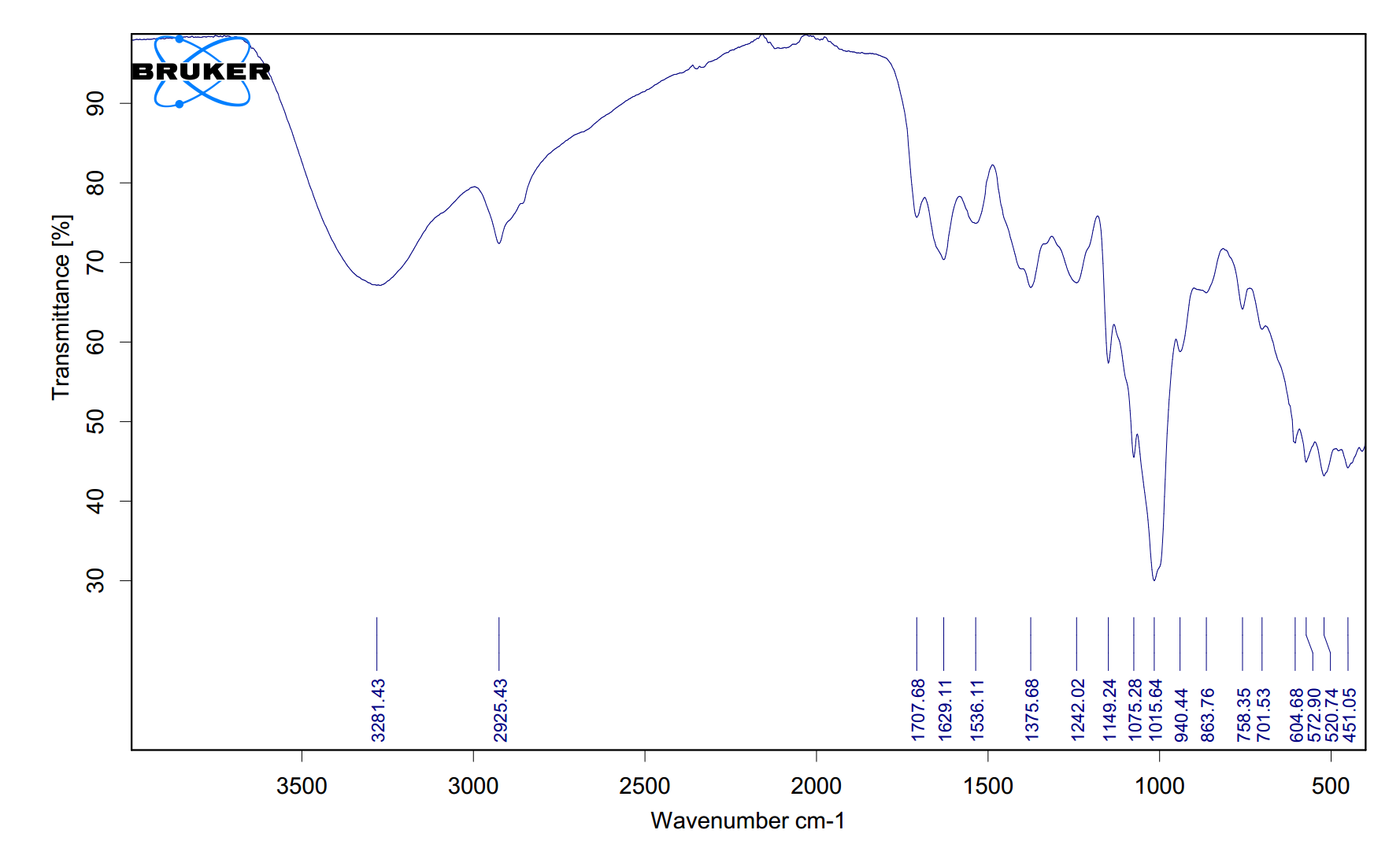 tem.csv
en&2