
fluorinated organic material with N-H/O-H and possible alkyl-substituted functionality
View the report above. Use the comments below if you need follow-up discussion.
fluorinated organic material with N-H/O-H and possible alkyl-substituted functionality
Sample & Measurement Parameters
Identification Result
0%The ordinary FTIR search does not support a firm compound-level assignment for this sample. The library Top-1 name is 1,1,1,3,3,3-hexafluoro-2-(trifluoromethyl)propan-2-ol, but all listed library similarities are effectively zero, so that specific identification is not reliable. A chemically safer reading is that the spectrum is broadly consistent with a fluorinated organic material showing strong C-F/C-O-region absorption together with high-wavenumber N-H or O-H stretching and bands in the 1600-1650 cm-1 region that may indicate unsaturation, amine-related deformation, or another heteroatom-containing functionality
Detailed interpretation
- Top library match: 1,1,1,3,3,3-hexafluoro-2-(trifluoromethyl)propan-2-ol #11819
- The ordinary FTIR search does not support a firm compound-level assignment for this sample. The library Top-1 name is 1,1,1,3,3,3-hexafluoro-2-(trifluoromethyl)propan-2-ol, but all listed library similarities are effectively zero, S-O that specific identification is not reliable. A chemically safer reading is that the spectrum is broadly consistent with a fluorinated organic material showing strong C-F/C-O-region absorption together with high-wavenumber N-H or O-H stretching and bands in the 1600-1650 cm-1 region that may indicate unsaturation, amine-related deformation, or another heteroatom-containing functionality.
- The Top-1 library hit has zero similarity, S-O the specific compound name is not directly supported by the search quality.
- Several leading library candidates are chemically inconsistent with one another, spanning fluorinated alcohols, anilines, perfluorinated cycloalkanes, perfluoropolyethers, and oils.
- A purely perfluorinated hydrocarbon assignment is limited by the observed N-H/O-H region bands at 3192-3452 cm-1.
- It remains unclear whether the high-wavenumber absorption is due primarily to O-H, N-H, or a mixture of both.
- The 1620-1653 cm-1 region is not uniquely assigned from the current evidence and could reflect different heteroatom-containing motifs.
- The current data do not distinguish confidently among a fluorinated alcohol, fluorinated amine-containing material, fluorinated ether-containing material, or a mixture.
Library Comparison
Library Search Results — Top 15 Candidates
| Rank | Match % | Compound | SMILES | Spectrum No. | Action |
|---|---|---|---|---|---|
| Loading library candidates... | |||||
Peak Analysis
★ = Literature-supported assignmentAppendix — Raw Spectrum

Comments and follow-up evidence
Use this area to continue the interpretation, ask questions, or add extra verification evidence.
The above shows the FTIR analysis results of a Pdf file uploaded by a user from India. The original image and extracted CSV file are displayed below.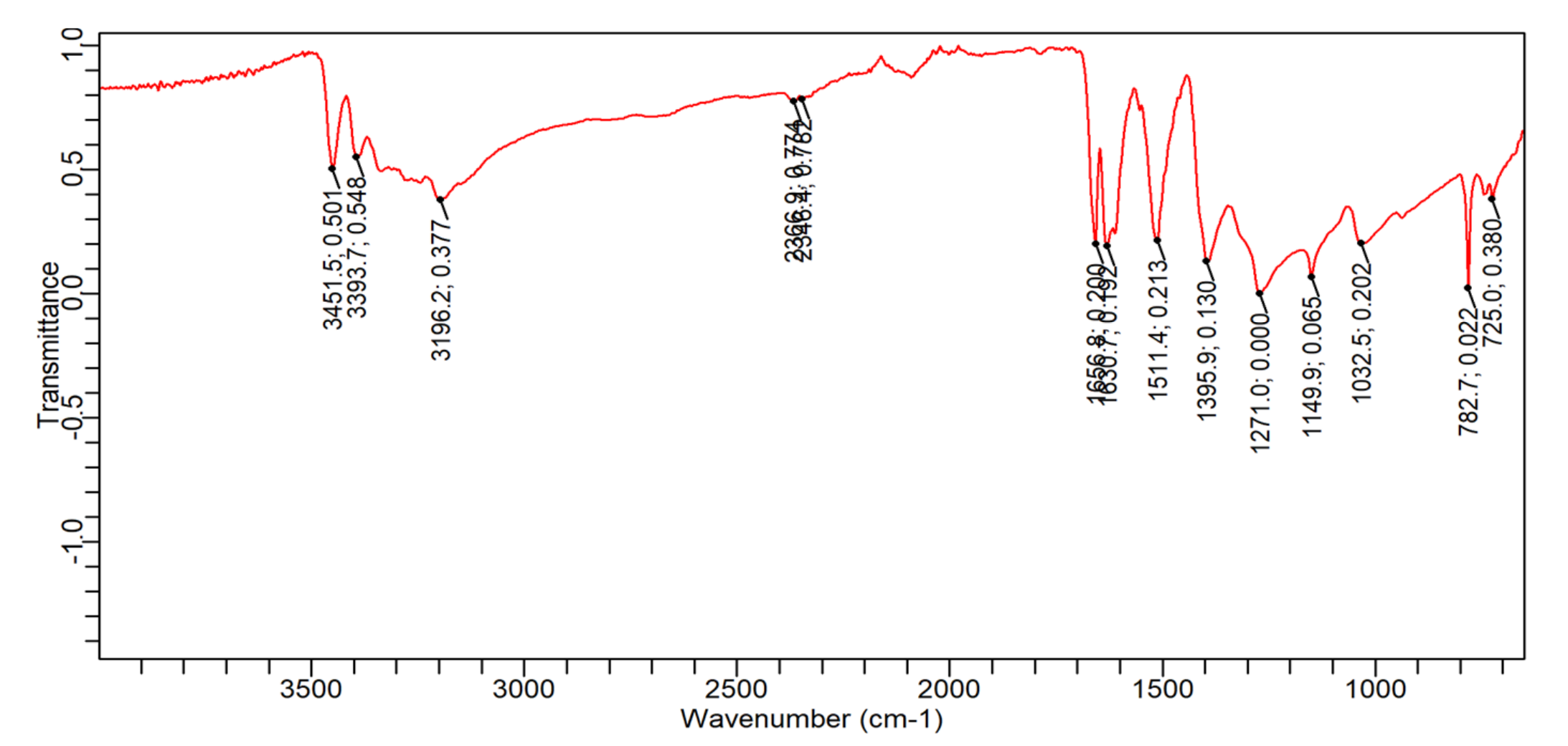 tem.csv
en&2