RESULT PAGE

carbonyl-containing ester material, plausibly an acrylate- or polyester-type composition

View the report above. Use the comments below if you need follow-up discussion.

Result No.: 20250722000900659368613 Owner: publicuser Comments: 1
FTIR Analysis Report

carbonyl-containing ester material, plausibly an acrylate- or polyester-type composition

Sample & Measurement Parameters

Report No. 20250722000900659368613
Date 2025-07-23 02:14:16
Spectral Range (cm⁻¹) [(650, 4000)]
Baseline AsLS baseline correction
Library match 0%

Identification Result

0%

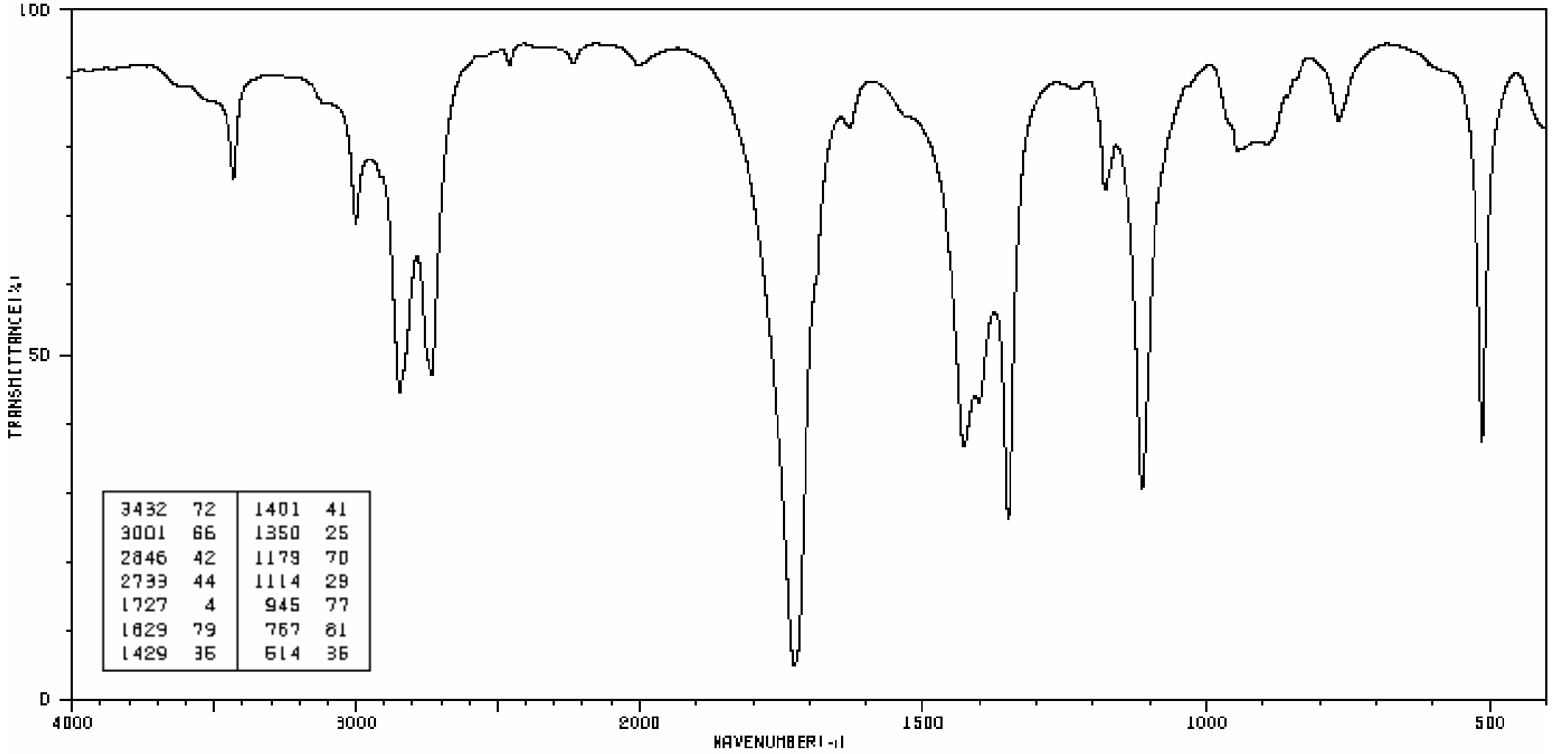
The spectrum is most consistent with a carbonyl-containing ester material, with the library placing Poly(ethyl acrylate) as the nearest named candidate. However, the overall match strength is very weak and there is no direct reference or related-literature support to justify a firm material assignment. The observed bands support a broad ester-containing organic composition, plausibly within an acrylate- or polyester-like direction, but the present evidence is not sufficient to confirm Poly(ethyl acrylate) specifically

Detailed interpretation

  • Top library match: Poly(ethyl acrylate) #347
  • The library confidence is low, with no meaningful separation among candidates.
  • No related-literature match was recovered to support a specific polymer or small-molecule identity.
  • The limited peak set does not provide distinctive bands needed to securely identify Poly(ethyl acrylate) over other ester-containing materials.
  • It remains unclear whether the sample is specifically Poly(ethyl acrylate), another acrylic polymer, a polyester, or a lower-molecular-weight ester-containing substance.
  • The feature at 2740 cm⁻¹ is not by itself sufficient to define a unique structure in the absence of stronger corroborating bands.
  • Additional characteristic fingerprint-region information would be needed to separate acrylate polymers from other ester-rich materials.

Recommended next steps: Recollect or inspect the full FTIR spectrum, especially the 1500-600 cm⁻¹ fingerprint region, to verify ester C-O-C band patterning and look for polymer-specific backbone features. Compare the sample directly against authenticated spectra of Poly(ethyl acrylate), a generic acrylic polymer, and representative aliphatic polyesters such as poly(butylene adipate). If the sample is a coating, adhesive, or extractable residue, run complementary analysis such as ATR-FTIR repeat measurement, DSC, or Py-GC/MS to distinguish an acrylate polymer from a polyester or small-molecule ester. Check for repeatable carbonyl peak shape and position across replicate measurements, since ester subclass assignment often depends on the detailed carbonyl and C-O band profile.

Library Comparison

Match group:
Library spectrum will appear here.

Library Search Results — Top 15 Candidates

Rank Match % Compound SMILES Spectrum No. Action
Loading library candidates...

Peak Analysis

★ = Literature-supported assignment
# Wavenumber (cm⁻¹) Absorbance Assignment Citation Assignment status
1 · 1727 1.00 - - -
2 · 1719 0.70 - - -
3 · 1350 0.27 - - -
4 · 1113 0.22 - - -
5 · 1427 0.20 - - -
6 · 2844 0.16 - - -
7 · 2740 0.15 - - -

Appendix — Raw Spectrum

Raw sample spectrum
Generated by FTIR.fun — Report #20250722000900659368613 2025-07-23 02:14:16
Discussion

Comments and follow-up evidence

Use this area to continue the interpretation, ask questions, or add extra verification evidence.

The above shows the FTIR analysis results of a doc file uploaded by a user from CANADA. The original image and extracted CSV file are displayed below.20250723091131.pngtem.csv
en&2
Submit Requirement Form