RESULT PAGE

oxygenated unsaturated organic material, possibly a polymeric or copolymeric material containing carbonyl and C–O functionality

View the report above. Use the comments below if you need follow-up discussion.

Result No.: 20250717143820336159581 Owner: publicuser Comments: 1
FTIR Analysis Report

oxygenated unsaturated organic material, possibly a polymeric or copolymeric material containing carbonyl and C–O functionality

Sample & Measurement Parameters

Report No. 20250717143820336159581
Date 2025-07-18 01:19:54
Spectral Range (cm⁻¹) [(650, 4000)]
Baseline AsLS baseline correction
Library match 0%

Identification Result

0%

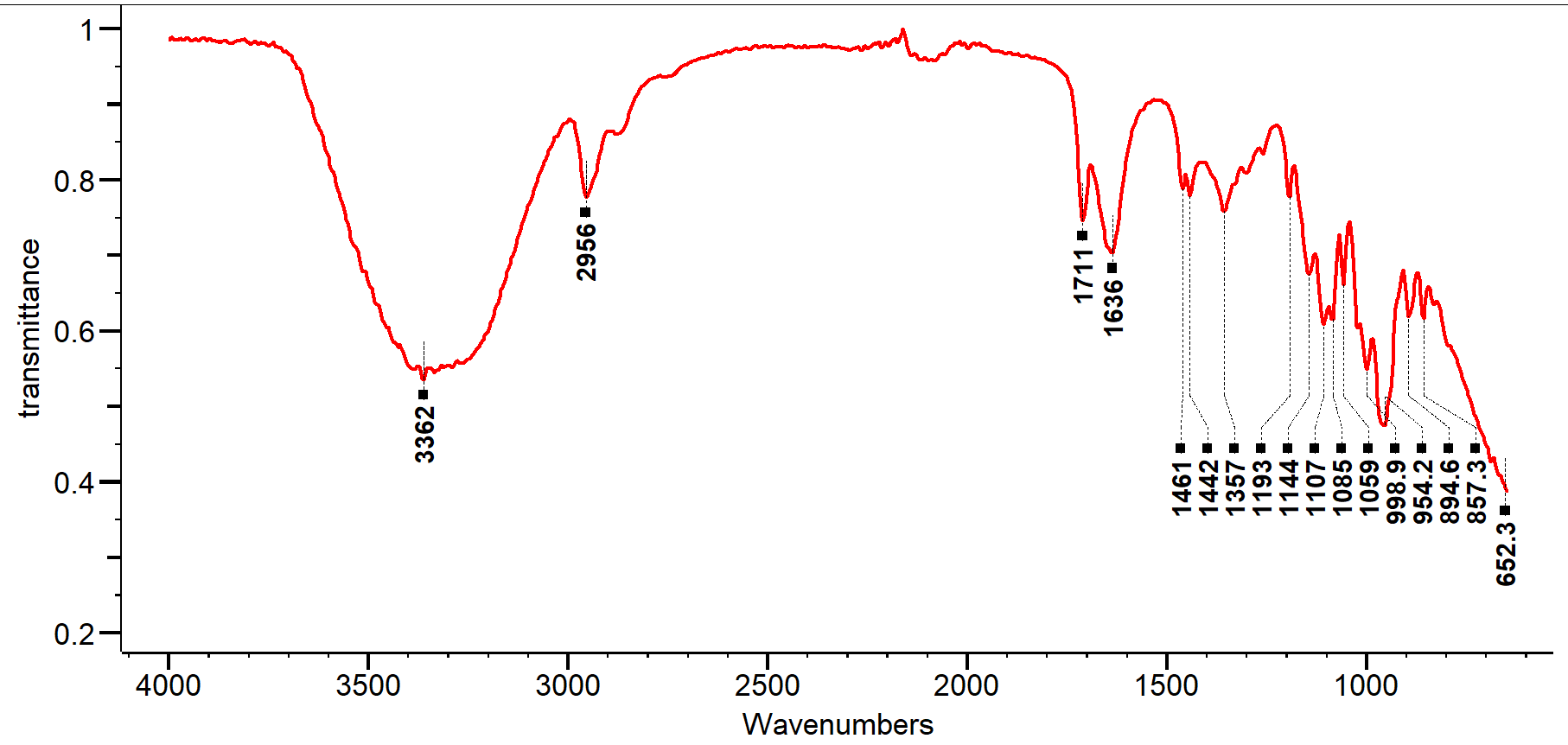
The current FTIR evidence does not support a firm material identification. The library top hit is Vinyl chloride/vinyl acetate copolymer, but all listed library similarities are effectively non-discriminating, and no direct or related literature evidence narrows the assignment. The observed bands are more securely interpreted as an oxygenated organic material with a carbonyl band near 1710 cm-1, C–O stretching near 1107 cm-1, aliphatic C–H near 2953 cm-1, and unsaturation indicated near 1640 and 961 cm-1. A polymeric or copolymeric organic material remains plausible, but the present evidence is too weak to defend the specific library name as the sample identity

Detailed interpretation

  • Top library match: Vinyl chloride/vinyl acetate copolymer #322
  • The library match quality is very weak: the reported top candidate and the rest of the Top-15 all show non-discriminating similarity values.
  • The current peak set does not provide clear confirming evidence for a chlorinated polymer assignment, S-O a vinyl chloride-based conclusion would be too specific.
  • The carbonyl type is not resolved from the present peak list alone.
  • The broad 3362 cm-1 feature could arise from hydroxyl content, moisture, or surface contamination.
  • The 676 cm-1 band is insufficient to determine whether halogen substitution is truly present.
  • Without stronger library agreement or corroborating reference evidence, the sample cannot be confidently assigned to the named library material.

Recommended next steps: Re-run the FTIR spectrum with improved signal quality and baseline treatment, especially in the fingerprint region below 1500 cm-1. Check whether the 3362 cm-1 band persists after drying or purging; if it decreases, moisture interference is likely. Inspect the 1800-1500 cm-1 region at higher quality to refine the carbonyl assignment and determine whether the 1710 cm-1 band is ester-like or from another carbonyl type. If a chlorinated polymer remains a possibility, verify with complementary elemental analysis such as XRF or EDS for chlorine.

Library Comparison

Match group:
Library spectrum will appear here.

Library Search Results — Top 15 Candidates

Rank Match % Compound SMILES Spectrum No. Action
Loading library candidates...

Peak Analysis

★ = Literature-supported assignment
# Wavenumber (cm⁻¹) Absorbance Assignment Citation Assignment status
1 · 676 1.00 - - -
2 · 961 0.41 - - -
3 · 1107 0.17 - - -
4 · 1640 0.16 - - -
5 · 1710 0.13 - - -
6 · 3362 0.12 - - -
7 · 2953 0.11 - - -
8 · 1355 0.10 - - -

Appendix — Raw Spectrum

Raw sample spectrum
Generated by FTIR.fun — Report #20250717143820336159581 2025-07-18 01:19:54
Discussion

Comments and follow-up evidence

Use this area to continue the interpretation, ask questions, or add extra verification evidence.

The above shows the FTIR analysis results of a doc file uploaded by a user from USA. The original image and extracted CSV file are displayed below.2.pngtem.csv
en&2
Submit Requirement Form