
PUBLIC SPECTRUM SEARCH
1-Chloro-2-iodobenzene
Free public result — the submitted spectrum with its top library candidates, not an AI identification.
SPECTRUM & LIBRARY MATCHES
Submitted spectrum and top library candidates

Top 15 library matches
| # | Reference | CAS | Similarity |
|---|---|---|---|
| 1 | 1-Chloro-2-iodobenzene | 615-41-8 | - |
| 2 | (E)-3-phenylbut-2-en-1-ol | 1504-54-7 | - |
| 3 | ethyl 1-methylcyclopropane-1-carboxylate | 71441-76-4 | - |
| 4 | 2-Bromo-1,1-diethoxyethane | 2032-35-1 | - |
| 5 | 2-(2-chlorophenyl)ethanol | 19819-95-5 | - |
| 6 | 1,1-Diethoxy-N,N-dimethylmethanamine | 1188-33-6 | - |
| 7 | dimethoxy-(3-methyl-4-nitrophenoxy)-sulfanylidenephosphorane | 122-14-5 | - |
| 8 | Vinyl chloride/vinyl acetate copolymer | 9003-22-9 | - |
| 9 | 3-Hydroxypropanenitrile | 109-78-4 | - |
| 10 | Dimethyl sulfate | 77-78-1 | - |
| 11 | Poly(butadiene:acrylonitrile) | none | - |
| 12 | prop-1-en-2-yl acetate | 108-22-5 | - |
| 13 | 2-chloro-1-methylpyridin-1-ium; 4-methylbenzenesulfonate | 7403-46-5 | - |
| 14 | none | none | - |
| 15 | 2-Phenyl-1,3-dithiane | 5425-44-5 | - |
Discussion
Comments and follow-up evidence
Use this area to continue the interpretation, ask questions, or add extra verification evidence.
The above shows the FTIR analysis results of a PNG file uploaded by a user from The Philippines . The original image is displayed below.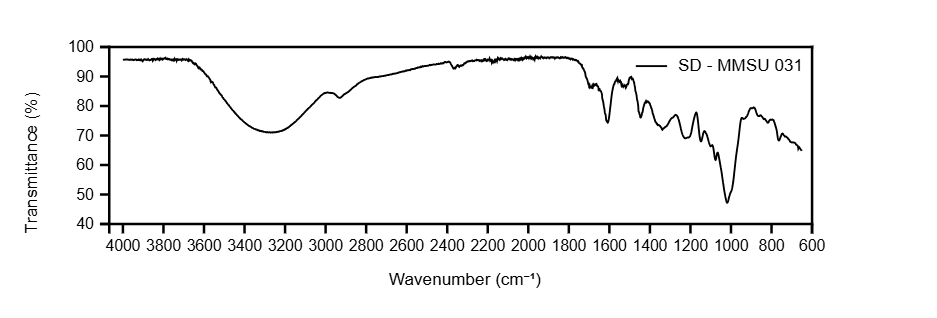 Extracted CSV file:tem.csv
en&2