
aliphatic hydrocarbon-type material with possible halogen substitution
Consultez le rapport ci-dessus. Utilisez les commentaires ci-dessous si vous avez besoin d'une discussion de suivi.
aliphatic hydrocarbon-type material with possible halogen substitution
Paramètres d'échantillon et de mesure
Résultat d'identification
0%La recherche FTIR ordinaire ne soutient pas une identification au niveau du composé pour cet échantillon. Bien que l'entrée la plus proche de la bibliothèque soit le 2-Bromoheptane, toutes les similitudes de bibliothèque listées sont de 0,000 et aucune preuve directe ou associée de la littérature ne précise l'attribution. Le spectre observé est plus sûrement décrit comme un matériau de type hydrocarbure aliphatique, dominé par de fortes bandes d'étirement et de flexion C-H, avec une possible contribution de la substitution halogène en raison des bandes à bas nombre d'onde près de 660-769 cm⁻¹. Cependant, ces caractéristiques à bas nombre d'onde ne suffisent pas à elles seules pour confirmer un bromoalcane spécifique.
Interprétation détaillée
- Meilleure correspondance de bibliothèque: 2-Bromoheptane #232 | match 0.0%
- L'enveloppe d'étirement C-H aliphatique forte à 2835, 2857, 2878, 2889, 2904, 2913, 2925, 2941, 2950 et 2972 cm⁻¹ soutient la teneur en hydrocarbures saturés.
- Les bandes de déformation C-H à 1469, 1442 et 1368 cm⁻¹ soutiennent les groupes alkyle.
- Les bandes à 712 et 729 cm⁻¹ soutiennent un caractère hydrocarboné riche en méthylène ou en chaîne.
- Les bandes en dessous de 800 cm⁻¹ laissent ouverte la possibilité de matériau aliphatique halogéné.
- Le motif chimiquement cohérent le plus fort dans l'échantillon est l'absorption C-H aliphatique : plusieurs bandes à 2835-2972 cm⁻¹ ainsi que des caractéristiques de flexion à 1469, 1442 et 1368 cm⁻¹ sont cohérentes avec des groupes alkyle saturés.
- Les bandes à 712 et 729 cm⁻¹ sont compatibles avec un caractère hydrocarboné à longue chaîne ou riche en méthylène.
- Les bandes à bas nombre d'onde à 660, 675, 749 et 769 cm⁻¹ pourraient être cohérentes avec une substitution par un atome lourd comme C-Br ou d'autres modes squelettiques/hors plan, mais elles ne sont pas uniques pour l'identification.
- Une faible caractéristique près de 1645 cm⁻¹ et des bandes à plus haut nombre d'onde près de 3170-3178 cm⁻¹ ne fournissent pas une correspondance claire et cohérente avec le premier résultat de la bibliothèque, le 2-Bromoheptane.
- La liste des 15 premiers de la bibliothèque est chimiquement hétérogène, comprenant des alcools, des acides, des amines, des oléfines, des composés soufrés et un copolymère, elle ne fournit donc pas de direction stable vers un matériau commun au-delà d'un motif très large de petites molécules/organiques.
- Le principal candidat de la bibliothèque, le 2-Bromoheptane, n'est pas fortement soutenu car la similarité rapportée est de 0,000.
- Les principaux candidats de la bibliothèque ne convergent pas vers une classe chimique unique, ce qui limite la confiance dans une identification précise.
- Les caractéristiques près de 1645 et 3170-3178 cm⁻¹ ne sont pas bien expliquées par un simple bromoalcane saturé seul.
- Les bandes à bas nombre d'onde ne suffisent pas à confirmer une substitution par du brome par rapport à d'autres causes dans la région d'empreinte.
- Les preuves actuelles ne permettent pas de distinguer de manière fiable entre un alcane simple, un alcane halogéné ou un mélange contenant un composant hydrocarboné aliphatique.
- Aucune correspondance de référence soutenue par la littérature n'ayant été retrouvée, la direction du matériau doit rester large.
Comparaison de bibliothèques
Résultats de recherche dans la bibliothèque — Top 15 des candidats
| Rang | Correspondance % | Composé | SMILES | N° de spectre | Action |
|---|---|---|---|---|---|
| Chargement des candidats de la bibliothèque... | |||||
Analyse des pics
★ = Attribution soutenue par la littérature| # | Nombre d'onde (cm⁻¹) | Absorbance | Attribution | Citation | État de l'attribution | |
|---|---|---|---|---|---|---|
| 1 | · | 1442 | 1.00 | - | - | - |
| 2 | · | 2835 | 0.98 | - | - | - |
| 3 | · | 1469 | 0.88 | - | - | - |
| 4 | · | 1368 | 0.83 | - | - | - |
| 5 | · | 2950 | 0.80 | - | - | - |
| 6 | · | 2857 | 0.78 | - | - | - |
| 7 | · | 2941 | 0.68 | - | - | - |
| 8 | · | 2904 | 0.65 | - | - | - |
| 9 | · | 2972 | 0.61 | - | - | - |
| 10 | · | 2925 | 0.59 | - | - | - |
| 11 | · | 2913 | 0.57 | - | - | - |
| 12 | · | 2878 | 0.55 | - | - | - |
| 13 | · | 2889 | 0.54 | - | - | - |
| 14 | · | 712 | 0.35 | - | - | - |
| 15 | · | 729 | 0.24 | - | - | - |
| 16 | · | 982 | 0.20 | - | - | - |
| 17 | · | 749 | 0.19 | - | - | - |
| 18 | · | 1150 | 0.19 | - | - | - |
| 19 | · | 675 | 0.18 | - | - | - |
| 20 | · | 1002 | 0.18 | - | - | - |
| 21 | · | 2673 | 0.17 | - | - | - |
| 22 | · | 1021 | 0.17 | - | - | - |
| 23 | · | 1645 | 0.17 | - | - | - |
| 24 | · | 1047 | 0.15 | - | - | - |
| 25 | · | 1067 | 0.14 | - | - | - |
| 26 | · | 1079 | 0.14 | - | - | - |
| 27 | · | 769 | 0.14 | - | - | - |
| 28 | · | 660 | 0.13 | - | - | - |
| 29 | · | 3004 | 0.13 | - | - | - |
| 30 | · | 3170 | 0.13 | - | - | - |
| 31 | · | 3178 | 0.13 | - | - | - |
| 32 | · | 1295 | 0.11 | - | - | - |
Annexe — Spectre brut

Commentaires et preuves de suivi
Utilisez cette zone pour poursuivre l'interprétation, poser des questions ou ajouter des preuves de vérification supplémentaires.
The above shows the FTIR analysis results of a jpg file uploaded by a user from UK . The original image is displayed below.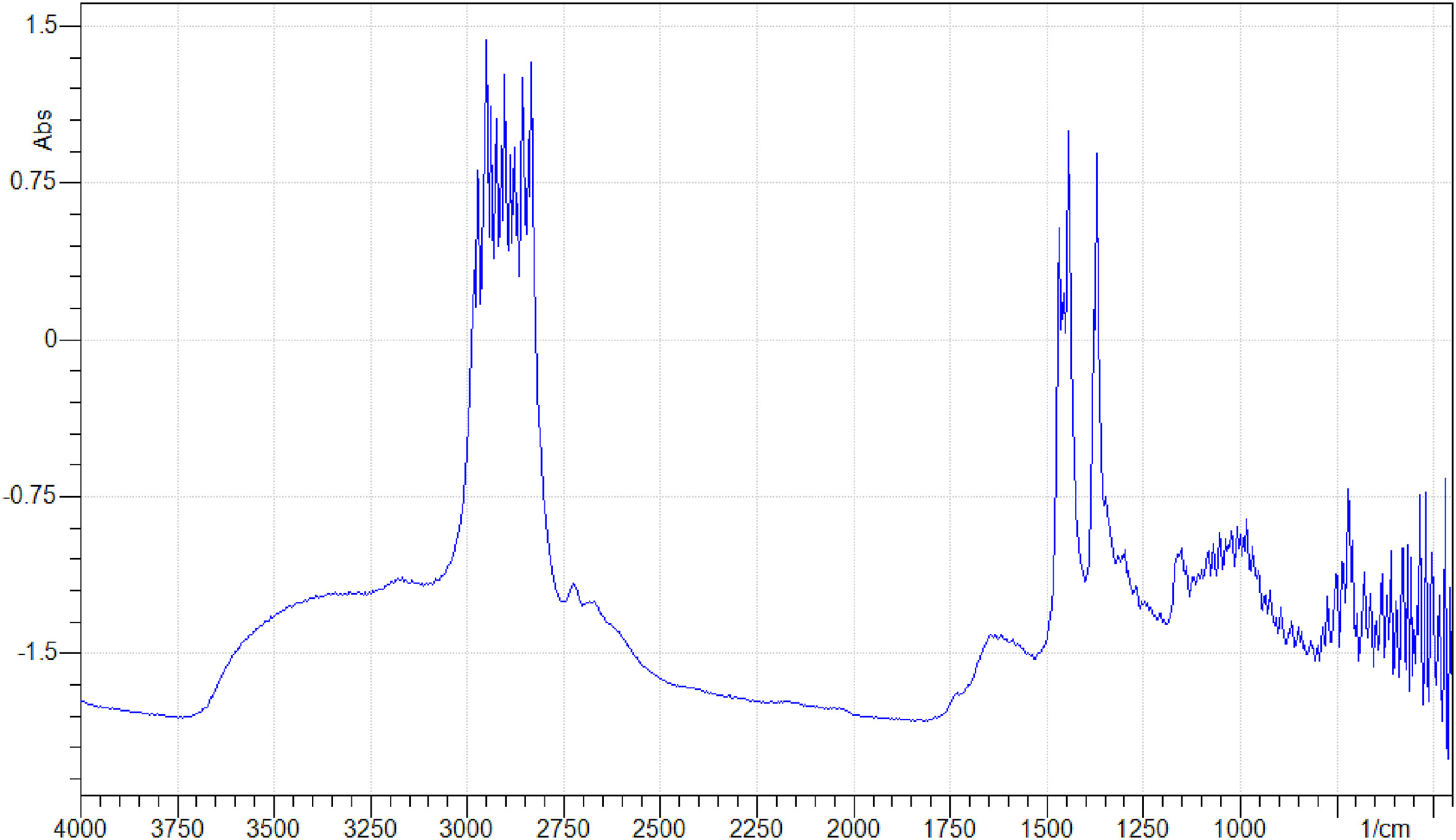 CSV FILE: tem.csv
en&2