RESULT PAGE

aromatic carbonyl-containing organic material, possibly an ester, ketone, or imide-like compound

View the report above. Use the comments below if you need follow-up discussion.

Result No.: 20250613101541207392280 Owner: publicuser Comments: 1
FTIR Analysis Report

aromatic carbonyl-containing organic material, possibly an ester, ketone, or imide-like compound

Sample & Measurement Parameters

Report No. 20250613101541207392280
Date 2025-06-13 12:24:36
Spectral Range (cm⁻¹) [(650, 4000)]
Baseline AsLS baseline correction
Library match 0%

Identification Result

0%

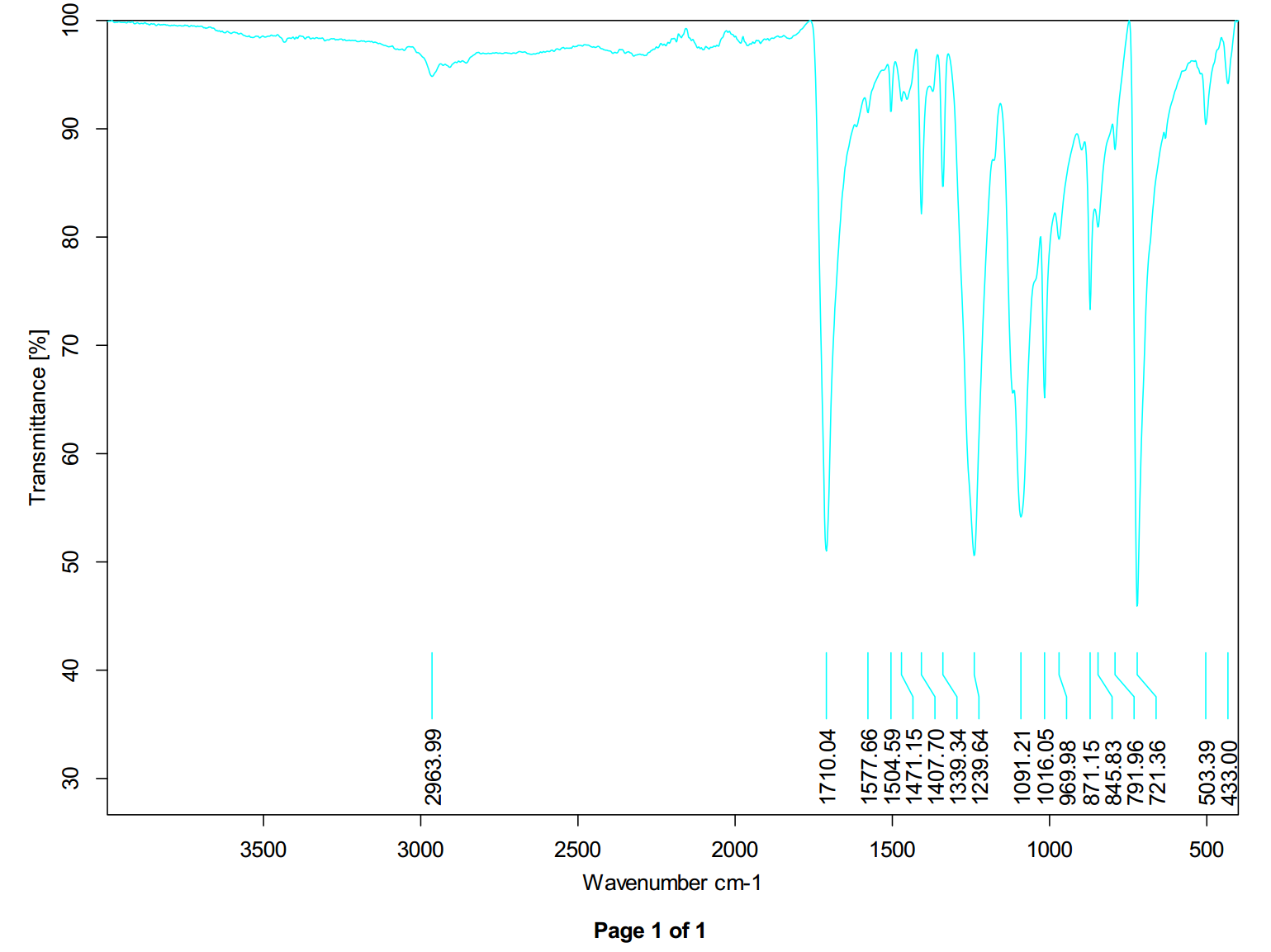
The ordinary FTIR evidence does not support a firm compound-level assignment for this sample. The nearest library entry is 5-ethyl-3-methyl-5-phenylimidazolidine-2,4-dione, but the library match confidence is effectively absent, and no direct reference or related-literature evidence independently supports that exact structure. The observed bands are more safely interpreted as indicating an aromatic organic material with a strong carbonyl absorption and multiple fingerprint-region C-O/C-N-type bands, consistent with a carbonyl-containing aromatic compound such as an ester-, ketone-, or imide-like material

Detailed interpretation

  • Top library match: 5-ethyl-3-methyl-5-phenylimidazolidine-2,4-dione #130
  • The top library candidate has a similarity of 0.000, S-O the retrieval does not provide meaningful direct support for that exact material identity.
  • No related-literature evidence was recovered to narrow the result to a specific aromatic carbonyl subclass.
  • The observed peak list is short and does not show enough characteristic bands to distinguish confidently among ester, ketone, amide/imide, or other aromatic carbonyl-containing structures.
  • The current evidence does not establish whether the carbonyl belongs specifically to an ester, ketone, amide, imide, or mixed functionality.
  • The aromatic substitution pattern is only partially constrained by the available low-wavenumber bands.
  • Because all reported library similarities are effectively zero, the named library hit should be treated only as a retrieval placeholder rather than a confirmed identification.

Recommended next steps: Acquire a higher-quality FTIR spectrum over the full range with band intensities and baseline correction, paying particular attention to the 1800-1500 cm-1 region to better separate ester-, ketone-, amide-, and imide-like carbonyl patterns. Check for additional characteristic bands that could confirm or exclude imide-like functionality, especially the presence or absence of multiple carbonyl absorptions and clearer C-N-associated bands. If available, run complementary Raman or NMR measurements to determine whether the sample is primarily an aromatic ester/ketone or a nitrogen-containing cyclic carbonyl compound. Compare the sample against targeted reference spectra for aromatic esters, aromatic ketones, and imide-containing aromatic compounds rather than relying on the present low-confidence broad library search.

Library Comparison

Match group:
Library spectrum will appear here.

Library Search Results — Top 15 Candidates

Rank Match % Compound SMILES Spectrum No. Action
Loading library candidates...

Peak Analysis

★ = Literature-supported assignment
# Wavenumber (cm⁻¹) Absorbance Assignment Citation Assignment status
1 · 715 1.00 - - -
2 · 1241 0.43 - - -
3 · 1713 0.41 - - -
4 · 1087 0.33 - - -
5 · 1011 0.18 - - -
6 · 868 0.12 - - -

Appendix — Raw Spectrum

Raw sample spectrum
Generated by FTIR.fun — Report #20250613101541207392280 2025-06-13 12:24:36
Discussion

Comments and follow-up evidence

Use this area to continue the interpretation, ask questions, or add extra verification evidence.

The above shows the FTIR analysis results of a PDF file uploaded by a user from UK . The original image is displayed below.1.png CSV FILE:20250613101541207392280.csv
en&2
Submit Requirement Form