RESULT PAGE

aliphatic carbonyl-containing organic material, possibly a cyclic ketone

View the report above. Use the comments below if you need follow-up discussion.

Result No.: 20250513230938656854422 Owner: publicuser Comments: 1
FTIR Analysis Report

aliphatic carbonyl-containing organic material, possibly a cyclic ketone

Sample & Measurement Parameters

Report No. 20250513230938656854422
Date 2025-05-14 06:52:11
Spectral Range (cm⁻¹) [(650, 4000)]
Baseline AsLS baseline correction
Library match 0%

Identification Result

0%

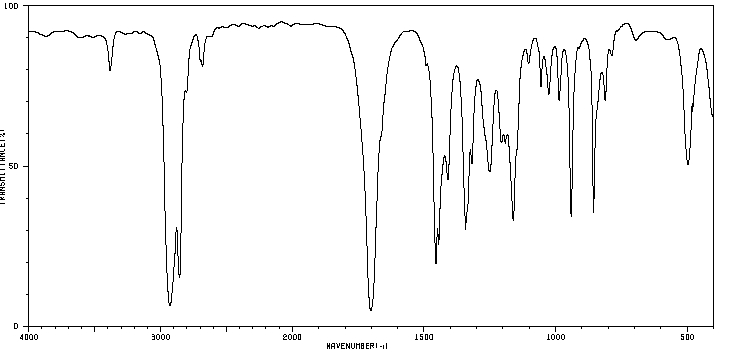
The ordinary FTIR evidence supports an aliphatic carbonyl-containing organic material, with the strongest narrow inference being a ketone-like compound and possibly a cyclic ketone. The library top hit is Cycloheptanone, but the match strength is effectively absent and no direct reference or related-literature evidence independently confirms that specific assignment. The observed 1699 cm-1 band is consistent with a ketone-type C=O absorption, while 2934 and 2863 cm-1 support aliphatic C-H stretching. Bands at 1452, 1338, 1244, 1158, 936, 851 cm-1 are compatible with fingerprint-region skeletal and C-H deformation modes, but they do not uniquely identify Cycloheptanone

Detailed interpretation

  • Top library match: Cycloheptanone #7607
  • The leading candidate Cycloheptanone is not securely established because the reported library similarity is 0.000.
  • The broader Top-15 candidate list is chemically mixed and includes structures requiring nitrogen- or multiple-carbonyl-containing motifs that are not directly supported by the observed peak list.
  • The observed spectrum does not show enough uniquely distinguishing bands to separate a simple cyclic ketone from other aliphatic carbonyl-containing organics.
  • The current evidence supports a carbonyl-containing aliphatic organic material, but not a firm single-compound identification.
  • A cyclic ketone remains plausible, yet other non-aromatic ketones or related carbonyl compounds could also fit the limited peak set.
  • The fingerprint-region pattern is too sparse here to verify ring size or exclude alternative ketone-containing structures.

Recommended next steps: Recollect the FTIR spectrum at higher signal quality and confirm the carbonyl band shape and exact position near 1700 cm-1. Check specifically for any weak O-H or N-H stretching bands above 3000 cm-1 to rule in or out alcohol- or amide/imide-containing alternatives suggested by some library candidates. Compare the sample against an authentic Cycloheptanone reference spectrum, focusing on the full fingerprint region rather than the carbonyl band alone. If confirmation is needed, use GC-MS or LC-MS to test whether the sample is a low-molecular-weight ketone such as Cycloheptanone versus another aliphatic carbonyl compound.

Library Comparison

Match group:
Library spectrum will appear here.

Library Search Results — Top 15 Candidates

Rank Match % Compound SMILES Spectrum No. Action
Loading library candidates...

Peak Analysis

★ = Literature-supported assignment
# Wavenumber (cm⁻¹) Absorbance Assignment Citation Assignment status
1 · 1699 1.00 - - -
2 · 2934 0.82 - - -
3 · 2863 0.43 - - -
4 · 1452 0.31 - - -
5 · 1338 0.25 - - -
6 · 1158 0.23 - - -
7 · 936 0.20 - - -
8 · 851 0.19 - - -
9 · 1244 0.16 - - -

Appendix — Raw Spectrum

Raw sample spectrum
Generated by FTIR.fun — Report #20250513230938656854422 2025-05-14 06:52:11
Discussion

Comments and follow-up evidence

Use this area to continue the interpretation, ask questions, or add extra verification evidence.

The above shows the FTIR analysis results of a jpeg file uploaded by a user (IP: 2600:: ). The original image is displayed below.20250513230938656854422.jpegcsv file:tem.csv
en&2
Submit Requirement Form