
PAGE DE RÉSULTATS
carbonyl-containing organic material, most consistent with an ester-like aliphatic material rather than the specific top library compound
Consultez le rapport ci-dessus. Utilisez les commentaires ci-dessous si vous avez besoin d'une discussion de suivi.
Rapport d'analyse FTIR
carbonyl-containing organic material, most consistent with an ester-like aliphatic material rather than the specific top library compound
Paramètres d'échantillon et de mesure
Rapport n°
20250423235425107656881-2
Date
2025-04-24 03:42:44
Plage spectrale (cm⁻¹)
[(650, 4000)]
Ligne de base
Correction de ligne de base AsLS
Correspondance de bibliothèque
0%
Résultat d'identification
0%Les preuves FTIR ne soutiennent pas une identification ferme comme N-(Phenylmethyl)acetamide, même s'il s'agit de l'entrée de bibliothèque la plus proche. Le spectre observé est mieux décrit globalement comme un matériau organique contenant un carbonyle avec un fort caractère aliphatique et un motif C=O/C-O de type ester. Cette direction plus large est plus soutenable chimiquement qu'une affectation spécifique d'amide ou contenant de l'azote.
Interprétation détaillée
- Meilleure correspondance de bibliothèque: N-(Phenylmethyl)acetamide #18552 | match 0.0%
- Les preuves FTIR ne soutiennent pas une identification ferme comme N-(Phenylmethyl)acetamide, même s'il s'agit de l'entrée de bibliothèque la plus proche. Le spectre observé est mieux décrit globalement comme un matériau organique contenant un carbonyle avec un fort caractère aliphatique et un motif C=O/C-O de type ester. Cette direction plus large est plus soutenable chimiquement qu'une affectation spécifique d'amide ou contenant de l'azote.
- La bande à 1736 cm⁻¹ soutient la présence d'un groupe carbonyle dans un environnement relativement sans liaison hydrogène.
- Les bandes à 1255, 1191 et 1098 cm⁻¹ soutiennent un étirement de liaison simple C-O attendu pour une fonctionnalité de type ester.
- Les bandes à 2931 et 2862 cm⁻¹ soutiennent une teneur substantielle en hydrocarbures aliphatiques.
- Plusieurs candidats esters parmi les principaux résultats de la bibliothèque fournissent une direction compositionnelle large et cohérente vers des organiques aliphatiques oxygénés.
- Une bande forte à 1736 cm⁻¹ est caractéristique d'un carbonyle non conjugué et est plus typique d'un ester que d'un amide simple.
- Les bandes à 1255, 1191 et 1098 cm⁻¹ sont cohérentes avec un étirement C-O, soutenant une fonctionnalité carbonyle oxygénée telle qu'un ester.
- Les bandes à 2931 et 2862 cm⁻¹ indiquent un étirement C-H aliphatique provenant de chaînes hydrocarbonées ou de groupes alkyles.
- Les bandes à 1429 et 1334 cm⁻¹ sont compatibles avec des déformations alkyles et des contributions de la région d'empreinte digitale d'un matériau organique aliphatique oxygéné.
- Le modèle des 15 premiers résultats de la bibliothèque comprend plusieurs esters à longue chaîne et d'autres composés aliphatiques oxygénés, ce qui correspond mieux au modèle observé 1736/1255/1191/1098 cm⁻¹ que la meilleure correspondance nominale.
- La correspondance de bibliothèque proposée N-(Phenylmethyl)acetamide exigerait normalement des caractéristiques d'amide plus claires, notamment une bande d'étirement N-H près de 3300 cm⁻¹ et un carbonyle d'amide inférieur à la région de 1736 cm⁻¹ observée ; celles-ci ne sont pas soutenues par les pics listés.
- Aucun motif de cycle aromatique clair n'est établi à partir de la liste de pics fournie, ce qui affaiblit l'affectation à un amide substitué par un benzyle.
- Les valeurs de similarité de la bibliothèque sont ici effectivement non discriminantes, donc la liste classée des hits en elle-même ne constitue pas une preuve d'identification solide.
- La présente liste de pics est limitée et ne permet pas d'établir si l'échantillon est un composé pur unique, un mélange ou un matériau formulé.
- La bande à bas nombre d'onde à 690 cm⁻¹ et la caractéristique à 962 cm⁻¹ ne sont pas suffisantes en elles-mêmes pour définir une structure plus étroite.
- Sans référence directe ou confirmation par littérature connexe, la conclusion la plus sûre reste un matériau organique contenant un carbonyle de type ester au sens large.
Comparaison de bibliothèques
Le spectre de la bibliothèque apparaîtra ici.
Résultats de recherche dans la bibliothèque — Top 15 des candidats
| Rang | Correspondance % | Composé | SMILES | N° de spectre | Action |
|---|---|---|---|---|---|
| Chargement des candidats de la bibliothèque... | |||||
Analyse des pics
★ = Attribution soutenue par la littératureAnnexe — Spectre brut

Discussion
Commentaires et preuves de suivi
Utilisez cette zone pour poursuivre l'interprétation, poser des questions ou ajouter des preuves de vérification supplémentaires.
The user from Taiwan (IP: 2407::) uploaded a DOCX file containing three IR spectra. Swipe up to view the qualitative analysis of the second spectrum. The user also expressed intent to calculate sample thickness using interference peaks. Here is the original spectrum of the sample extracted from the DOCX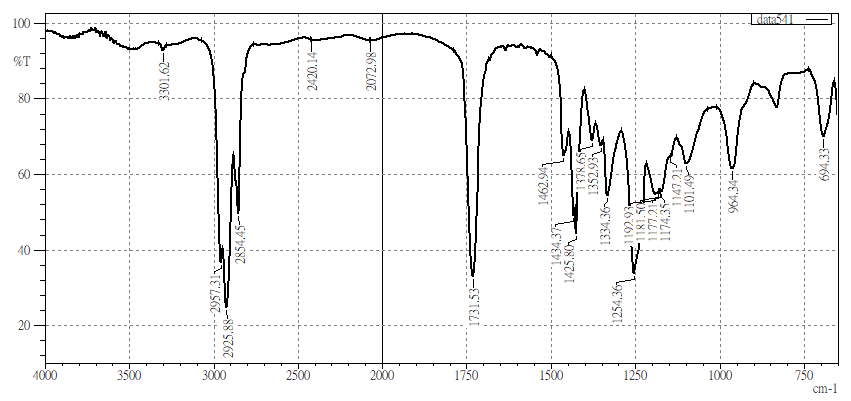
en&2This sample appears to be more similar to PVC or its copolymer. Please use the "Spectrum Search" function on this site and enter "PVC" to view the corresponding reference spectrum.
en&2