RESULT PAGE

carbonyl-containing organic material, most consistent with an ester-like aliphatic material rather than the specific top library compound

View the report above. Use the comments below if you need follow-up discussion.

Result No.: 20250423235425107656881-2 Owner: publicuser Comments: 2
FTIR Analysis Report

carbonyl-containing organic material, most consistent with an ester-like aliphatic material rather than the specific top library compound

Sample & Measurement Parameters

Report No. 20250423235425107656881-2
Date 2025-04-24 03:42:44
Spectral Range (cm⁻¹) [(650, 4000)]
Baseline AsLS baseline correction
Library match 0%

Identification Result

0%

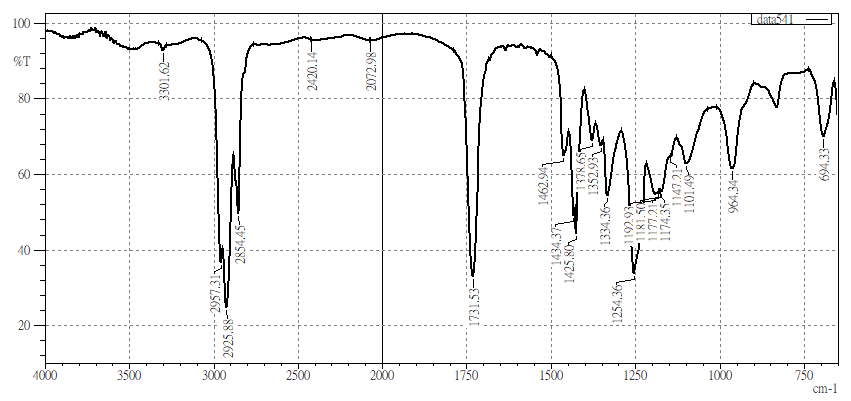
The FTIR evidence does not support a firm identification as N-(Phenylmethyl)acetamide, despite that being the nearest library entry. The observed spectrum is better described broadly as a carbonyl-containing organic material with strong aliphatic character and an ester-like C=O/C-O pattern. This broader direction is more chemically supportable than a specific amide or nitrogen-containing assignment

Detailed interpretation

  • Top library match: N-(Phenylmethyl)acetamide #18552
  • The proposed library match N-(Phenylmethyl)acetamide would ordinarily require clearer amide features, especially an N-H stretching band near 3300 cm-1 and an amide carbonyl lower than the observed 1736 cm-1 region; these are not supported by the listed peaks.
  • No clear aromatic ring pattern is established from the provided peak list, which weakens assignment to a benzyl-substituted amide.
  • Library similarity values are effectively non-discriminating here, S-O the ranked hit list by itself is not strong identification evidence.
  • The present peak list is limited and does not establish whether the sample is a single pure compound, a mixture, or a formulated material.
  • The low-wavenumber band at 690 cm-1 and the feature at 962 cm-1 are not sufficient on their own to define a narrower structure.
  • Without direct reference or related-literature confirmation, the safest conclusion remains a broad ester-like carbonyl-containing organic material.

Recommended next steps: Re-examine the full spectrum for a weak or broad N-H/O-H stretching region between about 3200 and 3600 cm-1 to test amide or alcohol involvement. Inspect the 1600-1500 cm-1 region for aromatic ring bands; their presence or absence would help distinguish benzyl/aromatic compounds from aliphatic esters. Check for the characteristic ester pair by confirming a strong C=O near 1735 cm-1 together with intense C-O bands across roughly 1300-1000 cm-1. If available, run GC-MS or LC-MS to determine whether the sample is a long-chain ester, another oxygenated aliphatic compound, or a mixture.

Library Comparison

Match group:
Library spectrum will appear here.

Library Search Results — Top 15 Candidates

Rank Match % Compound SMILES Spectrum No. Action
Loading library candidates...

Peak Analysis

★ = Literature-supported assignment
# Wavenumber (cm⁻¹) Absorbance Assignment Citation Assignment status
1 · 2931 1.00 - - -
2 · 1255 0.41 - - -
3 · 1736 0.41 - - -
4 · 1429 0.23 - - -
5 · 2862 0.21 - - -
6 · 1191 0.19 - - -
7 · 1334 0.18 - - -
8 · 962 0.15 - - -
9 · 1098 0.14 - - -
10 · 690 0.10 - - -

Appendix — Raw Spectrum

Raw sample spectrum
Generated by FTIR.fun — Report #20250423235425107656881-2 2025-04-24 03:42:44
Discussion

Comments and follow-up evidence

Use this area to continue the interpretation, ask questions, or add extra verification evidence.

The user from Taiwan (IP: 2407::) uploaded a DOCX file containing three IR spectra. Swipe up to view the qualitative analysis of the second spectrum. The user also expressed intent to calculate sample thickness using interference peaks. Here is the original spectrum of the sample extracted from the DOCX2.png
en&2

This sample appears to be more similar to PVC or its copolymer. Please use the "Spectrum Search" function on this site and enter "PVC" to view the corresponding reference spectrum.

en&2
Submit Requirement Form