
styrenic aromatic hydrocarbon polymer
Yukarıdaki raporu görüntüleyin. Takip görüşmesine ihtiyacınız olursa aşağıdaki yorumları kullanın.
styrenic aromatic hydrocarbon polymer
Numune ve Ölçüm Parametreleri
Tanımlama Sonucu
0%FTIR deseni en çok bir stirenik aromatik hidrokarbon polimer ile uyumludur, en yakın kütüphane eşleşmesi Polistiren'dir. Bu yön, 3031-3081 cm-1 civarındaki aromatik C-H gerilmesi, 1604 ve 1493 cm-1'deki aromatik halka bantları, 701, 751 ve 758 cm-1'deki güçlü düzlem dışı aromatik C-H bantları ve 2926 ve 2857 cm-1'deki alifatik C-H gerilmeleri tarafından desteklenmektedir; bunlar birlikte bir fenil-sübstitüe hidrokarbon polimerin karakteristiğidir. Bununla birlikte, kütüphane güveni çok düşüktür ve hiçbir doğrudan referans veya ilgili literatür kanıtı bağımsız olarak belirli bir varlık atamasını doğrulamaz, bu nedenle en savunulabilir sonuç, kesin bir varlık tanımlamasından ziyade bir stirenik aromatik hidrokarbon polimer yönüdür
Detaylı yorum
- En iyi kütüphane eşleşmesi: Polistiren #46662 | match 0.0%
- FTIR deseni en çok bir stirenik aromatik hidrokarbon polimer ile uyumludur, en yakın kütüphane eşleşmesi Polistiren'dir. Bu yön, 3031-3081 cm-1 civarındaki aromatik C-H gerilmesi, 1604 ve 1493 cm-1'deki aromatik halka bantları, 701, 751 ve 758 cm-1'deki güçlü düzlem dışı aromatik C-H bantları ve 2926 ve 2857 cm-1'deki alifatik C-H gerilmeleri tarafından desteklenmektedir; bunlar birlikte bir fenil-sübstitüe hidrokarbon polimerin karakteristiğidir. Bununla birlikte, kütüphane güveni çok düşüktür ve hiçbir doğrudan referans veya ilgili literatür kanıtı bağımsız olarak belirli bir varlık atamasını doğrulamaz, bu nedenle en savunulabilir sonuç, kesin bir varlık tanımlamasından ziyade bir stirenik aromatik hidrokarbon polimer yönüdür.
- En yakın kütüphane eşleşmesi: Polistiren, en üst aday pozisyonlarını işgal eden birden fazla ek Polistiren girişi ile.
- Ortak Top-15 kütüphane deseni: ağırlıklı olarak stirenik, aromatik hidrokarbon polimer spektrumları.
- Aromatik C-H gerilmesi 3031, 3071 ve 3081 cm-1'de mevcut.
- Aromatik halka titreşimleri 1604 ve 1493 cm-1'de mevcut.
- 701, 751 ve 758 cm-1'deki düzlem dışı aromatik C-H bantları bir stirenik aromatik sübstitüsyon desenini destekler.
- 2926, 2857, 1450, 1376 ve 1360 cm-1'deki alifatik C-H bantları bir hidrokarbon polimer çerçevesini destekler.
- Önde gelen kütüphane adayları ezici bir şekilde Polistiren girişleridir ve daha geniş Top-15 deseni stirenik malzemeler tarafından domine edilmektedir.
- Numune, 1604 ve 1493 cm-1'de karakteristik aromatik halka özellikleri ile birlikte 3031, 3071 ve 3081 cm-1'de aromatik C-H gerilmesi göstermektedir.
- 701, 751 ve 758 cm-1'deki bantlar, bir stirenik fenil halka ortamı için beklenen aromatik C-H düzlem dışı bükülmesi ile uyumludur.
- 2926 ve 2857 cm-1'deki alifatik C-H gerilmesi bir hidrokarbon polimer omurgasını destekler.
- Rapor edilen tepe listesi tarafından net bir karbonil, hidroksil, nitril veya diğer güçlü heteroatom içeren işlevsellik belirtilmemiştir, bu da yönü büyük ölçüde hidrokarbon aromatik polimer sınıfı içinde tutar.
- Kütüphane eşleşme güveni düşük olarak rapor edilmiştir, bu nedenle yalnızca erişim, kesin bir malzeme tanımlaması için yeterince güçlü değildir.
- Atamayı stirenik aromatik polimer yönünün ötesine daraltmak için ilgili literatür eşleşmesi bulunamamıştır.
- Rapor edilen kanıtlar, malzemenin saf Polistiren mi yoksa ilgili bir stirenik malzeme, karışım, kopolimer veya modifiye edilmiş form mu olduğunu belirlememektedir.
- Mevcut kanıtlar stirenik aromatik kimyayı desteklemektedir ancak Polistireni yakından ilişkili stirenik polimer malzemelerden güvenli bir şekilde ayırt etmemektedir.
- 903, 1025 ve 1070 cm-1 gibi küçük bantlar, daha güçlü referans desteği olmadan daha spesifik bir formülasyonu kanıtlamak için burada yeterli değildir.
- Doğrudan literatür ve referans onayı bulunmadığından, varlık düzeyindeki atama, geniş kimyasal yönden daha az kesin kalmaktadır.
Kütüphane Karşılaştırması
Kütüphane Arama Sonuçları — İlk 15 Aday
| Sıra | Eşleşme % | Bileşik | SMILES | Spektrum No. | Eylem |
|---|---|---|---|---|---|
| Kütüphane adayları yükleniyor... | |||||
Pik Analizi
★ = Literatür destekli atama| # | Dalga sayısı (cm⁻¹) | Absorbans | Atama | Alıntı | Atama durumu | |
|---|---|---|---|---|---|---|
| 1 | · | 701 | 1.00 | - | - | - |
| 2 | · | 2926 | 0.92 | - | - | - |
| 3 | · | 1450 | 0.91 | - | - | - |
| 4 | · | 3031 | 0.91 | - | - | - |
| 5 | · | 751 | 0.83 | - | - | - |
| 6 | · | 758 | 0.71 | - | - | - |
| 7 | · | 1493 | 0.41 | - | - | - |
| 8 | · | 3071 | 0.37 | - | - | - |
| 9 | · | 3081 | 0.33 | - | - | - |
| 10 | · | 2857 | 0.31 | - | - | - |
| 11 | · | 1604 | 0.28 | - | - | - |
| 12 | · | 1025 | 0.20 | - | - | - |
| 13 | · | 903 | 0.14 | - | - | - |
| 14 | · | 1070 | 0.13 | - | - | - |
| 15 | · | 1360 | 0.11 | - | - | - |
| 16 | · | 1376 | 0.11 | - | - | - |
Ek — Ham Spektrum

Yorumlar ve takip kanıtları
Bu alanı yoruma devam etmek, soru sormak veya ek doğrulama kanıtı eklemek için kullanın.
The user from Taiwan (IP: 2407::) uploaded a DOCX file containing three IR spectra. Swipe up to view the qualitative analysis of the first spectrum. The user also expressed intent to calculate sample thickness using interference peaks. Based on the spectra, the analysis was performed at wave numbers 2501 and 2563, yielding an interference peak difference (V₁ - V₂) of 62 cm-1 and ΔN = 1. By inputting the film's refractive index(n), the sample thickness (d) was determined.Here is the original spectrum of the sample extracted from the DOCX file.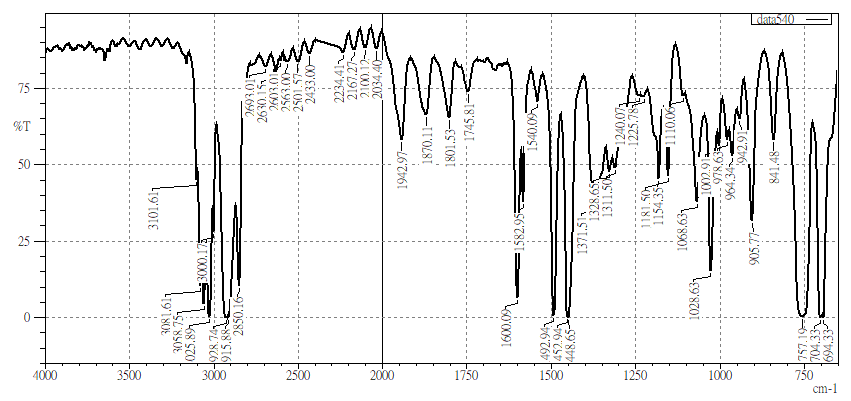
en&2