
styrenic aromatic hydrocarbon polymer
Tingnan ang ulat sa itaas. Gamitin ang mga komento sa ibaba kung kailangan mo ng karagdagang pag-uusap.
styrenic aromatic hydrocarbon polymer
Mga Parameter ng Sample at Pagsukat
Resulta ng Pagkilala
0%Ang FTIR pattern ay pinaka-ayon sa isang styrenic aromatic hydrocarbon polymer, na may Polystyrene bilang pinakamalapit na tugma sa library. Ang direksyong ito ay sinusuportahan ng aromatic C-H stretching malapit sa 3031-3081 cm-1, aromatic ring bands sa 1604 at 1493 cm-1, malakas na out-of-plane aromatic C-H bands sa 701, 751, at 758 cm-1, at aliphatic C-H stretches sa 2926 at 2857 cm-1, na magkakasama ay katangian ng isang phenyl-substituted hydrocarbon polymer. Gayunpaman, ang kumpiyansa sa library ay napakababa at walang direktang sanggunian o kaugnay na literatura na ebidensya na independiyenteng nagkukumpirma ng isang partikular na entity assignment, kaya ang pinakapanghahawakang konklusyon ay isang styrenic aromatic hydrocarbon polymer direction sa halip na isang matibay na entity identification.
Detalyadong interpretasyon
- Nangungunang tugma ng aklatan: Polystyrene #46662 | match 0.0%
- Ang FTIR pattern ay pinaka-ayon sa isang styrenic aromatic hydrocarbon polymer, na may Polystyrene bilang pinakamalapit na tugma sa library. Ang direksyong ito ay sinusuportahan ng aromatic C-H stretching malapit sa 3031-3081 cm-1, aromatic ring bands sa 1604 at 1493 cm-1, malakas na out-of-plane aromatic C-H bands sa 701, 751, at 758 cm-1, at aliphatic C-H stretches sa 2926 at 2857 cm-1, na magkakasama ay katangian ng isang phenyl-substituted hydrocarbon polymer. Gayunpaman, ang kumpiyansa sa library ay napakababa at walang direktang sanggunian o kaugnay na literatura na ebidensya na independiyenteng nagkukumpirma ng isang partikular na entity assignment, kaya ang pinakapanghahawakang konklusyon ay isang styrenic aromatic hydrocarbon polymer direction sa halip na isang matibay na entity identification.
- Pinakamalapit na tugma sa library: Polystyrene, na may maraming karagdagang Polystyrene entries na sumasakop sa mga nangungunang posisyon.
- Karaniwang Top-15 pattern ng library: karamihan ay styrenic, aromatic hydrocarbon polymer spectra.
- Ang aromatic C-H stretching ay naroroon sa 3031, 3071, at 3081 cm-1.
- Ang aromatic ring vibrations ay naroroon sa 1604 at 1493 cm-1.
- Ang out-of-plane aromatic C-H bands sa 701, 751, at 758 cm-1 ay sumusuporta sa isang styrenic aromatic substitution pattern.
- Ang aliphatic C-H bands sa 2926, 2857, 1450, 1376, at 1360 cm-1 ay sumusuporta sa isang hydrocarbon polymer framework.
- Ang mga nangungunang kandidato sa library ay karamihan ay mga Polystyrene entries, at ang mas malawak na Top-15 pattern ay pinangungunahan ng mga styrenic materials.
- Ang sample ay nagpapakita ng mga katangiang aromatic ring features sa 1604 at 1493 cm-1 kasama ang aromatic C-H stretching sa 3031, 3071, at 3081 cm-1.
- Ang mga bands sa 701, 751, at 758 cm-1 ay naaayon sa aromatic C-H out-of-plane bending na inaasahan para sa isang styrenic phenyl ring environment.
- Ang aliphatic C-H stretching sa 2926 at 2857 cm-1 ay sumusuporta sa isang hydrocarbon polymer backbone.
- Walang malinaw na carbonyl, hydroxyl, nitrile, o iba pang matinding heteroatom-bearing functionality na ipinapahiwatig ng iniulat na peak list, na nagpapanatili ng direksyon sa loob ng isang pangunahing hydrocarbon aromatic polymer class.
- Ang kumpiyansa sa tugma ng library ay iniulat na mababa, kaya ang retrieval lamang ay hindi sapat na malakas para sa isang matibay na material identification.
- Walang nakitang kaugnay na literatura na tugma upang paliitin ang assignment higit sa isang styrenic aromatic polymer direction.
- Ang iniulat na ebidensya ay hindi nagtatatag kung ang materyal ay purong Polystyrene o isang kaugnay na styrenic material, blend, copolymer, o modified form.
- Ang kasalukuyang ebidensya ay sumusuporta sa styrenic aromatic chemistry ngunit hindi matiyak na makilala ang Polystyrene mula sa malapit na kaugnay na styrenic polymer materials.
- Ang mga menor de edad na bands tulad ng 903, 1025, at 1070 cm-1 ay hindi sapat dito upang patunayan ang isang mas tiyak na formulation nang walang mas malakas na reference support.
- Dahil wala ang direktang literatura at reference confirmation, ang entity-level assignment ay nananatiling hindi gaanong tiyak kaysa sa malawak na chemical direction.
Paghahambing ng Library
Mga Resulta ng Paghahanap sa Library — Nangungunang 15 na Kandidato
| Ranggo | Itugma ang % | Compound | SMILES | Blg. ng Spectrum | Aksyon |
|---|---|---|---|---|---|
| Naglo-load ng mga kandidato sa library... | |||||
Pagsusuri ng Peak
★ = Takdang suportado ng literatura| # | Bilang ng alon (cm⁻¹) | Absorbans | Assignment | Pagsipi | Katayuan ng pagtatalaga | |
|---|---|---|---|---|---|---|
| 1 | · | 701 | 1.00 | - | - | - |
| 2 | · | 2926 | 0.92 | - | - | - |
| 3 | · | 1450 | 0.91 | - | - | - |
| 4 | · | 3031 | 0.91 | - | - | - |
| 5 | · | 751 | 0.83 | - | - | - |
| 6 | · | 758 | 0.71 | - | - | - |
| 7 | · | 1493 | 0.41 | - | - | - |
| 8 | · | 3071 | 0.37 | - | - | - |
| 9 | · | 3081 | 0.33 | - | - | - |
| 10 | · | 2857 | 0.31 | - | - | - |
| 11 | · | 1604 | 0.28 | - | - | - |
| 12 | · | 1025 | 0.20 | - | - | - |
| 13 | · | 903 | 0.14 | - | - | - |
| 14 | · | 1070 | 0.13 | - | - | - |
| 15 | · | 1360 | 0.11 | - | - | - |
| 16 | · | 1376 | 0.11 | - | - | - |
Appendix — Hilaw na Spectrum

Mga komento at sumunod na ebidensya
Gamitin ang lugar na ito upang ipagpatuloy ang interpretasyon, magtanong, o magdagdag ng dagdag na ebidensya ng pagpapatunay.
The user from Taiwan (IP: 2407::) uploaded a DOCX file containing three IR spectra. Swipe up to view the qualitative analysis of the first spectrum. The user also expressed intent to calculate sample thickness using interference peaks. Based on the spectra, the analysis was performed at wave numbers 2501 and 2563, yielding an interference peak difference (V₁ - V₂) of 62 cm-1 and ΔN = 1. By inputting the film's refractive index(n), the sample thickness (d) was determined.Here is the original spectrum of the sample extracted from the DOCX file.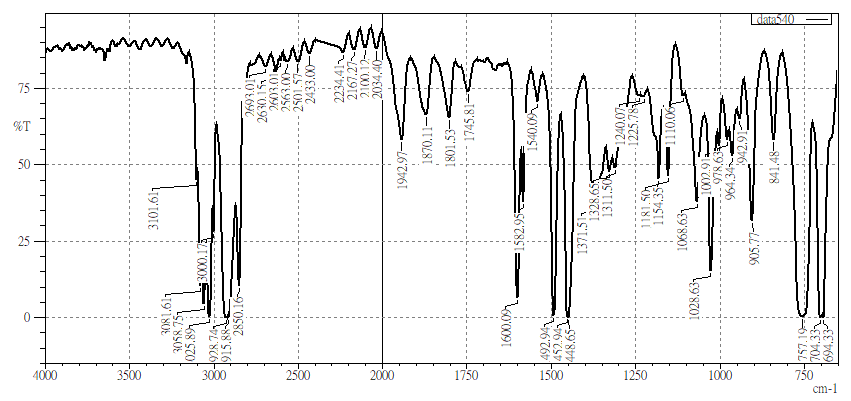
en&2