
styrenic aromatic hydrocarbon polymer
Visa rapporten ovan. Använd kommentarerna nedan om du behöver uppföljningsdiskussion.
styrenic aromatic hydrocarbon polymer
Prov- och mätparametrar
Identifieringsresultat
0%FTIR-mönstret överensstämmer bäst med en styrenisk aromatisk kolvätepolymer, med polystyren som närmaste biblioteksträff. Denna riktning stöds av aromatisk C-H-sträckning nära 3031-3081 cm-1, aromatiska ringband vid 1604 och 1493 cm-1, starka ut-ur-planet aromatiska C-H-band vid 701, 751 och 758 cm-1, samt alifatiska C-H-sträckningar vid 2926 och 2857 cm-1, vilka tillsammans är karakteristiska för en fenylsubstituerad kolvätepolymer. Dock är bibliotekets förtroende mycket lågt och inga direkta referens- eller relaterad litteraturbevis bekräftar oberoende en specifik enhetstilldelning, så den mest försvarbara slutsatsen är en riktning mot styrenisk aromatisk kolvätepolymer snarare än en fast enhetsidentifiering
Detaljerad tolkning
- Bästa biblioteksträff: Polystyren #46662 | träff 0.0%
- FTIR-mönstret överensstämmer bäst med en styrenisk aromatisk kolvätepolymer, med polystyren som närmaste biblioteksträff. Denna riktning stöds av aromatisk C-H-sträckning nära 3031-3081 cm-1, aromatiska ringband vid 1604 och 1493 cm-1, starka ut-ur-planet aromatiska C-H-band vid 701, 751 och 758 cm-1, samt alifatiska C-H-sträckningar vid 2926 och 2857 cm-1, vilka tillsammans är karakteristiska för en fenylsubstituerad kolvätepolymer. Dock är bibliotekets förtroende mycket lågt och inga direkta referens- eller relaterad litteraturbevis bekräftar oberoende en specifik enhetstilldelning, så den mest försvarbara slutsatsen är en riktning mot styrenisk aromatisk kolvätepolymer snarare än en fast enhetsidentifiering.
- Närmaste biblioteksträff: Polystyren, med flera ytterligare polystyrenposter som upptar de främsta kandidatpositionerna.
- Vanligt Top-15-biblioteksmönster: övervägande styreniska, aromatiska kolvätepolymer-spektra.
- Aromatisk C-H-sträckning finns vid 3031, 3071 och 3081 cm-1.
- Aromatiska ringvibrationer finns vid 1604 och 1493 cm-1.
- Ut-ur-planet aromatiska C-H-band vid 701, 751 och 758 cm-1 stöder ett styreniskt aromatiskt substitutionsmönster.
- Alifatiska C-H-band vid 2926, 2857, 1450, 1376 och 1360 cm-1 stöder en kolvätepolymerram.
- De ledande bibliotekskandidaterna är överväldigande polystyrenposter, och det bredare Top-15-mönstret domineras av styreniska material.
- Provet visar karakteristiska aromatiska ringdrag vid 1604 och 1493 cm-1 tillsammans med aromatisk C-H-sträckning vid 3031, 3071 och 3081 cm-1.
- Band vid 701, 751 och 758 cm-1 överensstämmer med aromatisk C-H-ut-ur-plan-böjning förväntad för en styrenisk fenylringmiljö.
- Alifatisk C-H-sträckning vid 2926 och 2857 cm-1 stöder en kolvätepolymerryggrad.
- Ingen tydlig karbonyl, hydroxyl, nitril eller annan starkt heteroatombärande funktionalitet indikeras av den rapporterade topplistan, vilket håller riktningen inom en i huvudsak kolvätebaserad aromatisk polymerklass.
- Biblioteksträffens förtroende rapporteras som lågt, så själva sökningen är inte tillräckligt stark för en säker materialidentifiering.
- Ingen relaterad litteraturträff återfanns för att begränsa tilldelningen utöver en styrenisk aromatisk polymerriktning.
- De rapporterade bevisen fastställer inte om materialet är ren polystyren eller ett relaterat styreniskt material, blandning, sampolymer eller modifierad form.
- Nuvarande bevis stöder styrenisk aromatisk kemi men skiljer inte säkert polystyren från nära besläktade styreniska polymermaterial.
- Mindre band såsom 903, 1025 och 1070 cm-1 är inte tillräckliga här för att bevisa en mer specifik formulering utan starkare referensstöd.
- Eftersom direkt litteratur- och referensbekräftelse saknas förblir enhetsnivåns tilldelning mindre säker än den breda kemiska riktningen.
Biblioteksjämförelse
Bibliotekssökresultat — Topp 15 kandidater
| Rankning | Matcha % | Förening | SMILES | Spektrum nr. | Åtgärd |
|---|---|---|---|---|---|
| Laddar bibliotekskandidater... | |||||
Toppanalys
★ = Litteraturstödd tilldelning| # | Vågtal (cm⁻¹) | Absorbans | Tilldelning | Citering | Tilldelningsstatus | |
|---|---|---|---|---|---|---|
| 1 | · | 701 | 1.00 | - | - | - |
| 2 | · | 2926 | 0.92 | - | - | - |
| 3 | · | 1450 | 0.91 | - | - | - |
| 4 | · | 3031 | 0.91 | - | - | - |
| 5 | · | 751 | 0.83 | - | - | - |
| 6 | · | 758 | 0.71 | - | - | - |
| 7 | · | 1493 | 0.41 | - | - | - |
| 8 | · | 3071 | 0.37 | - | - | - |
| 9 | · | 3081 | 0.33 | - | - | - |
| 10 | · | 2857 | 0.31 | - | - | - |
| 11 | · | 1604 | 0.28 | - | - | - |
| 12 | · | 1025 | 0.20 | - | - | - |
| 13 | · | 903 | 0.14 | - | - | - |
| 14 | · | 1070 | 0.13 | - | - | - |
| 15 | · | 1360 | 0.11 | - | - | - |
| 16 | · | 1376 | 0.11 | - | - | - |
Bilaga — Råspektrum

Kommentarer och uppföljningsbevis
Använd detta område för att fortsätta tolkningen, ställa frågor eller lägga till extra verifieringsbevis.
The user from Taiwan (IP: 2407::) uploaded a DOCX file containing three IR spectra. Swipe up to view the qualitative analysis of the first spectrum. The user also expressed intent to calculate sample thickness using interference peaks. Based on the spectra, the analysis was performed at wave numbers 2501 and 2563, yielding an interference peak difference (V₁ - V₂) of 62 cm-1 and ΔN = 1. By inputting the film's refractive index(n), the sample thickness (d) was determined.Here is the original spectrum of the sample extracted from the DOCX file.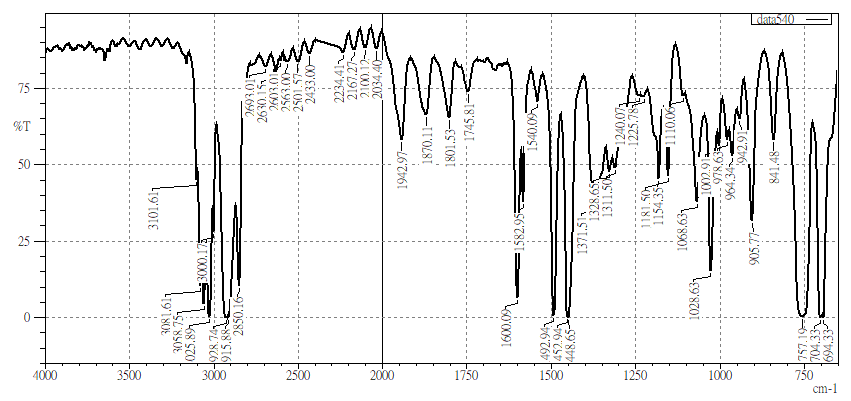
en&2