
styrenic aromatic hydrocarbon polymer
Lihat laporan di atas. Gunakan komen di bawah jika anda memerlukan perbincangan lanjut.
styrenic aromatic hydrocarbon polymer
Parameter Sampel & Pengukuran
Keputusan Pengenalan
0%Corak FTIR paling konsisten dengan polimer hidrokarbon aromatik stirenik, dengan Polistirena sebagai padanan perpustakaan terdekat. Arah ini disokong oleh regangan C-H aromatik berhampiran 3031-3081 cm-1, jalur gelang aromatik pada 1604 dan 1493 cm-1, jalur C-H aromatik luar satah yang kuat pada 701, 751, dan 758 cm-1, dan regangan C-H alifatik pada 2926 dan 2857 cm-1, yang bersama-sama merupakan ciri polimer hidrokarbon yang digantikan fenil. Walau bagaimanapun, keyakinan perpustakaan sangat rendah dan tiada rujukan langsung atau bukti literatur berkaitan secara bebas mengesahkan tugasan entiti tertentu, jadi kesimpulan yang paling dipertahankan ialah arah polimer hidrokarbon aromatik stirenik dan bukannya pengenalan entiti yang kukuh
Tafsiran terperinci
- Padanan perpustakaan teratas: Polistirena #46662 | match 0.0%
- Corak FTIR paling konsisten dengan polimer hidrokarbon aromatik stirenik, dengan Polistirena sebagai padanan perpustakaan terdekat. Arah ini disokong oleh regangan C-H aromatik berhampiran 3031-3081 cm-1, jalur gelang aromatik pada 1604 dan 1493 cm-1, jalur C-H aromatik luar satah yang kuat pada 701, 751, dan 758 cm-1, dan regangan C-H alifatik pada 2926 dan 2857 cm-1, yang bersama-sama merupakan ciri polimer hidrokarbon yang digantikan fenil. Walau bagaimanapun, keyakinan perpustakaan sangat rendah dan tiada rujukan langsung atau bukti literatur berkaitan secara bebas mengesahkan tugasan entiti tertentu, jadi kesimpulan yang paling dipertahankan ialah arah polimer hidrokarbon aromatik stirenik dan bukannya pengenalan entiti yang kukuh.
- Padanan perpustakaan terdekat: Polistirena, dengan beberapa entri Polistirena tambahan menduduki kedudukan calon teratas.
- Corak perpustakaan Top-15 biasa: kebanyakannya spektrum polimer hidrokarbon aromatik stirenik.
- Regangan C-H aromatik hadir pada 3031, 3071, dan 3081 cm-1.
- Getaran gelang aromatik hadir pada 1604 dan 1493 cm-1.
- Jalur C-H aromatik luar satah pada 701, 751, dan 758 cm-1 menyokong corak substitusi aromatik stirenik.
- Jalur C-H alifatik pada 2926, 2857, 1450, 1376, dan 1360 cm-1 menyokong rangka polimer hidrokarbon.
- Calon perpustakaan terkemuka adalah kebanyakannya entri Polistirena, dan corak Top-15 yang lebih luas dikuasai oleh bahan stirenik.
- Sampel menunjukkan ciri gelang aromatik pada 1604 dan 1493 cm-1 bersama-sama regangan C-H aromatik pada 3031, 3071, dan 3081 cm-1.
- Jalur pada 701, 751, dan 758 cm-1 konsisten dengan lenturan C-H aromatik luar satah yang dijangka untuk persekitaran gelang fenil stirenik.
- Regangan C-H alifatik pada 2926 dan 2857 cm-1 menyokong tulang belakang polimer hidrokarbon.
- Tiada karbonil, hidroksil, nitril, atau kefungsian lain yang mengandungi heteroatom kuat yang jelas ditunjukkan oleh senarai puncak yang dilaporkan, yang mengekalkan arah dalam kelas polimer aromatik hidrokarbon sebahagian besarnya.
- Keyakinan padanan perpustakaan dilaporkan rendah, jadi pengambilan semula sahaja tidak cukup kuat untuk pengenalan bahan yang kukuh.
- Tiada padanan literatur berkaitan diperoleh untuk menyempitkan tugasan melebihi arah polimer aromatik stirenik.
- Bukti yang dilaporkan tidak menetapkan sama ada bahan itu adalah Polistirena tulen atau bahan stirenik berkaitan, campuran, kopolimer, atau bentuk diubah suai.
- Bukti semasa menyokong kimia aromatik stirenik tetapi tidak membezakan dengan selamat Polistirena daripada bahan polimer stirenik yang berkait rapat.
- Jalur kecil seperti 903, 1025, dan 1070 cm-1 tidak mencukupi di sini untuk membuktikan formulasi yang lebih spesifik tanpa sokongan rujukan yang lebih kuat.
- Oleh kerana pengesahan literatur dan rujukan langsung tidak hadir, tugasan peringkat entiti kekal kurang pasti daripada arah kimia yang luas.
Perbandingan Perpustakaan
Keputusan Carian Perpustakaan — 15 Calon Teratas
| Kedudukan | Padanan % | Sebatian | SMILES | No. Spektrum | Tindakan |
|---|---|---|---|---|---|
| Memuatkan calon perpustakaan... | |||||
Analisis Puncak
★ = Tugasan disokong literatur| # | Nombor gelombang (cm⁻¹) | Absorbans | Tugasan | Petikan | Status penetapan | |
|---|---|---|---|---|---|---|
| 1 | · | 701 | 1.00 | - | - | - |
| 2 | · | 2926 | 0.92 | - | - | - |
| 3 | · | 1450 | 0.91 | - | - | - |
| 4 | · | 3031 | 0.91 | - | - | - |
| 5 | · | 751 | 0.83 | - | - | - |
| 6 | · | 758 | 0.71 | - | - | - |
| 7 | · | 1493 | 0.41 | - | - | - |
| 8 | · | 3071 | 0.37 | - | - | - |
| 9 | · | 3081 | 0.33 | - | - | - |
| 10 | · | 2857 | 0.31 | - | - | - |
| 11 | · | 1604 | 0.28 | - | - | - |
| 12 | · | 1025 | 0.20 | - | - | - |
| 13 | · | 903 | 0.14 | - | - | - |
| 14 | · | 1070 | 0.13 | - | - | - |
| 15 | · | 1360 | 0.11 | - | - | - |
| 16 | · | 1376 | 0.11 | - | - | - |
Lampiran — Spektrum Mentah

Komen dan bukti lanjutan
Gunakan kawasan ini untuk meneruskan tafsiran, bertanya soalan, atau menambah bukti pengesahan tambahan.
The user from Taiwan (IP: 2407::) uploaded a DOCX file containing three IR spectra. Swipe up to view the qualitative analysis of the first spectrum. The user also expressed intent to calculate sample thickness using interference peaks. Based on the spectra, the analysis was performed at wave numbers 2501 and 2563, yielding an interference peak difference (V₁ - V₂) of 62 cm-1 and ΔN = 1. By inputting the film's refractive index(n), the sample thickness (d) was determined.Here is the original spectrum of the sample extracted from the DOCX file.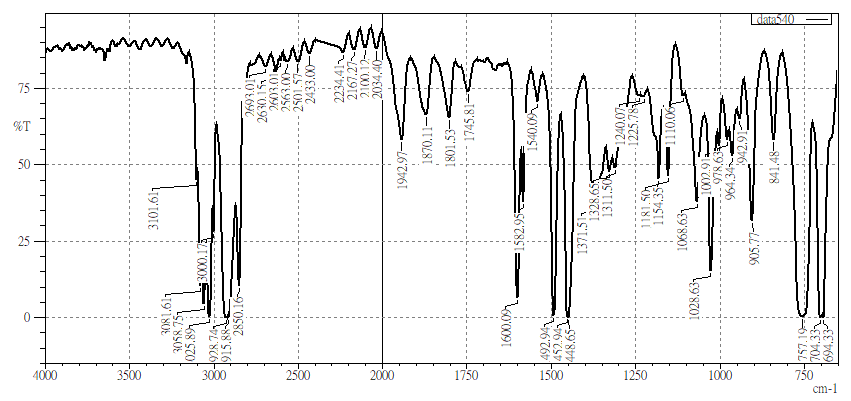
en&2