
styrenic aromatic hydrocarbon polymer
Peržiūrėkite aukščiau esančią ataskaitą. Naudokite toliau pateiktus komentarus, jei reikia tolesnės diskusijos.
styrenic aromatic hydrocarbon polymer
Mėginio ir matavimo parametrai
Identifikavimo rezultatas
0%FTIR spektras labiausiai atitinka stireninį aromatinį angliavandenilių polimerą, o artimiausias bibliotekos atitikimas yra polistirenas. Šią kryptį patvirtina aromatinių C-H tempimas netoli 3031-3081 cm-1, aromatinio žiedo juostos ties 1604 ir 1493 cm-1, stiprios iš plokštumos nutolusios aromatinės C-H juostos ties 701, 751 ir 758 cm-1 bei alifatinių C-H tempimai ties 2926 ir 2857 cm-1, kurie kartu būdingi fenil-pakeistam angliavandenilių polimerui. Tačiau bibliotekos patikimumas yra labai žemas, o jokie tiesioginiai ar literatūriniai įrodymai nepatvirtina konkretaus subjekto priskyrimo, todėl labiau pagrįsta išvada yra stireninio aromatinio angliavandenilių polimero kryptis, o ne tvirtas subjekto identifikavimas.
Išsami interpretacija
- Geriausias bibliotekos atitikmuo: Polistirenas #46662 | atitikimas 0.0%
- FTIR spektras labiausiai atitinka stireninį aromatinį angliavandenilių polimerą, o artimiausias bibliotekos atitikimas yra polistirenas. Šią kryptį patvirtina aromatinių C-H tempimas netoli 3031-3081 cm-1, aromatinio žiedo juostos ties 1604 ir 1493 cm-1, stiprios iš plokštumos nutolusios aromatinės C-H juostos ties 701, 751 ir 758 cm-1 bei alifatinių C-H tempimai ties 2926 ir 2857 cm-1, kurie kartu būdingi fenil-pakeistam angliavandenilių polimerui. Tačiau bibliotekos patikimumas yra labai žemas, o jokie tiesioginiai ar literatūriniai įrodymai nepatvirtina konkretaus subjekto priskyrimo, todėl labiau pagrįsta išvada yra stireninio aromatinio angliavandenilių polimero kryptis, o ne tvirtas subjekto identifikavimas.
- Artimiausias bibliotekos atitikimas: polistirenas, su daugybe papildomų polistireno įrašų, užimančių aukščiausias kandidatų pozicijas.
- Bendras Top-15 bibliotekos modelis: daugiausia stireniniai, aromatiniai angliavandenilių polimerų spektrai.
- Aromatinių C-H tempimas yra ties 3031, 3071 ir 3081 cm-1.
- Aromatinio žiedo virpesiai yra ties 1604 ir 1493 cm-1.
- Iš plokštumos nutolusios aromatinės C-H juostos ties 701, 751 ir 758 cm-1 patvirtina stireninį aromatinį pakeitimo modelį.
- Alifatinių C-H juostos ties 2926, 2857, 1450, 1376 ir 1360 cm-1 patvirtina angliavandenilių polimero pagrindą.
- Pagrindiniai bibliotekos kandidatai yra daugiausia polistireno įrašai, o platesnį Top-15 modelį dominuoja stireninės medžiagos.
- Mėginys rodo būdingus aromatinio žiedo požymius ties 1604 ir 1493 cm-1 kartu su aromatiniu C-H tempimu ties 3031, 3071 ir 3081 cm-1.
- Juostos ties 701, 751 ir 758 cm-1 atitinka aromatinį C-H išplokštuminį lenkimą, tikėtiną stireninės fenilo žiedo aplinkoje.
- Alifatinių C-H tempimas ties 2926 ir 2857 cm-1 patvirtina angliavandenilių polimero pagrindą.
- Pateiktame smailių sąraše nėra aiškių karbonilo, hidroksilo, nitrilo ar kitų stipriai heteroatomų turinčių funkcinių grupių, o tai išlaiko kryptį daugiausia angliavandenilių aromatinių polimerų klasėje.
- Bibliotekos atitikimo patikimumas yra nurodytas kaip žemas, todėl vien gavimas nėra pakankamai stiprus tvirtam medžiagos identifikavimui.
- Nerasta jokių literatūros atitikmenų, kurie susiaurintų priskyrimą už stireninio aromatinio polimero krypties ribų.
- Pateikti įrodymai nenustato, ar medžiaga yra grynas polistirenas, ar susijusi stireninė medžiaga, mišinys, kopolimeras ar modifikuota forma.
- Dabartiniai įrodymai patvirtina stireninę aromatinę chemiją, tačiau neleidžia patikimai atskirti polistireno nuo artimai susijusių stireninių polimerų medžiagų.
- Mažos juostos, tokios kaip 903, 1025 ir 1070 cm-1, čia nėra pakankamos, kad įrodytų konkretesnę formulę be stipresnės etaloninės paramos.
- Kadangi tiesioginės literatūros ir etaloninio patvirtinimo nėra, subjekto lygmens priskyrimas išlieka mažiau tikras nei plati cheminė kryptis.
Bibliotekų palyginimas
Bibliotekos paieškos rezultatai — 15 geriausių kandidatų
| Reitingas | Atitikimas % | Sudėtinis | SMILES | Spektro Nr. | Veiksmas |
|---|---|---|---|---|---|
| Įkeliami bibliotekos kandidatai... | |||||
Smailių analizė
★ = Literatūra pagrįstas priskyrimas| # | Bangos skaičius (cm⁻¹) | Absorbcija | Priskyrimas | Citata | Priskyrimo būsena | |
|---|---|---|---|---|---|---|
| 1 | · | 701 | 1.00 | - | - | - |
| 2 | · | 2926 | 0.92 | - | - | - |
| 3 | · | 1450 | 0.91 | - | - | - |
| 4 | · | 3031 | 0.91 | - | - | - |
| 5 | · | 751 | 0.83 | - | - | - |
| 6 | · | 758 | 0.71 | - | - | - |
| 7 | · | 1493 | 0.41 | - | - | - |
| 8 | · | 3071 | 0.37 | - | - | - |
| 9 | · | 3081 | 0.33 | - | - | - |
| 10 | · | 2857 | 0.31 | - | - | - |
| 11 | · | 1604 | 0.28 | - | - | - |
| 12 | · | 1025 | 0.20 | - | - | - |
| 13 | · | 903 | 0.14 | - | - | - |
| 14 | · | 1070 | 0.13 | - | - | - |
| 15 | · | 1360 | 0.11 | - | - | - |
| 16 | · | 1376 | 0.11 | - | - | - |
Priedas — Neapdorotas spektras

Komentarai ir tolesni įrodymai
Naudokite šią sritį interpretacijai tęsti, klausimams užduoti ar papildomiems patvirtinimo įrodymams pridėti.
The user from Taiwan (IP: 2407::) uploaded a DOCX file containing three IR spectra. Swipe up to view the qualitative analysis of the first spectrum. The user also expressed intent to calculate sample thickness using interference peaks. Based on the spectra, the analysis was performed at wave numbers 2501 and 2563, yielding an interference peak difference (V₁ - V₂) of 62 cm-1 and ΔN = 1. By inputting the film's refractive index(n), the sample thickness (d) was determined.Here is the original spectrum of the sample extracted from the DOCX file.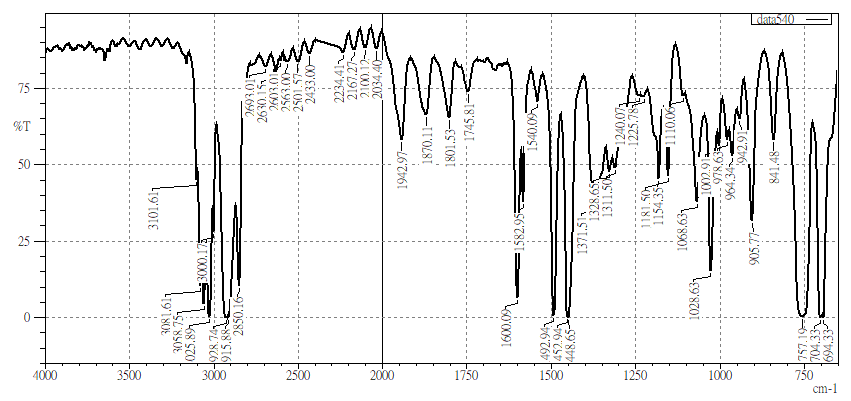
en&2