
low-confidence oxygenated aliphatic material, possibly a simple alcohol or alcohol-containing mixture
Consultez le rapport ci-dessus. Utilisez les commentaires ci-dessous si vous avez besoin d'une discussion de suivi.
low-confidence oxygenated aliphatic material, possibly a simple alcohol or alcohol-containing mixture
Paramètres d'échantillon et de mesure
Résultat d'identification
0%Le profil FTIR actuel ne supporte pas une identification ferme de matériau à partir de la recherche dans la bibliothèque. Bien que l'entrée la plus proche de la bibliothèque soit le méthanol, la confiance de récupération est effectivement nulle et l'ensemble plus large des 15 meilleurs candidats est chimiquement incohérent. Le spectre observé est plus prudemment décrit comme un matériau aliphatique oxygéné de faible confiance, possiblement un alcool simple ou un mélange contenant de l'alcool, basé sur une bande d'étirement O-H près de 3363 cm-1, des absorptions fortes dans la région C-O à 1020-1081 cm-1, et un étirement C-H aliphatique près de 2980 cm-1. Une bande près de 1652 cm-1 suggère soit de l'eau absorbée, des effets de liaison hydrogène, ou une contribution insaturée ou liée à une impureté supplémentaire, ce qui empêche une assignation étroite
Interprétation détaillée
- Meilleure correspondance de bibliothèque: méthanol #52315 | match 0.0%
- Le profil FTIR actuel ne supporte pas une identification ferme de matériau à partir de la recherche dans la bibliothèque. Bien que l'entrée la plus proche de la bibliothèque soit le méthanol, la confiance de récupération est effectivement nulle et l'ensemble plus large des 15 meilleurs candidats est chimiquement incohérent. Le spectre observé est plus prudemment décrit comme un matériau aliphatique oxygéné de faible confiance, possiblement un alcool simple ou un mélange contenant de l'alcool, basé sur une bande d'étirement O-H près de 3363 cm-1, des absorptions fortes dans la région C-O à 1020-1081 cm-1, et un étirement C-H aliphatique près de 2980 cm-1. Une bande près de 1652 cm-1 suggère soit de l'eau absorbée, des effets de liaison hydrogène, ou une contribution insaturée ou liée à une impureté supplémentaire, ce qui empêche une assignation étroite.
- 3363 cm-1 soutient la présence d'un composant contenant un hydroxyle.
- 1020-1081 cm-1 soutient l'étirement C-O attendu pour les alcools ou les aliphatiques oxygénés apparentés.
- 2980 cm-1 et 1385 cm-1 soutiennent le caractère hydrocarbure aliphatique.
- Plusieurs des 15 meilleurs candidats contiennent de petits motifs aliphatiques oxygénés tels que des groupes alcool ou alcoxy, ce qui est globalement cohérent avec les bandes O-H et C-O observées.
- L'échantillon montre une large bande d'étirement O-H à 3363 cm-1 cohérente avec un alcool ou un autre matériau contenant un hydroxyle.
- Les bandes à 1020, 1037, 1061 et 1081 cm-1 soutiennent l'étirement C-O dans une substance aliphatique oxygénée.
- La bande à 2980 cm-1 est cohérente avec l'étirement C-H aliphatique.
- Un pic à 1385 cm-1 est compatible avec la déformation C-H alkyle.
- La bande à 1652 cm-1 n'est pas suffisante en elle-même pour définir un composé spécifique et peut refléter de l'eau, une liaison hydrogène ou un autre composant mineur.
- Le résultat de la bibliothèque n'est pas chimiquement sûr car la meilleure correspondance et tous les autres principaux candidats ont une similarité nulle et ne forment pas un motif cohérent de matériau unique.
- L'assignation principale de la bibliothèque au méthanol n'est pas directement fiable car son score de similarité est nul.
- Les 15 meilleurs candidats sont chimiquement mélangés, incluant des hydrocarbures chlorés, des composés phosphorés, du fluorosilane, des hydrocarbures et des structures de type alcool, donc la récupération ne converge pas vers une substance défendable.
- Le spectre ne fournit pas de support clair pour plusieurs fonctionnalités impliquées par d'autres candidats principaux, telles que des assignations fortes de polymères halogénés ou spécifiques au phosphore.
- La bande à 1652 cm-1 reste ambiguë et pourrait indiquer de l'humidité, une liaison hydrogène ou un composant supplémentaire.
- Sans une qualité de correspondance plus forte ou des preuves de référence corroborantes, l'échantillon ne peut pas être réduit de manière sûre à une identification unique au niveau de l'entité.
- Les preuves actuelles ne distinguent pas bien entre un petit alcool pur, une formulation contenant de l'alcool, ou un échantillon aliphatique oxygéné mélangé.
Comparaison de bibliothèques
Résultats de recherche dans la bibliothèque — Top 15 des candidats
| Rang | Correspondance % | Composé | SMILES | N° de spectre | Action |
|---|---|---|---|---|---|
| Chargement des candidats de la bibliothèque... | |||||
Analyse des pics
★ = Attribution soutenue par la littératureAnnexe — Spectre brut

Commentaires et preuves de suivi
Utilisez cette zone pour poursuivre l'interprétation, poser des questions ou ajouter des preuves de vérification supplémentaires.
This is the FTIR analysis result of a pdf file uploaded by a user with IP 121.xx.xx.21 The original image is shown below.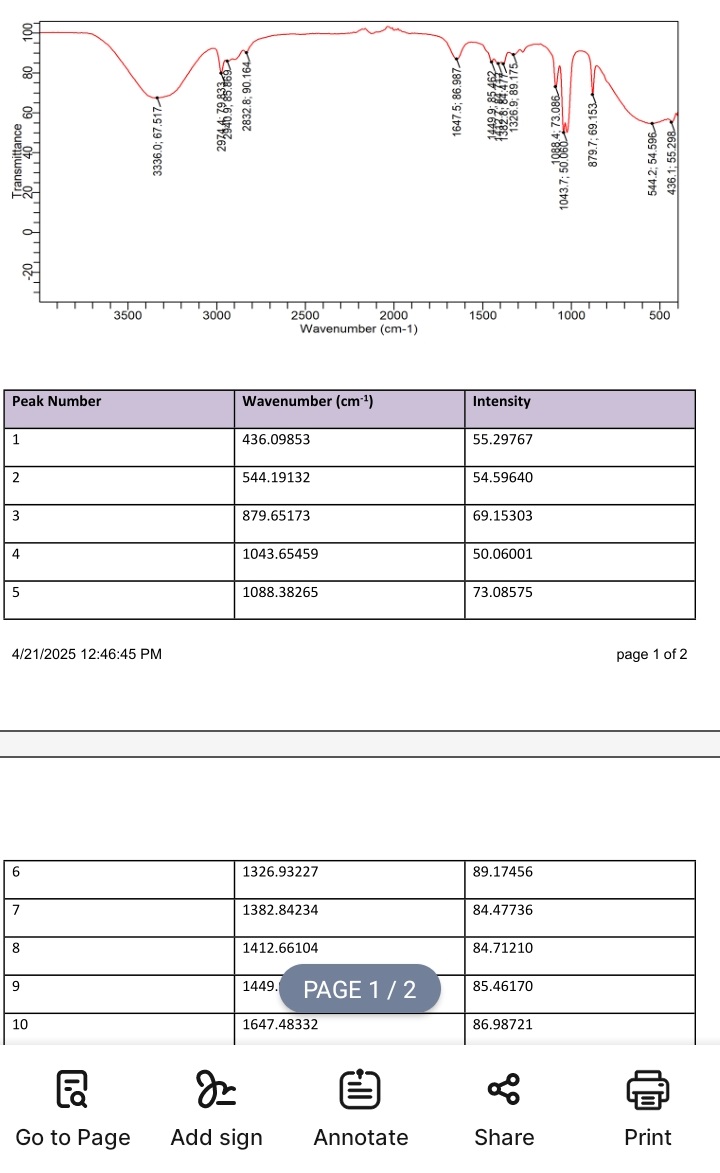
en&2