
low-confidence oxygenated aliphatic material, possibly a simple alcohol or alcohol-containing mixture
Peak assignment, library matching and the evidence behind the conclusion.
low-confidence oxygenated aliphatic material, possibly a simple alcohol or alcohol-containing mixture
Sample & Measurement Parameters
Interpretation summary
0%The present FTIR pattern does not support a firm material identification from the library search. Although the nearest library entry is methanol, the retrieval confidence is effectively zero and the broader Top-15 set is chemically inconsistent. The observed spectrum is more safely described as a low-confidence oxygenated aliphatic material, possibly a simple alcohol or alcohol-containing mixture, based on an O-H stretching band near 3363 cm-1, strong C-O region absorptions at 1020-1081 cm-1, and aliphatic C-H stretching near 2980 cm-1. A band near 1652 cm-1 suggests either absorbed water, hydrogen-bonding effects, or an additional unsaturated or impurity-related contribution, which prevents a narrow assignment
Detailed interpretation
- Top library match: methanol #52315
- The leading library assignment to methanol is not directly reliable because its similarity score is zero.
- The Top-15 candidates are chemically mixed, including chlorinated hydrocarbons, phosphorus compounds, fluorosilane, hydrocarbon, and alcohol-like structures, S-O the retrieval does not converge on one defensible substance.
- The spectrum does not provide clear support for several functionalities implied by other top candidates, such as strong halogenated-polymer or phosphorus-specific assignments.
- The 1652 cm-1 band remains ambiguous and could indicate moisture, hydrogen bonding, or an additional component.
- Without stronger match quality or corroborating reference evidence, the sample cannot be safely reduced to a single entity-level identification.
- The current evidence does not distinguish well between a neat small alcohol, an alcohol-containing formulation, or a mixed oxygenated aliphatic sample.
Retrieved reference candidates
Library Search Results — Top 15 Candidates
| Rank | Match % | Compound | SMILES | Spectrum No. | Action |
|---|---|---|---|---|---|
| Loading library candidates... | |||||
Peak Analysis
★ = Literature-supported assignmentAppendix — Raw Spectrum

Comments and follow-up evidence
Use this area to continue the interpretation, ask questions, or add extra verification evidence.
This is the FTIR analysis result of a pdf file uploaded by a user with IP 121.xx.xx.21 The original image is shown below.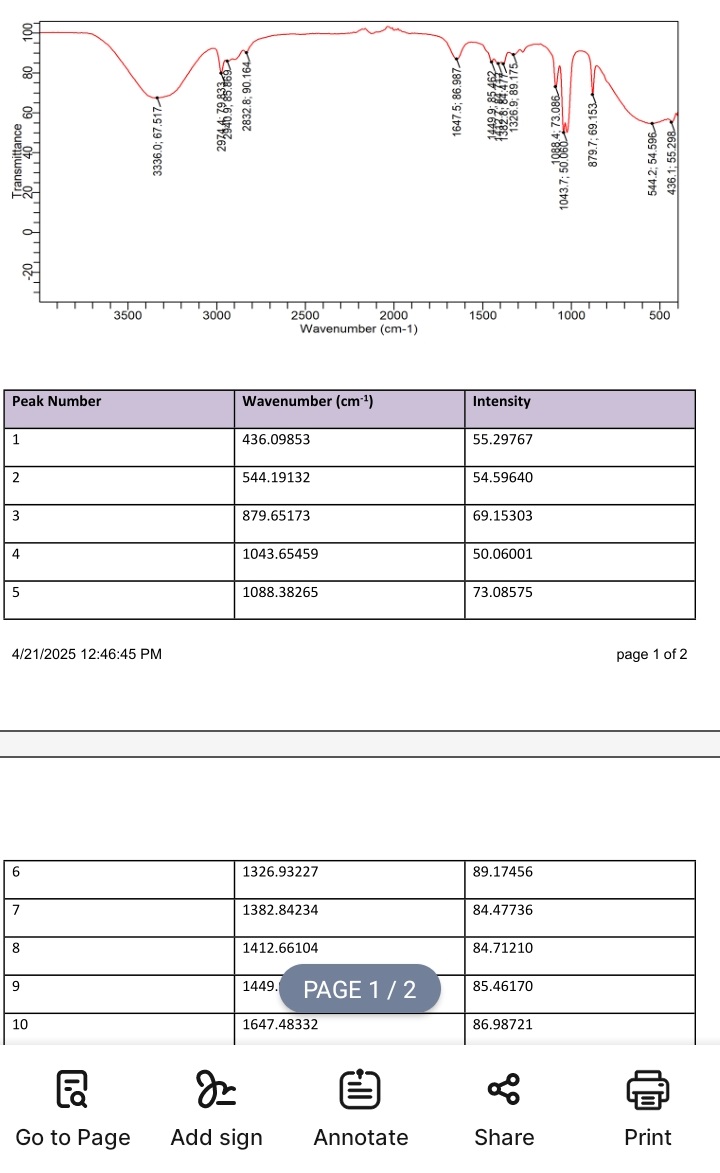
en&2