
PUBLIC SPECTRUM SEARCH
Poly(ethylenimine),epichlorohydrin modified
Free public result — the submitted spectrum with its top library candidates, not an AI identification.
SPECTRUM & LIBRARY MATCHES
Submitted spectrum and top library candidates

Top 15 library matches
| # | Reference | CAS | Similarity |
|---|---|---|---|
| 1 | Poly(ethylenimine),epichlorohydrin modified | 0-00-0 | - |
| 2 | Poly(ethylenimine) | 0-00-0 | - |
| 3 | butane-1,2,3,4-tetrol | 6968-16-7 | - |
| 4 | Trizinc diphosphate | 7779-90-0 | - |
| 5 | cyclohexane-1,3,5-triol | 2041-15-8 | - |
| 6 | N-prop-2-enylprop-2-en-1-amine | 124-02-7 | - |
| 7 | Laminarin | none | - |
| 8 | sodium 7-phenyl-5-[(4-sulfonatophenyl)amino]benzo[c]phenazin-7-ium-6-sulfonate | 25641-18-3 | - |
| 9 | Poly(caprolactone)triol | 0-00-0 | - |
| 10 | Poly(dimethylamine:epichlorohydrin) | 0-00-0 | - |
| 11 | Poly(vinylbenzylammonium chloride) | 0-00-0 | - |
| 12 | disodium 5-[4-[[3-methyl-5-oxo-1-(4-sulfonatophenyl)-4H-pyrazol-4-yl]diazenyl]phenyl]-2-[4-(4-methylphenyl)sulfonyloxyphenyl]diazenylbenzenesulfonate | 15792-50-4 | - |
| 13 | (7-amino-8-methylphenothiazin-3-ylidene)-dimethylazanium chloride | 92-31-9 | - |
| 14 | (7-amino-8-methylphenothiazin-3-ylidene)-dimethylazanium chloride | 92-31-9 | - |
| 15 | Poly(oxothioxoquinazoline succinamide) | none | - |
Discussion
Comments and follow-up evidence
Use this area to continue the interpretation, ask questions, or add extra verification evidence.
This is the FTIR analysis result of a TIFF file uploaded by a user with IP156.xx.xx.163 The original image is shown below.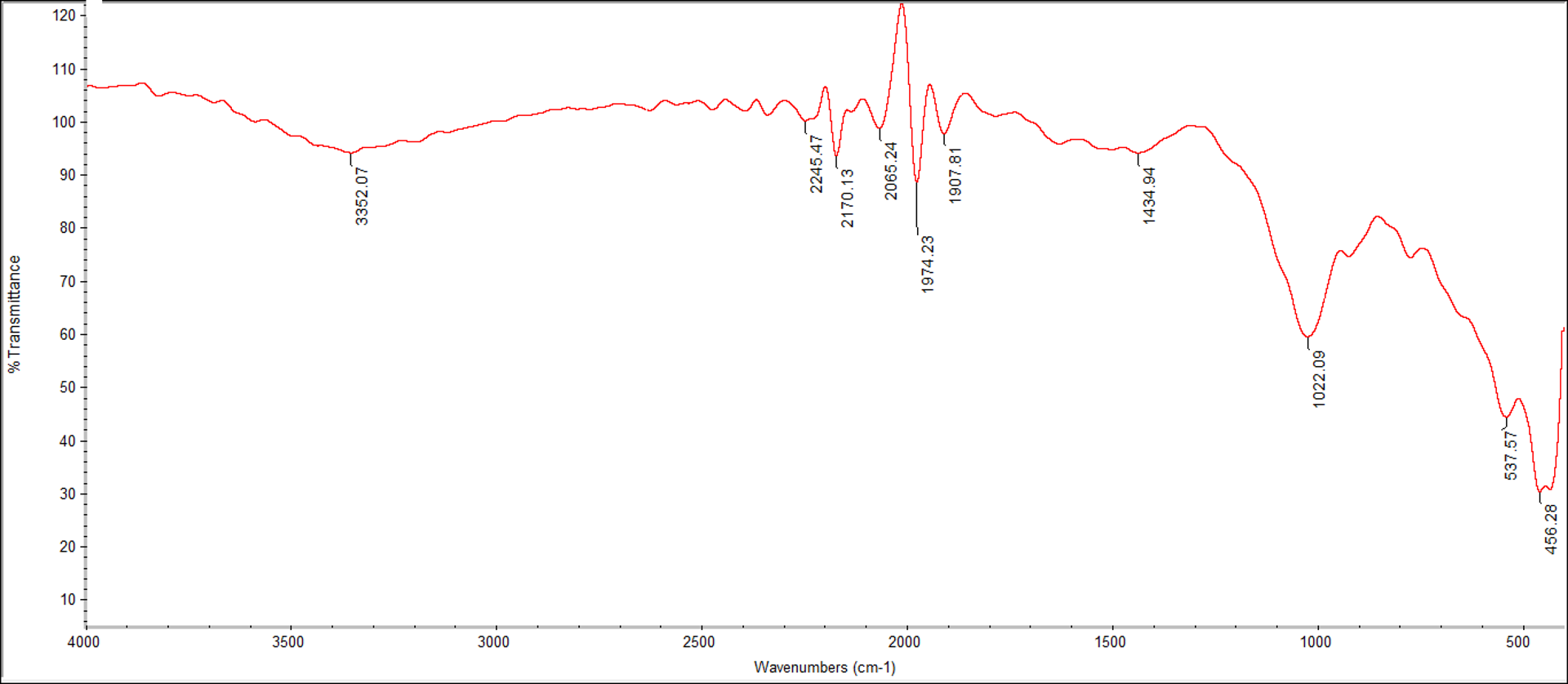
en&2