
PUBLIC SPECTRUM SEARCH
calcium;magnesium;dicarbonate
Free public result — the submitted spectrum with its top library candidates, not an AI identification.
SPECTRUM & LIBRARY MATCHES
Submitted spectrum and top library candidates

Top 15 library matches
| # | Reference | CAS | Similarity |
|---|---|---|---|
| 1 | calcium;magnesium;dicarbonate | 16389-88-1 | - |
| 2 | 1,2,4,5-tetradeuterio-3,6-difluorobenzene | 1423-09-2 | - |
| 3 | Ethyl 1-methylpiperidine-3-carboxylate | 5166-67-6 | - |
| 4 | Acetonitrile | 75-05-8 | - |
| 5 | 2,3,5,6-Tetramethylpyrazine | 1124-11-4 | - |
| 6 | (C70-D5h(6))[5,6]fullerene | 115383-22-7 | - |
| 7 | Butanedinitrile | 110-61-2 | - |
| 8 | Butanedinitrile | 110-61-2 | - |
| 9 | Triethoxy-ethylsilane | 78-07-9 | - |
| 10 | 3,5-DICHLORO-2,4,6-TRIFLUOROPYRIDINE | 1737-93-5 | - |
| 11 | 3,5-DICHLORO-2,4,6-TRIFLUOROPYRIDINE | 1737-93-5 | - |
| 12 | Sulfuryl dichloride | 7791-25-5 | - |
| 13 | Sulfuryl dichloride | 7791-25-5 | - |
| 14 | Poly(2,6-dibromo-1,4-phenylene ether) | none | - |
| 15 | 1,2,4-trichloro-5-(2,4,5-trichlorophenyl)disulfanylbenzene | 3808-87-5 | - |
Discussion
Comments and follow-up evidence
Use this area to continue the interpretation, ask questions, or add extra verification evidence.
This is the FTIR analysis result of a pdf file uploaded by a user with IP 2409::: The original image is shown below.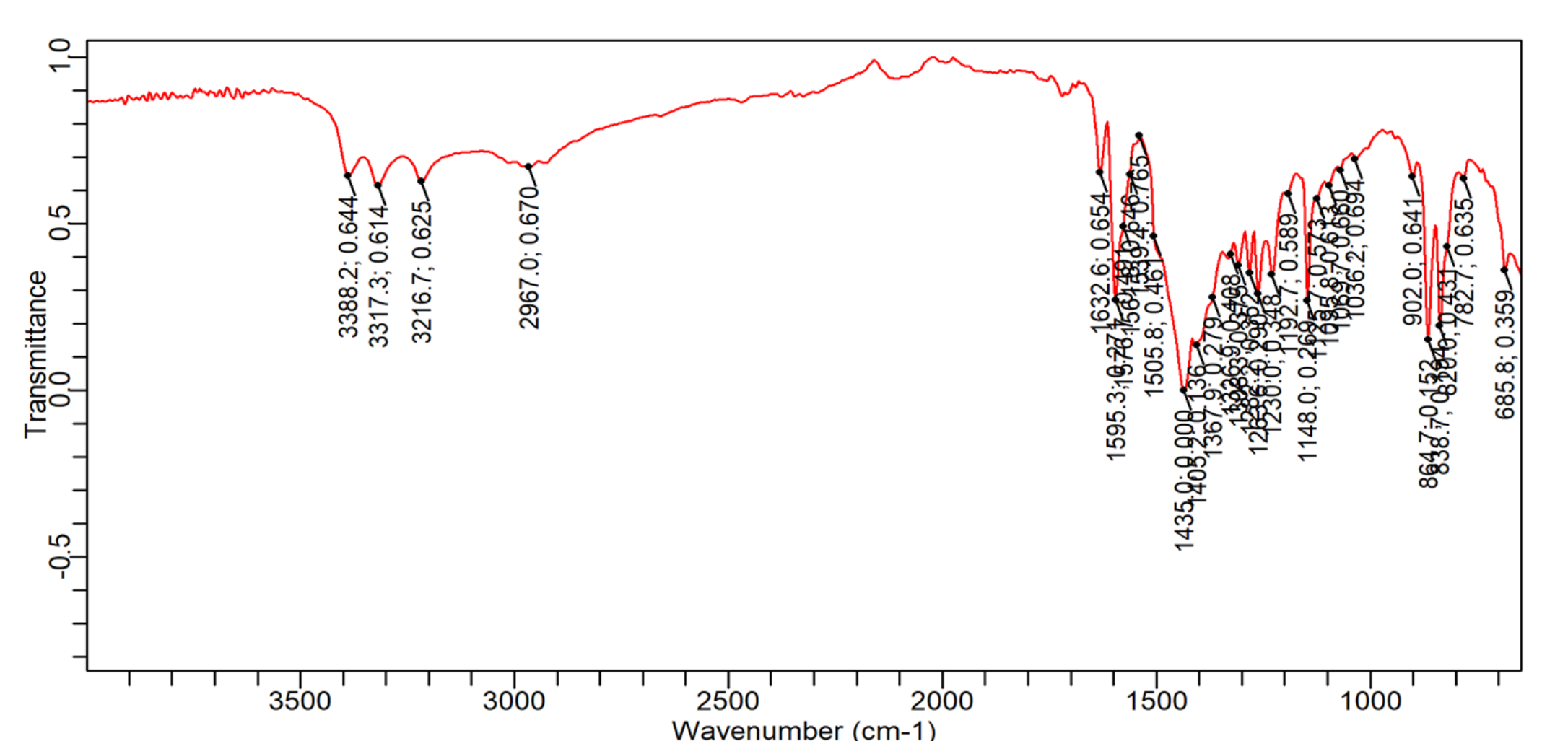
en&2