
oxygenated hydrocarbon material with aliphatic C-H and hydroxyl/carbonyl functionality, possibly including a vinyl chloride-containing polymer component
Sehen Sie sich den Bericht oben an. Nutzen Sie die Kommentare unten, wenn Sie eine Folgediskussion benötigen.
oxygenated hydrocarbon material with aliphatic C-H and hydroxyl/carbonyl functionality, possibly including a vinyl chloride-containing polymer component
Proben- und Messparameter
Identifikationsergebnis
0%Die nächste Übereinstimmung in der Bibliothek ist POLYVINYL CHLORIDE, aber die Übereinstimmungsqualität ist sehr schwach und nicht ausreichend für eine sichere Materialidentifikation. Das beobachtete Spektrum wird besser als oxygeniertes organisches Material mit aliphatischen C-H-Banden, einer starken Carbonylbande und mehreren O-H-Merkmalen beschrieben, mit einer gewissen geringen Konsistenz mit vinylchloridhaltigen Bibliothekseinträgen, aber ohne ausreichende charakteristische Unterstützung zur Bestätigung von PVC selbst.
Detailinterpretation
- Beste Bibliotheksübereinstimmung: POLYVINYL CHLORIDE #7953 | Übereinstimmung 0.0%
- Die nächste Übereinstimmung in der Bibliothek ist POLYVINYL CHLORIDE, aber die Übereinstimmungsqualität ist sehr schwach und nicht ausreichend für eine sichere Materialidentifikation. Das beobachtete Spektrum wird besser als oxygeniertes organisches Material mit aliphatischen C-H-Banden, einer starken Carbonylbande und mehreren O-H-Merkmalen beschrieben, mit einer gewissen geringen Konsistenz mit vinylchloridhaltigen Bibliothekseinträgen, aber ohne ausreichende charakteristische Unterstützung zur Bestätigung von PVC selbst.
- Nächste Bibliotheksbezeichnung: POLYVINYL CHLORIDE.
- Mehrere führende Kandidaten umfassen vinylchloridhaltige Polymere, was auf eine gewisse Musterähnlichkeit mit dieser Bibliotheksregion hindeutet.
- Beobachtete aliphatische C-H-Banden bei 2852, 2922 und 2955 cm-1 sind mit polymeren oder weichgemachten organischen Materialien vereinbar.
- Der Cluster im Fingerprint-Bereich bei 1005-1271 cm-1 unterstützt sauerstoffhaltige Funktionalität, was mit mehreren oxygenierten Co-Polymer- oder additivehaltigen Bibliothekskandidaten übereinstimmt.
- Die Probe zeigt aliphatische C-H-Streckschwingungsbanden bei 2852, 2922 und 2955 cm-1, was mit einem organischen Kohlenwasserstoffgerüst oder Substituenten übereinstimmt.
- Eine starke Bande bei 1727 cm-1 unterstützt das Vorhandensein einer carbonylhaltigen Komponente, was für unmodifiziertes PVC als alleiniges Material nicht erwartet wird.
- Banden bei 3439, 3527, 3619 und 3695 cm-1 deuten auf hydroxylhaltige Spezies oder adsorbiertes/assoziiertes O-H hin, was erneut einen oxygenierten Materialbeitrag begünstigt.
- Banden bei 1005, 1032, 1073, 1120 und 1271 cm-1 sind konsistent mit C-O- oder verwandten Fingerprint-Bereichsabsorptionen, die häufig in oxygenierten Organika oder Polymeradditiven beobachtet werden.
- Das Top-15-Muster der Bibliothek umfasst Einträge vom Typ PVC und Vinylchlorid/Vinylacetat/Vinylalkohol, was darauf hindeutet, dass eine chlorierte Vinylpolymerfamilie eine mögliche Richtung ist, aber die Gesamt-Retrieval-Konfidenz ist niedrig und nicht exklusiv.
- Alle berichteten Bibliotheksähnlichkeiten sind praktisch null, daher liefert das Retrieval keine starke Identifikationskraft.
- Das Spektrum enthält eine klare Carbonylbande bei 1727 cm-1, was gegen die Zuordnung von reinem PVC als alleinigem Material spricht.
- Starke O-H-Merkmale bei 3439-3695 cm-1 sind keine ausreichende Unterstützung für eine einfache PVC-Zuordnung und deuten auf zusätzlichen oxygenierten Gehalt, Oberflächenkontamination, Additivbeitrag oder eine andere Materialklasse hin.
- Es bleibt unklar, ob die oxygenierten Banden von einem Copolymer, einem Weichmacher/Additiv-Paket, Abbauprodukten oder Oberflächenkontamination stammen.
- Die vorliegenden Beweise etablieren keine sicher genug chlorhaltigen Banden, um PVC zu bestätigen.
- Da keine direkte Literaturübereinstimmung gefunden wurde, sollte die aktuelle Schlussfolgerung auf einer breiten Materialrichtungsebene und nicht auf einer Entitätsbehauptung bleiben.
Bibliotheksvergleich
Bibliothekssuchergebnisse – Top 15 Kandidaten
| Rang | Übereinstimmung % | Zusammensetzung | SMILES | Spektrum-Nr. | Aktion |
|---|---|---|---|---|---|
| Bibliothekskandidaten werden geladen... | |||||
Peak-Analyse
★ = Literaturgestützte Zuordnung| # | Wellenzahl (cm⁻¹) | Absorbanz | Zuordnung | Zitat | Zuordnungsstatus | |
|---|---|---|---|---|---|---|
| 1 | · | 1727 | 1.00 | - | - | - |
| 2 | · | 1425 | 0.95 | - | - | - |
| 3 | · | 2922 | 0.92 | - | - | - |
| 4 | · | 1271 | 0.84 | - | - | - |
| 5 | · | 1120 | 0.65 | - | - | - |
| 6 | · | 2955 | 0.64 | - | - | - |
| 7 | · | 872 | 0.55 | - | - | - |
| 8 | · | 2852 | 0.54 | - | - | - |
| 9 | · | 1005 | 0.50 | - | - | - |
| 10 | · | 952 | 0.46 | - | - | - |
| 11 | · | 741 | 0.45 | - | - | - |
| 12 | · | 1032 | 0.43 | - | - | - |
| 13 | · | 1073 | 0.37 | - | - | - |
| 14 | · | 690 | 0.27 | - | - | - |
| 15 | · | 800 | 0.25 | - | - | - |
| 16 | · | 832 | 0.22 | - | - | - |
| 17 | · | 3695 | 0.20 | - | - | - |
| 18 | · | 1634 | 0.17 | - | - | - |
| 19 | · | 1579 | 0.14 | - | - | - |
| 20 | · | 2117 | 0.13 | - | - | - |
| 21 | · | 3619 | 0.13 | - | - | - |
| 22 | · | 3439 | 0.12 | - | - | - |
| 23 | · | 3527 | 0.12 | - | - | - |
| 24 | · | 3074 | 0.12 | - | - | - |
| 25 | · | 2670 | 0.11 | - | - | - |
| 26 | · | 2325 | 0.10 | - | - | - |
Anhang – Rohspektrum

Kommentare und Folgebeweise
Nutzen Sie diesen Bereich, um die Interpretation fortzusetzen, Fragen zu stellen oder zusätzliche Überprüfungsbeweise hinzuzufügen.
This is the FTIR analysis result of a .dx file uploaded by a user with IP 191.XX.XXX.255 The original image is shown below.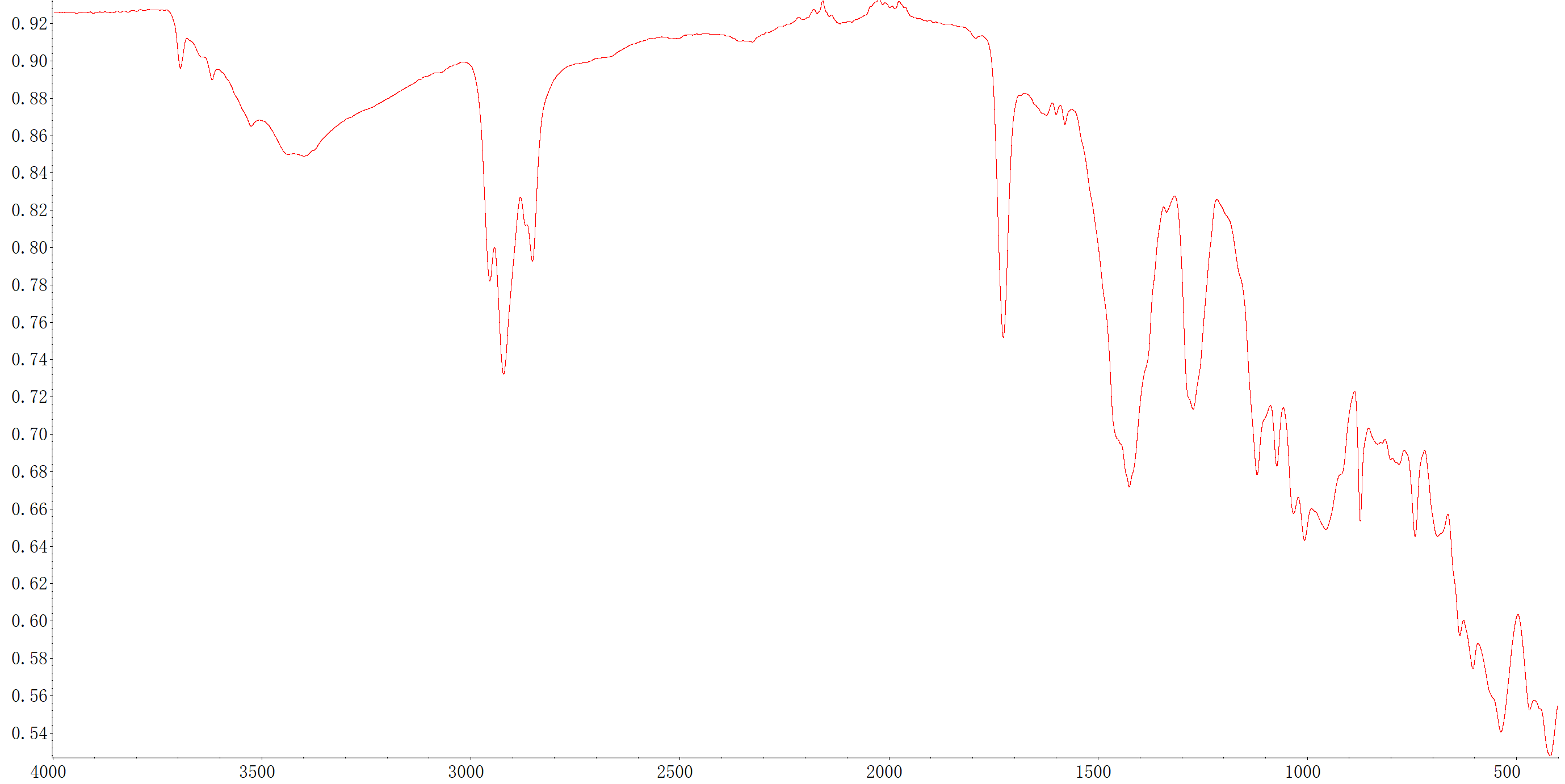
en&2