RESULT PAGE

heteroatom-containing aromatic organic compound

View the report above. Use the comments below if you need follow-up discussion.

Result No.: 20250408125047391800850 Owner: Admin Comments: 1
FTIR Analysis Report

heteroatom-containing aromatic organic compound

Sample & Measurement Parameters

Report No. 20250408125047391800850
Date 2025-04-08 12:17:48
Spectral Range (cm⁻¹) [(650, 4000)]
Baseline AsLS baseline correction
Library match 0%

Identification Result

0%

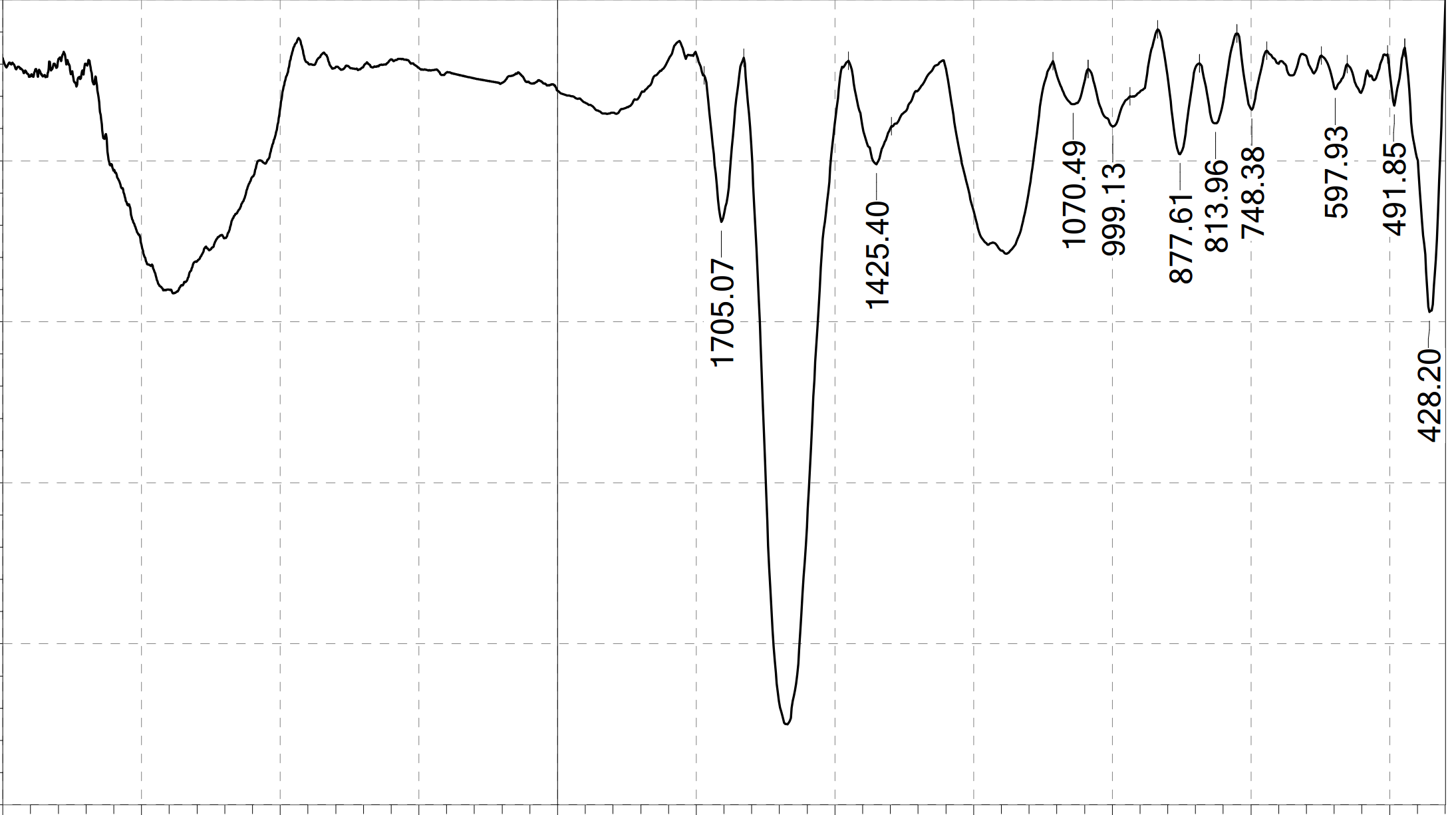
The present FTIR result does not support a firm compound-level identification. The library top hit is 5,6,8-trihydroxy-7-methylnaphthalene-1,4-dione, but all reported library similarities are 0.000 and the sample contains only a single observed band at 1584 cm-1. That band is compatible with a general aromatic ring or conjugated heteroatom-containing organic structure, but it is not sufficient to confirm the specific quinone-like top candidate or the alternative nitrogen-, nitro-, sulfur-, or halogen-containing candidates appearing in the broader library pattern. The most chemically supportable conclusion is therefore a broad heteroatom-containing aromatic organic compound

Detailed interpretation

  • Top library match: 5,6,8-trihydroxy-7-methylnaphthalene-1,4-dione #51997
  • No characteristic carbonyl, hydroxyl, nitro, C-halogen, sulfur-oxygen, or clearly resolved nitrogen-containing bands are reported to support the more specific functional groups implied by the top candidates.
  • The library consensus wording includes sulfur-oxygen and nitrogen heterocycle character, but the sample evidence does not independently show bands needed to substantiate those assignments.
  • A single band at 1584 cm-1 cannot distinguish among aromatic hydrocarbons, quinones, heteroaromatics, or other conjugated organics.
  • No related-literature match was recovered to reinforce a specific compound or class.
  • The absence of additional reported peaks leaves the presence and identity of heteroatom functional groups uncertain.

Recommended next steps: Acquire a full FTIR spectrum over the standard mid-IR range and confirm whether characteristic bands for C=O, O-H, N-O, C-N, C-S, or C-halogen groups are present. Inspect the 1800-600 cm-1 region for distinguishing bands that could separate quinone-like aromatics from nitrogen heterocycles or nitro-containing compounds. If the sample amount allows, use Raman or GC-MS/LC-MS to determine whether the material is a discrete aromatic molecule rather than a mixed or weakly absorbing residue. If a quinone-like assignment is still suspected after obtaining a fuller spectrum, specifically check for strong conjugated carbonyl bands and broad phenolic O-H absorption.

Library Comparison

Match group:
Library spectrum will appear here.

Library Search Results — Top 15 Candidates

Rank Match % Compound SMILES Spectrum No. Action
Loading library candidates...

Peak Analysis

★ = Literature-supported assignment
# Wavenumber (cm⁻¹) Absorbance Assignment Citation Assignment status
1 · 1584 1.00 - - -

Appendix — Raw Spectrum

Raw sample spectrum
Generated by FTIR.fun — Report #20250408125047391800850 2025-04-08 12:17:48
Discussion

Comments and follow-up evidence

Use this area to continue the interpretation, ask questions, or add extra verification evidence.

This is the FTIR analysis result of a pdf file uploaded by a user with IP 103.XX.XXX.194 The original image is shown below.QQ截图20250408194446.png
en&2
Submit Requirement Form