RESULT PAGE

carbonyl-containing organic compound with alkyl C-H and possible O-H or N-H functionality

View the report above. Use the comments below if you need follow-up discussion.

Result No.: 20250327085033386765648 Owner: publicuser Comments: 1
FTIR Analysis Report

carbonyl-containing organic compound with alkyl C-H and possible O-H or N-H functionality

Sample & Measurement Parameters

Report No. 20250327085033386765648
Date 2025-03-27 07:14:27
Spectral Range (cm⁻¹) [(650, 4000)]
Baseline AsLS baseline correction
Library match 0%

Identification Result

0%

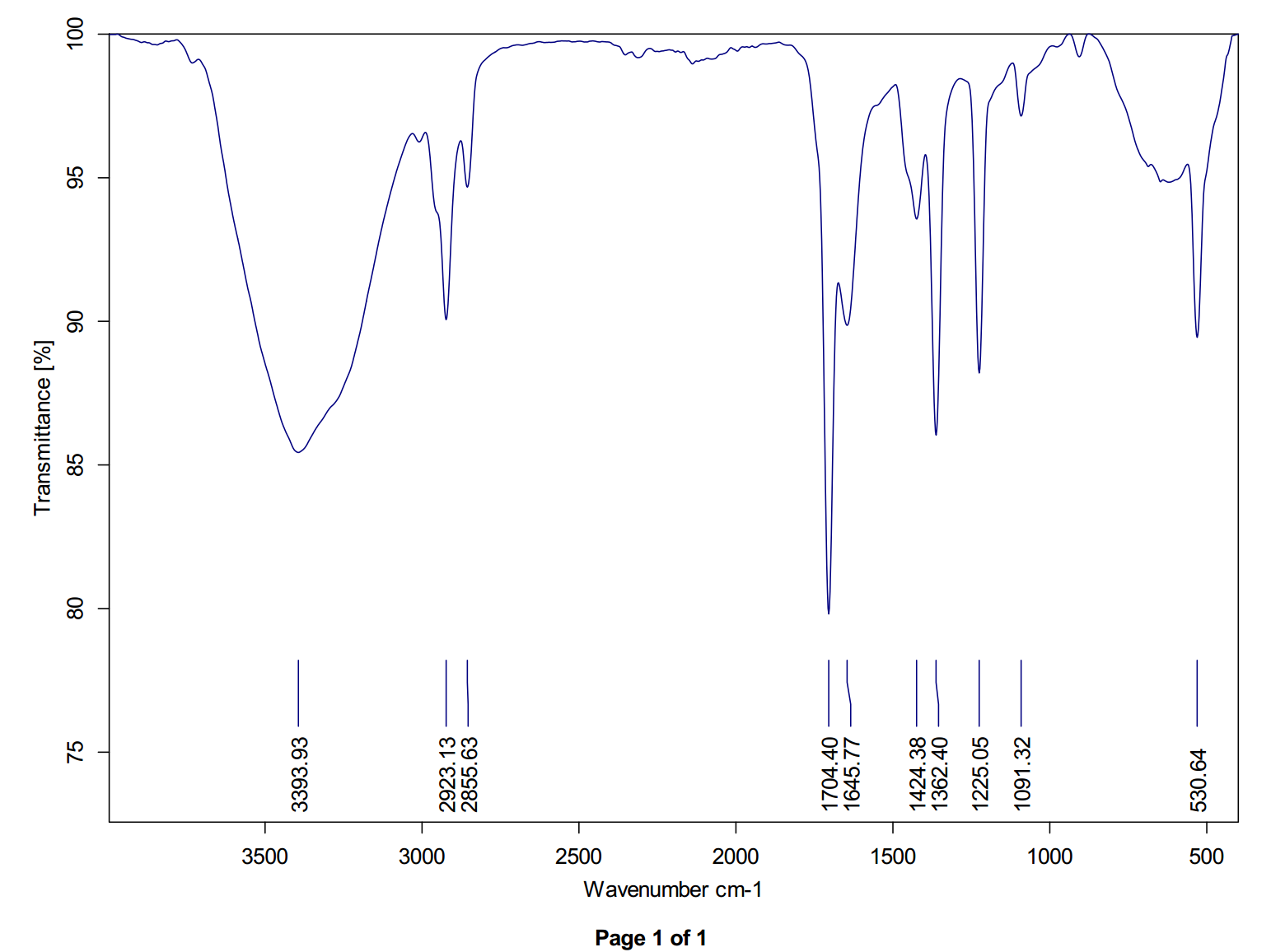
The FTIR evidence does not support a firm assignment to the library top hit, (2E,4E)-Dodeca-2,4-dienal. The observed bands are more safely interpreted as a broadly carbonyl-containing organic material showing alkyl C-H absorption and an additional polar X-H band consistent with possible O-H or N-H functionality. Because the library match quality is effectively absent and no direct or related literature evidence narrows the result, the chemically supportable conclusion is a broad material direction rather than a specific compound identification

Detailed interpretation

  • Top library match: (2E,4E)-Dodeca-2,4-dienal #51034
  • The top library hit has zero similarity support, S-O it cannot be treated as a reliable identification.
  • A clear 3399 cm-1 X-H band limits confidence in assigning the sample to a simple aldehyde such as (2E,4E)-Dodeca-2,4-dienal without additional corroborating aldehyde features.
  • The Top-15 library set includes aldehydes, ketones, esters, and amide-like compounds, S-O the retrieval pattern is too inconsistent for a narrow material call.
  • The 3399 cm-1 band could arise from O-H, N-H, or absorbed moisture, and that distinction is not resolved from the present data alone.
  • The carbonyl type cannot be securely separated among aldehyde, ketone, ester, amide, or related classes from the current peak set.
  • No identifying aldehyde C-H pair or other distinguishing bands were provided to justify the specific library candidate.

Recommended next steps: Recollect the FTIR spectrum with attention to baseline and moisture control to test whether the 3399 cm-1 band is intrinsic to the sample. Inspect the 2800-2750 cm-1 region for aldehyde C-H bands; their presence or absence would directly test the aldehyde suggestion from the top library hit. Examine the 1300-1000 cm-1 region at higher spectral quality to distinguish whether the 1223 cm-1 band is more consistent with C-O or C-N bonding. If available, use complementary GC-MS or LC-MS to determine whether the sample is a discrete small molecule rather than a mixed or contaminated carbonyl-containing material.

Library Comparison

Match group:
Library spectrum will appear here.

Library Search Results — Top 15 Candidates

Rank Match % Compound SMILES Spectrum No. Action
Loading library candidates...

Peak Analysis

★ = Literature-supported assignment
# Wavenumber (cm⁻¹) Absorbance Assignment Citation Assignment status
1 · 1704 1.00 - - -
2 · 3399 0.20 - - -
3 · 1362 0.18 - - -
4 · 1223 0.14 - - -
5 · 2925 0.11 - - -

Appendix — Raw Spectrum

Raw sample spectrum
Generated by FTIR.fun — Report #20250327085033386765648 2025-03-27 07:14:27
Discussion

Comments and follow-up evidence

Use this area to continue the interpretation, ask questions, or add extra verification evidence.

This is the FTIR analysis result of a pdf file uploaded by a user with IP 49.XX.XXX.110 The original image is shown below.20250327151544.png
en&2
Submit Requirement Form