
PUBLIC SPECTRUM SEARCH
1,2-Bis(dibromomethyl)benzene
Free public result — the submitted spectrum with its top library candidates, not an AI identification.
SPECTRUM & LIBRARY MATCHES
Submitted spectrum and top library candidates

Top 15 library matches
| # | Reference | CAS | Similarity |
|---|---|---|---|
| 1 | 1,2-Bis(dibromomethyl)benzene | 13209-15-9 | - |
| 2 | benzyl-decyl-dimethylazanium chloride | 63449-41-2 | - |
| 3 | iodyl iodate | 12029-98-0 | - |
| 4 | Tetrabromomethane | 558-13-4 | - |
| 5 | 1,4-Bis(chloromethyl)benzene | 623-25-6 | - |
| 6 | 1,1,1,2,2-Pentabromoethane | 75-95-6 | - |
| 7 | Bromoform | 75-25-2 | - |
| 8 | hex-5-ynenitrile | 14918-21-9 | - |
| 9 | Poly(styrene-co allyl alcohol) | 25119-62-4 | - |
| 10 | Poly(styrene-co allyl alcohol) | 25119-62-4 | - |
| 11 | Poly(2-acrylamido-2-methylpropanezulfonic acid:styrene) | 0-00-0 | - |
| 12 | Poly(vinylbenzyl chloride) | 0-00-0 | - |
| 13 | 6-nonyloxan-2-one | 2721-22-4 | - |
| 14 | 3-prop-2-ynoxyprop-1-yne | 6921-27-3 | - |
| 15 | none | none | - |
Discussion
Comments and follow-up evidence
Use this area to continue the interpretation, ask questions, or add extra verification evidence.
This is the FTIR analysis result of a png file uploaded by a user with IP 122.XX.XXX.114 The original image is shown below.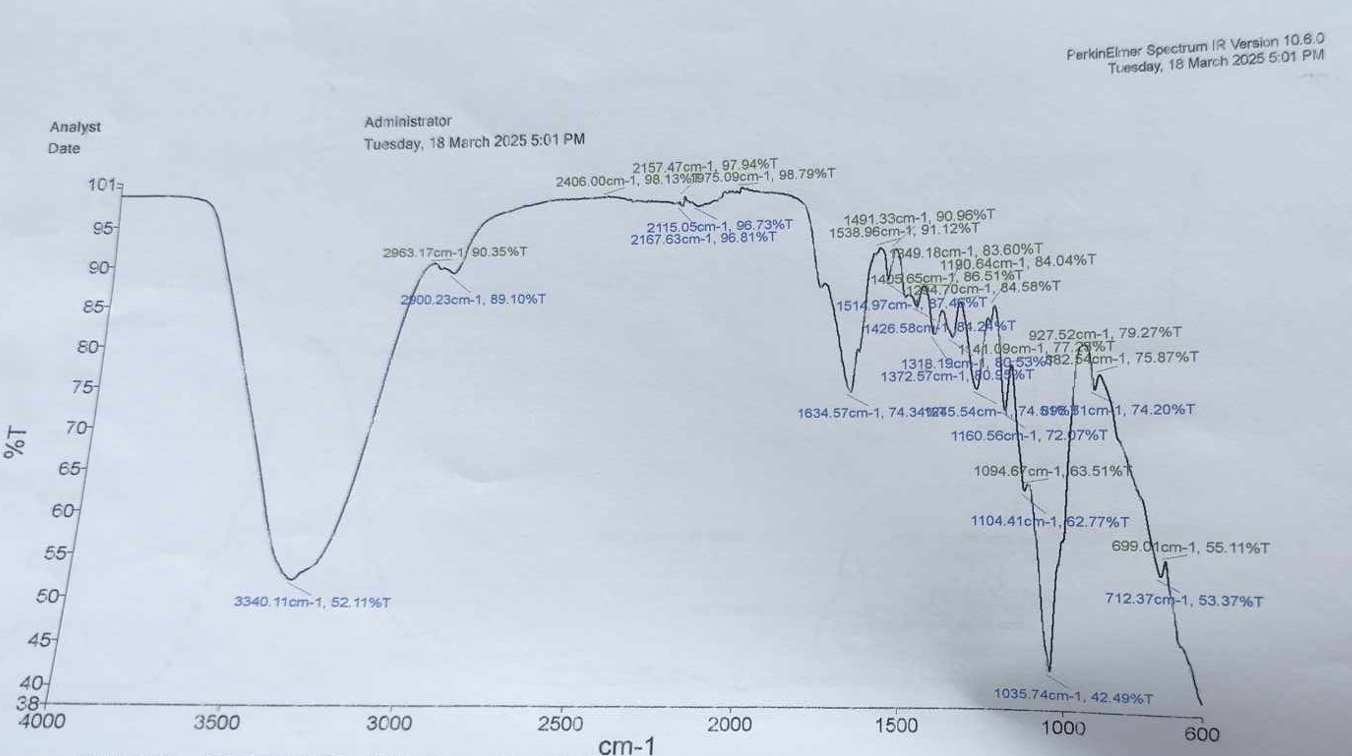
en&2