
结果页面
oxygen-containing ester polymer or oligomer, possibly hydroxy-terminated
查看上面的报告。如果需要后续讨论,请使用下方的评论。
FTIR分析报告
oxygen-containing ester polymer or oligomer, possibly hydroxy-terminated
样品与测量参数
报告编号
20250319230016134768862
日期
2025-03-20 02:15:42
光谱范围 (cm⁻¹)
[(650, 4000)]
基线
已禁用
库匹配
0%
鉴定结果
0%FTIR谱图与含氧酯类材料最为一致,可能是聚合或低聚物种而非简单烃类。最有力的样品证据是1708和1725 cm-1处的羰基区域,以及1055、1098、1165、1178、1240和1285 cm-1处的多个C-O伸缩谱带,加上2935 cm-1处的脂肪族C-H和3373 cm-1附近的宽O-H/N-H区域。谱库最高命中是聚己内酯单羟基封端,更广泛的顶级候选模式由含氧酯类聚合物主导,如甲基丙烯酸羟乙酯和聚酯型材料。然而,谱库匹配质量非常弱,并且没有直接或相关的文献证据独立确认特定的命名聚合物。因此,最可支持的结论是更广泛的含氧酯聚合物或低聚物方向,可能带有羟基封端,而非确定归属为聚己内酯单羟基封端。
详细解读
- 最佳库匹配: Poly(caprolactone),monohydroxy terminated #65435 | match 0.0%
- 1708和1725 cm-1处的谱带支持一个或多个羰基存在于酯类环境中。
- 1055、1098、1165、1178、1240和1285 cm-1处的谱带支持多个C-O伸缩振动,这是酯类和醚类含氧结构的特征。
- 3373 cm-1处的谱带支持存在羟基官能团或与含氧材料相关的氢键结合的水分。
- 谱库顶级匹配包括聚己内酯单羟基封端、聚甲基丙烯酸羟乙酯、聚癸二酸六亚甲基酯和聚丁二酸三亚甲基酯,所有这些都共享含氧酯化学。
- 样品在1708-1725 cm-1区域显示出强烈的酯类羰基特征,同时在1055至1285 cm-1区域有多个特征C-O谱带。
- 2935 cm-1处的谱带支持脂肪族C-H,这与带有烷基链段的聚酯或甲基丙烯酸酯型骨架兼容。
- 3373 cm-1处的宽谱带表明存在羟基以及可能的水分或弱N-H贡献;在此上下文中,这与含羟基的含氧材料一致。
- 在领先的谱库候选物中,重复出现的化学特征是富含氧的有机材料,尤其是含酯聚合物和相关含氧化合物。
- 最佳谱库匹配的相似度报告为零,因此命名的匹配本身不足以进行可靠的实体级鉴定。
- 观测到的峰列表没有提供独特的识别模式,无法在顶级候选集中清晰区分聚己内酯与其他含氧酯聚合物或低聚物。
- 不确定样品是特定的聚己内酯、甲基丙烯酸羟乙酯基聚合物、其他脂肪族聚酯还是相关的含氧低聚物。
- 3373 cm-1处的宽谱带可能反映末端羟基、吸附水或其他氢键贡献。
- 1708和1725 cm-1处的分裂羰基区域可能表示多个羰基环境、结晶效应或混合物,但当前证据无法区分这些可能性。
库对比
谱库光谱将显示在此处。
库搜索结果——前15个候选
| 排名 | 匹配% | 化合物 | SMILES | 光谱编号 | 操作 |
|---|---|---|---|---|---|
| 正在加载数据库候选... | |||||
峰值分析
★ = 文献支持的指认| # | 波数 (cm⁻¹) | 吸光度 | 归属 | 引用 | 归属状态 | |
|---|---|---|---|---|---|---|
| 1 | · | 1725 | 1.00 | - | - | - |
| 2 | · | 1165 | 0.94 | - | - | - |
| 3 | · | 1178 | 0.90 | - | - | - |
| 4 | · | 1708 | 0.48 | - | - | - |
| 5 | · | 718 | 0.44 | - | - | - |
| 6 | · | 1240 | 0.33 | - | - | - |
| 7 | · | 3373 | 0.30 | - | - | - |
| 8 | · | 1055 | 0.29 | - | - | - |
| 9 | · | 1098 | 0.27 | - | - | - |
| 10 | · | 960 | 0.21 | - | - | - |
| 11 | · | 1285 | 0.20 | - | - | - |
| 12 | · | 1362 | 0.18 | - | - | - |
| 13 | · | 2935 | 0.16 | - | - | - |
| 14 | · | 1462 | 0.13 | - | - | - |
附录——原始光谱

讨论
评论和后续证据
使用此区域继续解读、提问或添加额外验证证据。
This is the FTIR analysis result of a jpeg file uploaded by a user with IP 39.XX.XXX.109 The original image is shown below.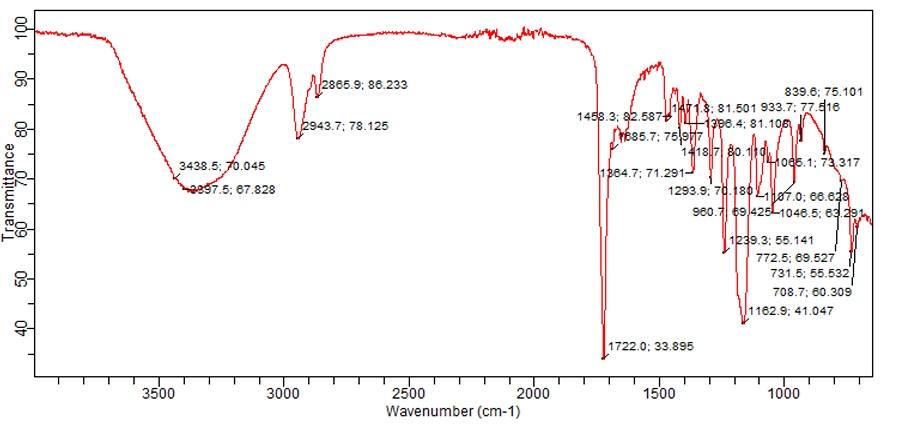
en&2