
oxygen-containing ester polymer or oligomer, possibly hydroxy-terminated
Visualize o relatório acima. Utilize os comentários abaixo caso necessite de um acompanhamento da discussão.
oxygen-containing ester polymer or oligomer, possibly hydroxy-terminated
Parâmetros de Amostra e Medição
Resultado de Identificação
0%O padrão FTIR é mais consistente com um material éster contendo oxigênio, provavelmente uma espécie polimérica ou oligomérica, em vez de um hidrocarboneto simples. A evidência mais forte da amostra é a região carbonila em 1708 e 1725 cm-1 juntamente com múltiplas bandas de estiramento C-O em 1055, 1098, 1165, 1178, 1240 e 1285 cm-1, além de C-H alifático em 2935 cm-1 e uma região larga de O-H/N-H perto de 3373 cm-1. O primeiro colocado da biblioteca é poli(caprolactona) monohidroxi-terminada, e o padrão geral dos principais candidatos é dominado por polímeros de éster oxigenados como materiais de hidroxietil metacrilato e poliéster. No entanto, a qualidade da correspondência da biblioteca é muito fraca, e nenhuma evidência direta ou relacionada da literatura confirma independentemente um polímero específico nomeado. Por essa razão, a conclusão mais sustentável é uma direção mais ampla de polímero ou oligômero de éster contendo oxigênio, com possível terminação hidroxila, em vez de uma atribuição firme a poli(caprolactona) monohidroxi-terminada
Interpretação detalhada
- Melhor correspondência da biblioteca: Poli(caprolactona) monohidroxi-terminada #65435 | match 0.0%
- Bandas em 1708 e 1725 cm-1 suportam um ou mais grupos carbonila em um ambiente semelhante a éster.
- Bandas em 1055, 1098, 1165, 1178, 1240 e 1285 cm-1 suportam múltiplas vibrações de estiramento C-O esperadas para estruturas oxigenadas semelhantes a éster e éter.
- A banda em 3373 cm-1 suporta a presença de funcionalidade hidroxila ou umidade ligada por hidrogênio associada a um material contendo oxigênio.
- O padrão principal da biblioteca inclui poli(caprolactona) monohidroxi-terminada, poli(2-hidroxietil metacrilato), poli(hexametileno sebacato) e poli(trimetileno succinato), todos os quais compartilham química de éster oxigenado.
- A amostra mostra uma forte assinatura carbonila semelhante a éster na região de 1708-1725 cm-1 juntamente com várias bandas C-O características de 1055 a 1285 cm-1.
- A banda em 2935 cm-1 suporta C-H alifático, que é compatível com cadeias principais de poliéster ou metacrilato contendo segmentos alquila.
- A banda larga em 3373 cm-1 indica hidroxila e possivelmente umidade ou contribuição fraca de N-H; neste contexto, é consistente com um material oxigenado contendo hidroxila.
- Entre os principais candidatos da biblioteca, a química recorrente é material orgânico rico em oxigênio, especialmente polímeros contendo éster e compostos oxigenados relacionados.
- O melhor resultado da biblioteca tem similaridade relatada zero, portanto a correspondência nomeada em si não é forte o suficiente para uma identificação firme em nível de entidade.
- A lista de picos observada não fornece um padrão de identificação único que separe claramente a policaprolactona de outros polímeros ou oligômeros de éster contendo oxigênio no conjunto dos principais candidatos.
- Permanece incerto se a amostra é especificamente policaprolactona, um polímero à base de hidroxietil metacrilato, outro poliéster alifático ou um oligômero oxigenado relacionado.
- A banda larga em 3373 cm-1 pode refletir grupos hidroxila terminais, água absorvida ou outra contribuição de ligação de hidrogênio.
- A região carbonila dividida em 1708 e 1725 cm-1 pode indicar mais de um ambiente carbonila, efeitos de cristalinidade ou uma mistura, mas a evidência atual não distingue entre essas possibilidades.
Comparação de Biblioteca
Resultados da Pesquisa na Biblioteca — Top 15 Candidatos
| Classificação | Correspondência % | Composto | SMILES | Nº do espectro | Ação |
|---|---|---|---|---|---|
| Carregando candidatos da biblioteca... | |||||
Análise de Picos
★ = Atribuição apoiada por literatura| # | Número de onda (cm⁻¹) | Absorbância | Atribuição | Citação | Status da atribuição | |
|---|---|---|---|---|---|---|
| 1 | · | 1725 | 1.00 | - | - | - |
| 2 | · | 1165 | 0.94 | - | - | - |
| 3 | · | 1178 | 0.90 | - | - | - |
| 4 | · | 1708 | 0.48 | - | - | - |
| 5 | · | 718 | 0.44 | - | - | - |
| 6 | · | 1240 | 0.33 | - | - | - |
| 7 | · | 3373 | 0.30 | - | - | - |
| 8 | · | 1055 | 0.29 | - | - | - |
| 9 | · | 1098 | 0.27 | - | - | - |
| 10 | · | 960 | 0.21 | - | - | - |
| 11 | · | 1285 | 0.20 | - | - | - |
| 12 | · | 1362 | 0.18 | - | - | - |
| 13 | · | 2935 | 0.16 | - | - | - |
| 14 | · | 1462 | 0.13 | - | - | - |
Apêndice — Espectro Bruto

Comentários e evidências de acompanhamento
Use esta área para continuar a interpretação, fazer perguntas ou adicionar evidências de verificação extras.
This is the FTIR analysis result of a jpeg file uploaded by a user with IP 39.XX.XXX.109 The original image is shown below.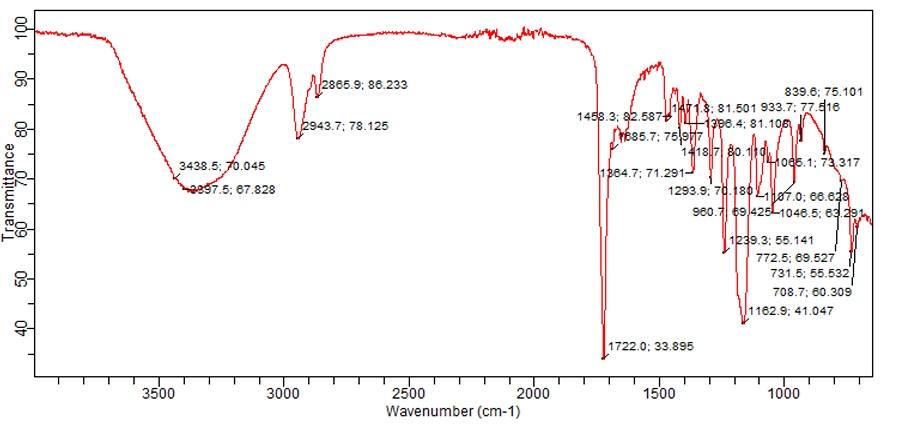
en&2