
oxygen-containing ester polymer or oligomer, possibly hydroxy-terminated
Bekijk het rapport hierboven. Gebruik de opmerkingen hieronder als u een vervolggesprek nodig heeft.
oxygen-containing ester polymer or oligomer, possibly hydroxy-terminated
Monster- en meetparameters
Identificatieresultaat
0%Het FTIR-patroon is het meest consistent met een zuurstofhoudend estermateriaal, waarschijnlijk een polymere of oligomere soort in plaats van een eenvoudige koolwaterstof. Het sterkste monsterevidentie is het carbonylgebied bij 1708 en 1725 cm-1 samen met meerdere C-O-rekbanden bij 1055, 1098, 1165, 1178, 1240 en 1285 cm-1, plus alifatische C-H bij 2935 cm-1 en een breed O-H/N-H gebied nabij 3373 cm-1. De beste hit in de bibliotheek is Poly(caprolacton),monohydroxy getermineerd, en het bredere toppatroon van kandidaten wordt gedomineerd door zuurstofhoudende esterpolymeren zoals hydroxyethylmethacrylaat- en polyester-achtige materialen. Echter, de kwaliteit van de bibliotheekovereenkomst is erg zwak, en geen direct of gerelateerd literatuurbewijs bevestigt onafhankelijk een specifiek genoemd polymeer. Om die reden is de meest ondersteunbare conclusie een bredere richting van zuurstofhoudend esterpolymeer of -oligomeer, met mogelijke hydroxylterminatie, in plaats van een vaste toewijzing aan Poly(caprolacton),monohydroxy getermineerd
Gedetailleerde interpretatie
- Beste bibliotheekovereenkomst: Poly(caprolactone),monohydroxy terminated #65435 | match 0.0%
- Band bij 1708 en 1725 cm-1 ondersteunen een of meer carbonylgroepen in een esterachtige omgeving.
- Band bij 1055, 1098, 1165, 1178, 1240 en 1285 cm-1 ondersteunen meerdere C-O-rekvibraties die worden verwacht voor ester- en etherachtige zuurstofhoudende structuren.
- De band bij 3373 cm-1 ondersteunt de aanwezigheid van hydroxylfunctionaliteit of waterstofgebonden vocht geassocieerd met een zuurstofhoudend materiaal.
- Het toppatroon van de bibliotheek omvat Poly(caprolacton),monohydroxy getermineerd, Poly(2-hydroxyethylmethacrylaat), poly(hexamethyleensebacaat) en poly(trimethyleensuccinaat), allemaal met zuurstofhoudende esterchemie.
- Het monster vertoont een sterke esterachtige carbonylsignatuur in het 1708-1725 cm-1 gebied samen met verschillende karakteristieke C-O banden van 1055 tot 1285 cm-1.
- De band bij 2935 cm-1 ondersteunt alifatische C-H, wat verenigbaar is met polyester- of methacrylaat-achtige ruggegraat met alkylsegmenten.
- De brede band bij 3373 cm-1 duidt op hydroxyl en mogelijk vocht of zwakke N-H bijdrage; in deze context is het consistent met een hydroxy-dragend zuurstofhoudend materiaal.
- Over de toonaangevende bibliotheekkandidaten heen is de terugkerende chemie zuurstofrijke organische materialen, vooral esterhoudende polymeren en verwante zuurstofhoudende verbindingen.
- De beste bibliotheekhit heeft nul gerapporteerde gelijkenis, dus de genoemde match zelf is niet sterk genoeg voor een stevige identificatie op entiteitsniveau.
- De waargenomen piekenlijst geeft geen uniek identificerend patroon dat polycaprolacton duidelijk scheidt van andere zuurstofhoudende esterpolymeren of -oligomeren in de topkandidatenset.
- Het blijft onzeker of het monster specifiek polycaprolacton is, een op hydroxyethylmethacrylaat gebaseerd polymeer, een andere alifatische polyester of een verwant zuurstofhoudend oligomeer.
- De brede band bij 3373 cm-1 kan terminale hydroxylgroepen, geabsorbeerd water of een andere waterstofbrugbijdrage weerspiegelen.
- Het gesplitste carbonylgebied bij 1708 en 1725 cm-1 kan wijzen op meer dan één carbonylomgeving, kristalliniteitseffecten of een mengsel, maar het huidige bewijs maakt geen onderscheid tussen deze mogelijkheden.
Bibliotheekvergelijking
Bibliotheekzoekresultaten — Top 15 kandidaten
| Rang | Match % | Samengesteld | SMILES | Spectrum nr. | Actie |
|---|---|---|---|---|---|
| Bibliotheekkandidaten laden... | |||||
Piekanalyse
★ = Door literatuur ondersteunde toewijzing| # | Golfgetal (cm⁻¹) | Absorptie | Toewijzing | Citaat | Toewijzingsstatus | |
|---|---|---|---|---|---|---|
| 1 | · | 1725 | 1.00 | - | - | - |
| 2 | · | 1165 | 0.94 | - | - | - |
| 3 | · | 1178 | 0.90 | - | - | - |
| 4 | · | 1708 | 0.48 | - | - | - |
| 5 | · | 718 | 0.44 | - | - | - |
| 6 | · | 1240 | 0.33 | - | - | - |
| 7 | · | 3373 | 0.30 | - | - | - |
| 8 | · | 1055 | 0.29 | - | - | - |
| 9 | · | 1098 | 0.27 | - | - | - |
| 10 | · | 960 | 0.21 | - | - | - |
| 11 | · | 1285 | 0.20 | - | - | - |
| 12 | · | 1362 | 0.18 | - | - | - |
| 13 | · | 2935 | 0.16 | - | - | - |
| 14 | · | 1462 | 0.13 | - | - | - |
Bijlage — Ruw spectrum

Opmerkingen en vervolgbewijs
Gebruik dit gebied om de interpretatie voort te zetten, vragen te stellen of extra verificatiebewijs toe te voegen.
This is the FTIR analysis result of a jpeg file uploaded by a user with IP 39.XX.XXX.109 The original image is shown below.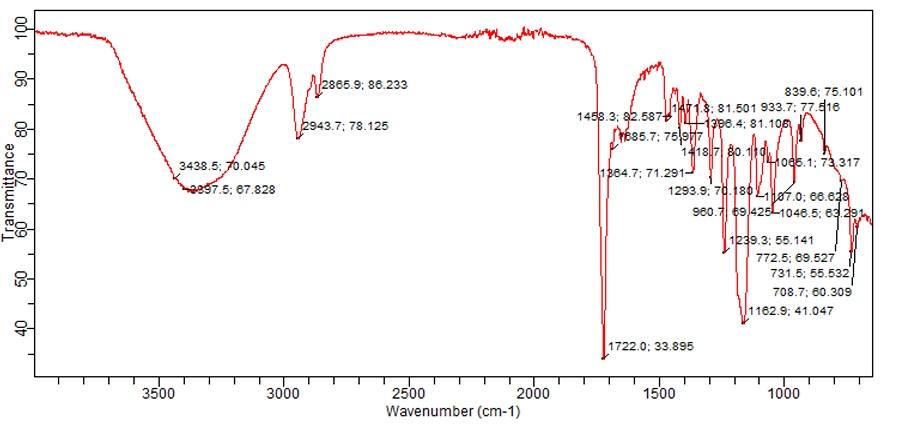
en&2