RESULT PAGE

oxygen-containing ester polymer or oligomer, possibly hydroxy-terminated

View the report above. Use the comments below if you need follow-up discussion.

Result No.: 20250319230016134768862 Owner: Admin Comments: 1
FTIR Analysis Report

oxygen-containing ester polymer or oligomer, possibly hydroxy-terminated

Sample & Measurement Parameters

Report No. 20250319230016134768862
Date 2025-03-20 02:15:42
Spectral Range (cm⁻¹) [(650, 4000)]
Baseline Disabled
Library match 0%

Identification Result

0%

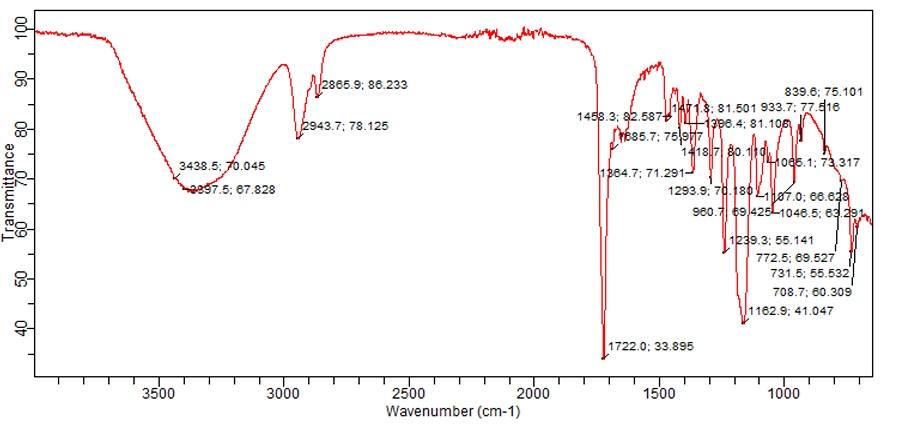
The FTIR pattern is most consistent with an oxygen-containing ester material, likely a polymeric or oligomeric species rather than a simple hydrocarbon. The strongest sample evidence is the carbonyl region at 1708 and 1725 cm-1 together with multiple C-O stretching bands at 1055, 1098, 1165, 1178, 1240, and 1285 cm-1, plus aliphatic C-H at 2935 cm-1 and a broad O-H/N-H region near 3373 cm-1. The library top hit is Poly(caprolactone),monohydroxy terminated, and the broader top-candidate pattern is dominated by oxygenated ester polymers such as hydroxyethyl methacrylate- and polyester-type materials. However, the library match quality is very weak, and no direct or related literature evidence independently confirms a specific named polymer. For that reason, the most supportable conclusion is a broader oxygen-containing ester polymer or oligomer direction, with possible hydroxyl termination, rather than a firm assignment to Poly(caprolactone),monohydroxy terminated

Detailed interpretation

  • Top library match: Poly(caprolactone),monohydroxy terminated #65435
  • The best library hit has zero reported similarity, S-O the named match itself is not strong enough for a firm entity-level identification.
  • The observed peak list does not provide a uniquely identifying pattern that clearly separates polycaprolactone from other oxygen-containing ester polymers or oligomers in the top-candidate set.
  • It remains uncertain whether the sample is specifically polycaprolactone, a hydroxyethyl methacrylate-based polymer, another aliphatic polyester, or a related oxygenated oligomer.
  • The broad 3373 cm-1 band may reflect terminal hydroxyl groups, absorbed water, or another hydrogen-bonding contribution.
  • The split carbonyl region at 1708 and 1725 cm-1 may indicate more than one carbonyl environment, crystallinity effects, or a mixture, but the current evidence does not distinguish among these possibilities.

Recommended next steps: Compare the full spectrum directly against authenticated FTIR references for Poly(caprolactone),monohydroxy terminated, poly(2-hydroxyethyl methacrylate), and common aliphatic polyesters such as poly(trimethylene succinate). Check for polyester-specific thermal behavior by DSC; a melting transition near the expected range for semicrystalline aliphatic polyester would help separate polycaprolactone-like material from methacrylate-based materials. Use 1H and 13C NMR to verify whether the sample contains caprolactone-type methylene environments, methacrylate backbone features, or mixed ester components. If the 3373 cm-1 band is important to the assignment, dry the sample and reacquire FTIR to determine whether the band persists as a true hydroxyl feature rather than adsorbed moisture.

Library Comparison

Match group:
Library spectrum will appear here.

Library Search Results — Top 15 Candidates

Rank Match % Compound SMILES Spectrum No. Action
Loading library candidates...

Peak Analysis

★ = Literature-supported assignment
# Wavenumber (cm⁻¹) Absorbance Assignment Citation Assignment status
1 · 1725 1.00 - - -
2 · 1165 0.94 - - -
3 · 1178 0.90 - - -
4 · 1708 0.48 - - -
5 · 718 0.44 - - -
6 · 1240 0.33 - - -
7 · 3373 0.30 - - -
8 · 1055 0.29 - - -
9 · 1098 0.27 - - -
10 · 960 0.21 - - -
11 · 1285 0.20 - - -
12 · 1362 0.18 - - -
13 · 2935 0.16 - - -
14 · 1462 0.13 - - -

Appendix — Raw Spectrum

Raw sample spectrum
Generated by FTIR.fun — Report #20250319230016134768862 2025-03-20 02:15:42
Discussion

Comments and follow-up evidence

Use this area to continue the interpretation, ask questions, or add extra verification evidence.

This is the FTIR analysis result of a jpeg file uploaded by a user with IP 39.XX.XXX.109 The original image is shown below.20250319230016134768862.jpeg
en&2
Submit Requirement Form