
PUBLIC SPECTRUM SEARCH
4-iminopentan-2-one
Free public result — the submitted spectrum with its top library candidates, not an AI identification.
SPECTRUM & LIBRARY MATCHES
Submitted spectrum and top library candidates

Top 15 library matches
| # | Reference | CAS | Similarity |
|---|---|---|---|
| 1 | 4-iminopentan-2-one | 870-74-6 | - |
| 2 | 4-iminopentan-2-one | 870-74-6 | - |
| 3 | Poly(amide-6,6:amide-6) | none | - |
| 4 | 2-Methyl-3-nitroaniline | 603-83-8 | - |
| 5 | 2-Methyl-3-nitroaniline | 603-83-8 | - |
| 6 | N,N-dibutylbutan-1-amine | 102-82-9 | - |
| 7 | Polyamide-4,6 | none | - |
| 8 | N-(phenylmethyl)benzamide | 1485-70-7 | - |
| 9 | 1,3-di(phenyl)urea | 102-07-8 | - |
| 10 | 1,2,3,5-Tetrafluoro-4-nitrobenzene | 314-41-0 | - |
| 11 | Poly(hexamethylene adipamide) | 32131-17-2 | - |
| 12 | N-(phenylmethyl)-3-(2-(pyridine-4-carbonyl)hydrazinyl)propanamide | 51-12-7 | - |
| 13 | Polycaprolactam | 25038-54-4 | - |
| 14 | 4-methyl-1,3-thiazol-2-amine | 1603-91-4 | - |
| 15 | N,N-Dimethyl-3-nitroaniline | 619-31-8 | - |
Discussion
Comments and follow-up evidence
Use this area to continue the interpretation, ask questions, or add extra verification evidence.
This is the FTIR analysis result of a png file uploaded by a user with IP 2406:7400:XXX:6abc The original image is shown below.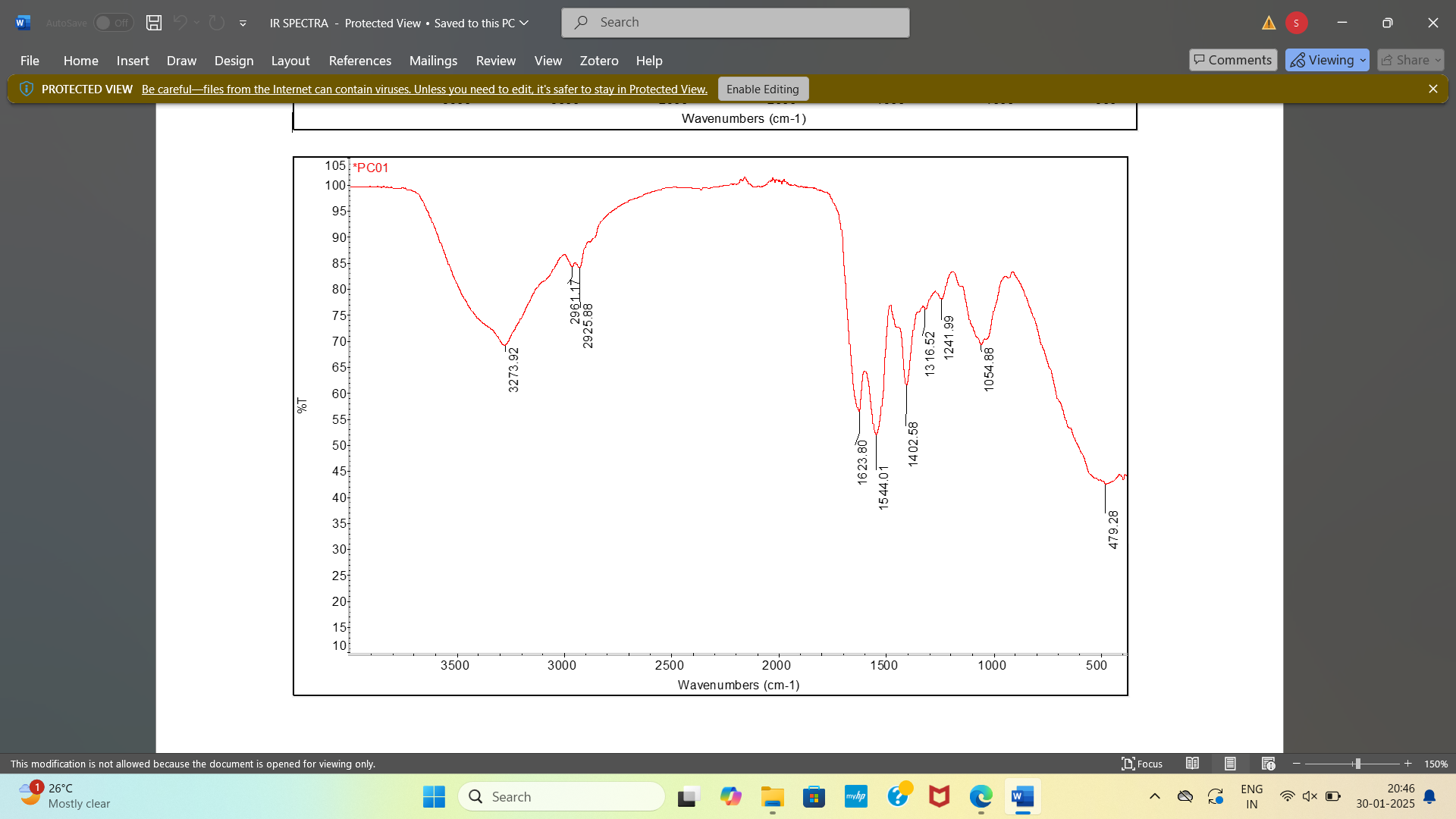
en&2