
RESULT PAGE
nitrogen-containing organic material with possible nitrile and N-H functionality
View the report above. Use the comments below if you need follow-up discussion.
FTIR Analysis Report
nitrogen-containing organic material with possible nitrile and N-H functionality
Sample & Measurement Parameters
Report No.
20250220165008564245896
Date
2025-02-21 08:33:29
Spectral Range (cm⁻¹)
[(650, 4000)]
Baseline
AsLS baseline correction
Library match
0%
Identification Result
0%The current FTIR evidence does not support a firm identification as Boric acid despite that library entry appearing first, because the library match quality is effectively absent and the observed bands are not characteristic of a simple boric acid spectrum. Instead, the sample is more cautiously described as a nitrogen-containing organic material, with a strong possibility of nitrile functionality and at least one N-H or hydrogen-bonded O-H containing group
Detailed interpretation
- Top library match: Boric acid #35827
- The leading library hit Boric acid has a similarity of 0.000, S-O the retrieval does not provide positive identification support.
- The strong 2260 cm-1 band is a major limitation for a boric acid conclusion and instead points toward a different functional class.
- The Top-15 library candidates are chemically inconsistent with one another, which limits confidence in any narrow material assignment.
- The available peak list is sparse, S-O the presence or absence of key companion bands for nitriles, amides, borates, or carboxylates cannot be checked fully.
- The high-wavenumber bands could reflect N-H, O-H, or mixed hydrogen-bonded contributions, S-O the heteroatom functionality is not uniquely resolved.
- Without clearer fingerprint-region structure, the sample cannot be narrowed reliably to a specific nitrile, amide, polymer, salt, or small molecule.
Library Comparison
Library spectrum will appear here.
Library Search Results — Top 15 Candidates
| Rank | Match % | Compound | SMILES | Spectrum No. | Action |
|---|---|---|---|---|---|
| Loading library candidates... | |||||
Peak Analysis
★ = Literature-supported assignmentAppendix — Raw Spectrum

Discussion
Comments and follow-up evidence
Use this area to continue the interpretation, ask questions, or add extra verification evidence.
This is the FTIR analysis result of a JPG file uploaded by a user with IP 99.X.XXX.92. The original image is shown below.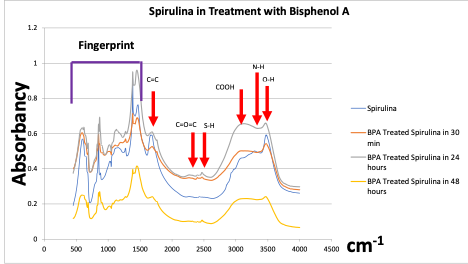
en&2