RESULT PAGE

long-chain aliphatic hydrocarbon material with carbonyl and hydroxyl/amine-type functionality

View the report above. Use the comments below if you need follow-up discussion.

Result No.: 20250214204153576407088 Owner: Admin Comments: 1
FTIR Analysis Report

long-chain aliphatic hydrocarbon material with carbonyl and hydroxyl/amine-type functionality

Sample & Measurement Parameters

Report No. 20250214204153576407088
Date 2025-02-15 07:46:40
Spectral Range (cm⁻¹) [(650, 4000)]
Baseline AsLS baseline correction
Library match 0%

Identification Result

0%

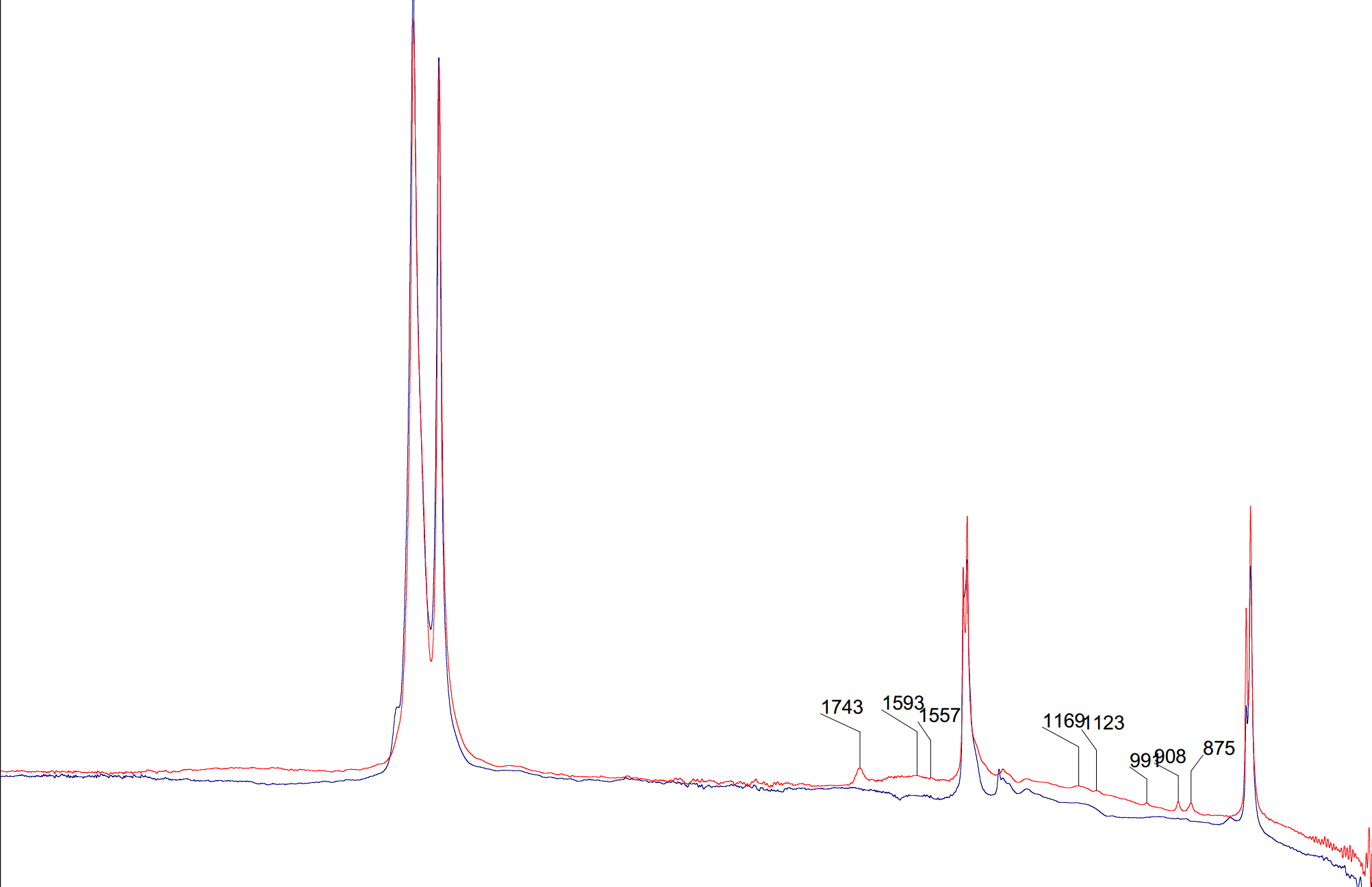
The library top hit is 1-Bromodocosane, but the match quality is effectively absent and the sample spectrum contains bands that are not consistent with a simple bromoalkane alone. The observed strong aliphatic C-H stretching region (2913, 2851 cm-1) and methylene-related bands including 1464 and 720 cm-1 support a long-chain hydrocarbon component. However, the clear band at 1748 cm-1 indicates a carbonyl group, and the broad/paired absorption near 3272-3321 cm-1 indicates hydroxyl and/or amine-type functionality, which substantially broadens the chemically supportable conclusion beyond the library's named top hit. On the present evidence, the sample is better described as a long-chain aliphatic organic material containing an additional carbonyl-bearing and hydrogen-bonding functional group rather than being assigned specifically as 1-Bromodocosane

Detailed interpretation

  • Top library match: 1-Bromodocosane #114
  • The library top hit, 1-Bromodocosane, is a simple long-chain bromoalkane and does not account for the observed 1748 cm-1 carbonyl band.
  • 1-Bromodocosane also does not explain the 3272-3321 cm-1 hydrogen-bonding absorption region.
  • All listed library similarities are 0.000, S-O the retrieval does not support a reliable entity-level identification.
  • The library consensus text suggesting oxygen heterocycle / n eq o is not directly supported by the specific observed peak pattern strongly enough to justify that narrower direction.
  • The spectrum supports a hydrocarbon-rich material with additional functionalization, but it does not uniquely distinguish among ester-, alcohol-, amide-, acid-, or mixed-component long-chain organics.
  • A halogenated assignment remains unconfirmed because no sample-specific bromine band evidence is provided here.
  • The current evidence cannot determine whether the sample is a single compound, an additive-containing material, or a mixture.

Recommended next steps: Verify the carbonyl assignment by inspecting the full fingerprint region for ester C-O stretching bands, especially in the approximate 1300-1000 cm-1 range. Check for N-H versus O-H character by examining the shape and breadth of the 3272-3321 cm-1 region and by looking for accompanying amide bands near 1650-1550 cm-1 if available. If brominated identity is important, confirm with an orthogonal method such as GC-MS, LC-MS, or XRF/elemental halogen analysis rather than FTIR alone. If the sample may be a polymer or formulated material, compare against reference spectra for long-chain esters, fatty amides, fatty alcohols, oxidized polyethylene, and wax-like hydrocarbon mixtures.

Library Comparison

Match group:
Library spectrum will appear here.

Library Search Results — Top 15 Candidates

Rank Match % Compound SMILES Spectrum No. Action
Loading library candidates...

Peak Analysis

★ = Literature-supported assignment
# Wavenumber (cm⁻¹) Absorbance Assignment Citation Assignment status
1 · 2913 1.00 - - -
2 · 2851 0.87 - - -
3 · 720 0.37 - - -
4 · 1464 0.36 - - -
5 · 1418 0.12 - - -
6 · 3321 0.11 - - -
7 · 3272 0.11 - - -
8 · 1327 0.11 - - -
9 · 1748 0.10 - - -
10 · 1409 0.10 - - -
11 · 1369 0.10 - - -

Appendix — Raw Spectrum

Raw sample spectrum
Generated by FTIR.fun — Report #20250214204153576407088 2025-02-15 07:46:40
Discussion

Comments and follow-up evidence

Use this area to continue the interpretation, ask questions, or add extra verification evidence.

This is the FTIR analysis result of a PDF file uploaded by a user with IP 217.xxx.xxx.79 . The original image is shown below. Due to the peak height threshold setting, some weak peaks were not included in the analysis and will be supplemented later.20250215152629.png
en&2
Submit Requirement Form