
PÁGINA DE RESULTADOS
small carbonyl-containing organic compound with methyl/aliphatic features; possibly nitrile-bearing
Visualize o relatório acima. Utilize os comentários abaixo caso necessite de um acompanhamento da discussão.
Relatório de Análise FTIR
small carbonyl-containing organic compound with methyl/aliphatic features; possibly nitrile-bearing
Parâmetros de Amostra e Medição
Relatório Nº
20250204153309836133940
Data
2025-02-05 12:22:55
Faixa Espectral (cm⁻¹)
[(650, 4000)]
Linha de base
Desativado
Correspondência da biblioteca
0%
Resultado de Identificação
0%O resultado atual do FTIR não suporta uma identificação firme em nível de composto. Embora a entrada mais próxima da biblioteca seja 7-oxabicyclo[4.1.0]heptan-5-one, a qualidade da correspondência é efetivamente não discriminante, e o padrão mais amplo da biblioteca é fraco. O espectro medido é mais seguramente descrito como um pequeno material orgânico contendo carbonila com características alifáticas ou tipo metila, enquanto uma possível contribuição de nitrila permanece tentativa, não estabelecida.
Interpretação detalhada
- Melhor correspondência da biblioteca: 7-oxabicyclo[4.1.0]heptan-5-one #63906 | match 0.0%
- O resultado atual do FTIR não suporta uma identificação firme em nível de composto. Embora a entrada mais próxima da biblioteca seja 7-oxabicyclo[4.1.0]heptan-5-one, a qualidade da correspondência é efetivamente não discriminante, e o padrão mais amplo da biblioteca é fraco. O espectro medido é mais seguramente descrito como um pequeno material orgânico contendo carbonila com características alifáticas ou tipo metila, enquanto uma possível contribuição de nitrila permanece tentativa, não estabelecida.
- Um material claro contendo carbonila é suportado pelas absorções pareadas em 1699 e 1711 cm-1.
- O conteúdo alifático ou tipo metila é suportado pela banda em 1445 cm-1 juntamente com as bandas de impressão digital de baixo número de onda em 710 e 722 cm-1.
- A nota de consenso da biblioteca fornece suporte limitado para química relacionada a metila e possível nitrila.
- O espectro observado mostra uma forte região de carbonila em 1699 e 1711 cm-1, consistente com um composto orgânico pequeno contendo C=O, como cetona, éster, lactona ou outro.
- Bandas em 1445 cm-1 e na região de 710-722 cm-1 são compatíveis com elementos estruturais contendo alifático/metila.
- Bandas adicionais em 1012, 1098, 1167 e 1262 cm-1 são consistentes com vibrações de C-O e/ou outras vibrações de heteroátomo de ligação simples na região de impressão digital, mas não são específicas o suficiente aqui para confirmar uma classe estrutural restrita.
- O padrão da biblioteca Top-15 foi resumido como apontando para química de nitrila/metila, mas os principais candidatos listados são quimicamente misturados e incluem espécies contendo carbonila, como uma cetona/éter bicíclico, uma formamida e um éster.
- Como os principais candidatos têm similaridade zero e nenhuma referência direta ou confirmação de literatura relacionada está disponível, o resultado da biblioteca é melhor tratado como evidência direcional fraca, em vez de uma identificação.
- O resultado proposto da biblioteca, 7-oxabicyclo[4.1.0]heptan-5-one, não é diretamente suportado por evidências de referência distintivas para esta amostra.
- Uma atribuição de nitrila não é confirmada porque nenhuma banda característica clara de nitrila é listada na região usual de 2210-2260 cm-1.
- Os principais candidatos da biblioteca não formam uma única classe química coerente, o que limita a confiança em qualquer atribuição restrita.
- Nenhuma referência direta da literatura estava disponível para confirmar o espectro atual.
- Nenhuma correspondência estável de literatura relacionada foi recuperada para restringir ainda mais a classe do material.
- As bandas da região de impressão digital poderiam se ajustar a mais de uma estrutura orgânica oxigenada pequena, incluindo cetonas, ésteres, lactonas ou compostos mistos contendo oxigênio.
- Sem uma absorção confirmada na região de nitrila, o aspecto nitrila permanece apenas uma hipótese limitada a partir do padrão fraco da biblioteca.
Comparação de Biblioteca
O espectro da biblioteca aparecerá aqui.
Resultados da Pesquisa na Biblioteca — Top 15 Candidatos
| Classificação | Correspondência % | Composto | SMILES | Nº do espectro | Ação |
|---|---|---|---|---|---|
| Carregando candidatos da biblioteca... | |||||
Análise de Picos
★ = Atribuição apoiada por literaturaApêndice — Espectro Bruto

Discussão
Comentários e evidências de acompanhamento
Use esta área para continuar a interpretação, fazer perguntas ou adicionar evidências de verificação extras.
This is the search result for the file with the extension .JEPG uploaded by user 200.xx.xx.75 raw image: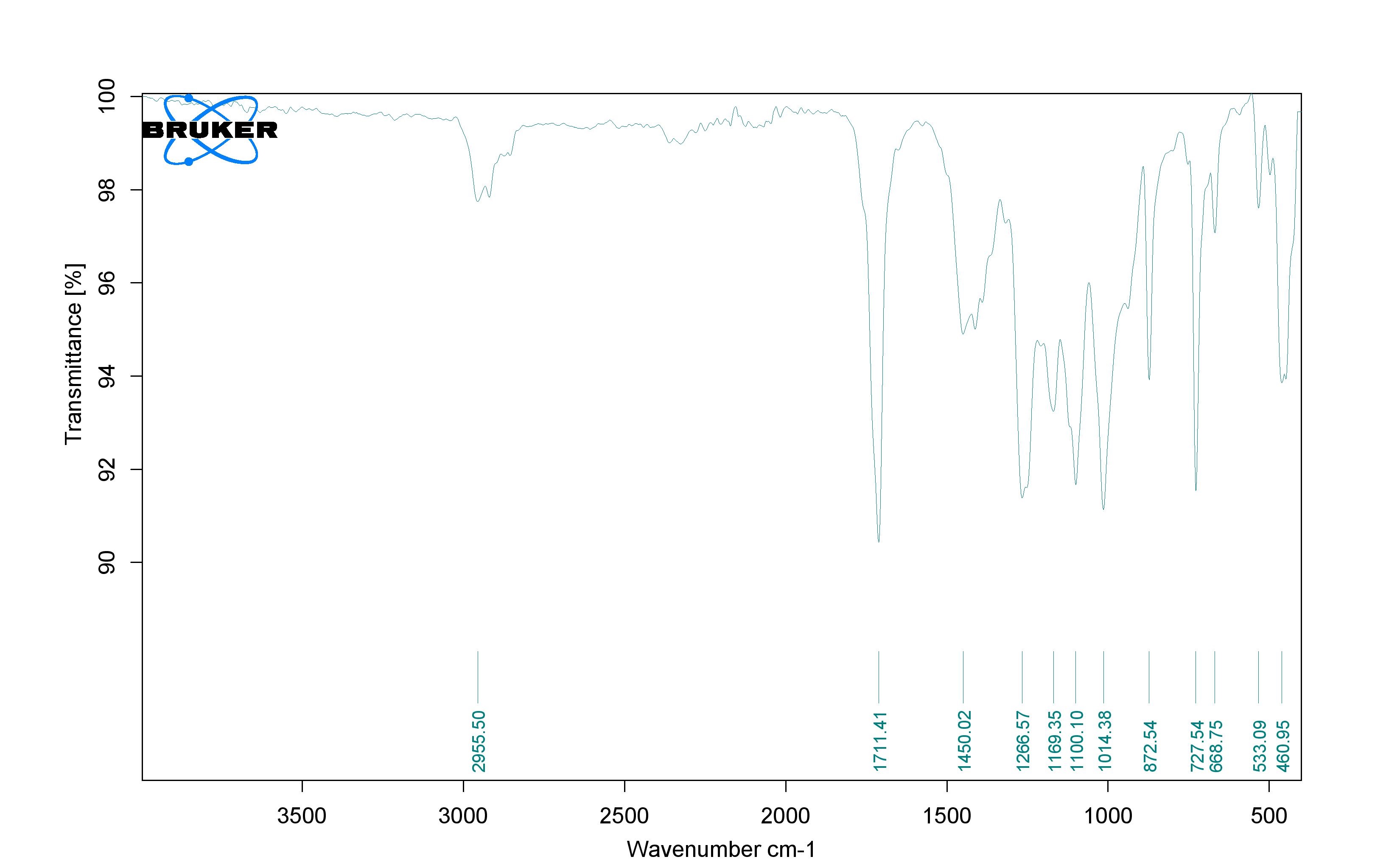 Evidently, this substance is a polymer containing ester groups and long-chain CH2 groups. Further analysis will be provided in a subsequent response.
en&2