RESULT PAGE

small carbonyl-containing organic compound with methyl/aliphatic features; possibly nitrile-bearing

View the report above. Use the comments below if you need follow-up discussion.

Result No.: 20250204153309836133940 Owner: Admin Comments: 1
FTIR Analysis Report

small carbonyl-containing organic compound with methyl/aliphatic features; possibly nitrile-bearing

Sample & Measurement Parameters

Report No. 20250204153309836133940
Date 2025-02-05 12:22:55
Spectral Range (cm⁻¹) [(650, 4000)]
Baseline Disabled
Library match 0%

Identification Result

0%

The current FTIR result does not support a firm compound-level identification. Although the nearest library entry is 7-oxabicyclo[4.1.0]heptan-5-one, the match quality is effectively non-discriminating, and the broader library pattern is weak. The measured spectrum is more safely described as a small carbonyl-containing organic material with aliphatic or methyl-type features, while a possible nitrile contribution remains tentative rather than established

Detailed interpretation

  • Top library match: 7-oxabicyclo[4.1.0]heptan-5-one #63906
  • The proposed library hit 7-oxabicyclo[4.1.0]heptan-5-one is not directly supported by distinctive reference evidence for this sample.
  • A nitrile assignment is not confirmed because no clear characteristic nitrile band is listed in the usual 2210-2260 cm-1 region.
  • The leading library candidates do not form a single coherent chemical class, which limits confidence in any narrow assignment.
  • No direct literature reference was available to confirm the present spectrum.
  • No stable related-literature match was recovered to narrow the material class further.
  • The fingerprint-region bands could fit more than one small oxygenated organic structure, including ketones, esters, lactones, or mixed oxygen-containing compounds.
  • Without a confirmed nitrile-region absorption, the nitrile aspect remains only a bounded hypothesis from the weak library pattern.

Recommended next steps: Re-measure the sample over the full mid-IR range with attention to the 2210-2260 cm-1 region to check specifically for a nitrile band. Inspect the 2800-3100 cm-1 region for C-H stretching pattern and the 3200-3600 cm-1 region for any O-H or N-H absorption, which would help separate ketone/ester/lactone from amide or alcohol-containing candidates. If enough sample is available, confirm the carbonyl type by GC-MS or LC-MS and compare against small oxygenated organic compounds rather than relying on the current weak FTIR library hit. If this is a formulation or extract rather than a pure compound, consider chromatographic separation before repeat FTIR, because mixed components can produce this kind of non-specific library outcome.

Library Comparison

Match group:
Library spectrum will appear here.

Library Search Results — Top 15 Candidates

Rank Match % Compound SMILES Spectrum No. Action
Loading library candidates...

Peak Analysis

★ = Literature-supported assignment
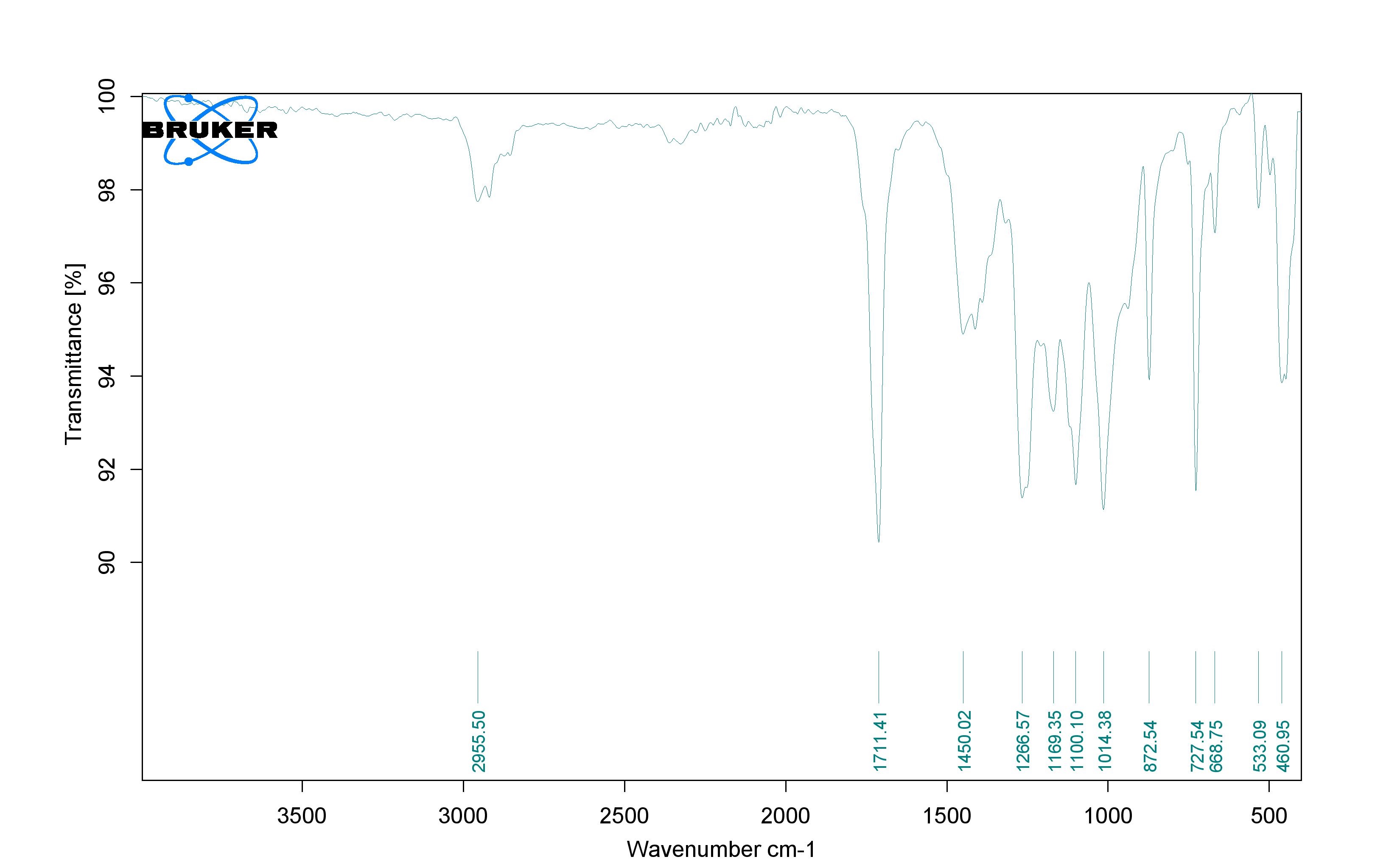
# Wavenumber (cm⁻¹) Absorbance Assignment Citation Assignment status
1 · 1711 1.00 - - -
2 · 1012 0.39 - - -
3 · 1262 0.35 - - -
4 · 722 0.31 - - -
5 · 1098 0.30 - - -
6 · 1699 0.26 - - -
7 · 1167 0.19 - - -
8 · 710 0.16 - - -
9 · 869 0.16 - - -
10 · 1445 0.12 - - -

Appendix — Raw Spectrum

Raw sample spectrum
Generated by FTIR.fun — Report #20250204153309836133940 2025-02-05 12:22:55
Discussion

Comments and follow-up evidence

Use this area to continue the interpretation, ask questions, or add extra verification evidence.

This is the search result for the file with the extension .JEPG uploaded by user 200.xx.xx.75 raw image:202502041533098361339401.jpgEvidently, this substance is a polymer containing ester groups and long-chain CH2 groups. Further analysis will be provided in a subsequent response.
en&2
Submit Requirement Form