RESULT PAGE

methyl-substituted siloxane or other oxygen-containing methyl-rich material

View the report above. Use the comments below if you need follow-up discussion.

Result No.: 20241213142727225688126 Owner: publicuser Comments: 1
FTIR Analysis Report

methyl-substituted siloxane or other oxygen-containing methyl-rich material

Sample & Measurement Parameters

Report No. 20241213142727225688126
Date 2024-12-13 12:32:03
Spectral Range (cm⁻¹) [(650, 4000)]
Baseline AsLS baseline correction
Library match 0%

Identification Result

0%

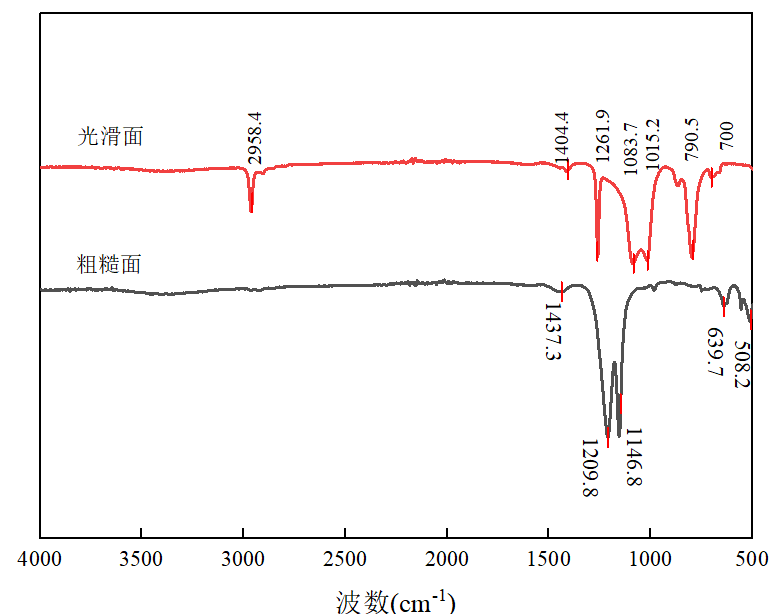
The observed FTIR pattern is most consistent with a methyl-rich oxygen-containing material, with a siloxane-type interpretation being plausible because the sample is dominated by strong bands at 1024, 1049, and 1083 cm⁻¹ together with methyl-region bands at 1258 and 1270 cm⁻¹ and low-wavenumber features at 795 and 806 cm⁻¹. However, the library result is low confidence and no direct or related literature evidence independently confirms the specific top-hit compound, so the data support only a broadened material direction rather than a firm compound-level identification

Detailed interpretation

  • Top library match: 2,2,4,4,6,6,8,8-octamethyl-1,3,5,7,2,4,6,8-tetraoxatetrasilocane #68221
  • All reported library similarities are 0.000, S-O the retrieval does not provide a reliable discriminating match.
  • The top-15 candidate set is chemically mixed, including nitriles, halogenated hydrocarbons, and other unrelated compounds, which limits confidence in a narrow identification.
  • No supporting peaks are reported outside the fingerprint region to confirm a unique molecular assignment.
  • The present data do not securely distinguish a specific cyclic siloxane from a broader methyl-substituted siloxane material.
  • Because the spectrum excerpt is narrow and literature support is absent, other methyl-rich oxygen-containing materials cannot be excluded solely from the current evidence.
  • The current evidence is sufficient for a broad material direction, but not for a definitive entity-level identification.

Recommended next steps: Re-measure the FTIR spectrum over the full range and confirm whether additional characteristic siloxane bands are present, especially the C-H stretching region near 2960-2900 cm⁻¹ and the absence of strong carbonyl or nitrile absorptions. Compare the sample directly against a reference spectrum for the library candidate 2,2,4,4,6,6,8,8-octamethyl-1,3,5,7,2,4,6,8-tetraoxatetrasilocane and against common PDMS/cyclic siloxane standards. Use GC-MS or LC-MS if the sample is extractable or volatile, since cyclic siloxanes are often more conclusively verified by mass spectrometric composition. If this is a surface residue or coating, complementary silicon-sensitive analysis such as XPS or EDS can test whether silicon is actually present and strengthen or rule out the siloxane direction.

Library Comparison

Match group:
Library spectrum will appear here.

Library Search Results — Top 15 Candidates

Rank Match % Compound SMILES Spectrum No. Action
Loading library candidates...

Peak Analysis

★ = Literature-supported assignment
# Wavenumber (cm⁻¹) Absorbance Assignment Citation Assignment status
1 · 1083 1.00 - - -
2 · 1024 0.47 - - -
3 · 795 0.44 - - -
4 · 1258 0.41 - - -
5 · 1049 0.31 - - -
6 · 806 0.25 - - -
7 · 1270 0.16 - - -

Appendix — Raw Spectrum

Raw sample spectrum
Generated by FTIR.fun — Report #20241213142727225688126 2024-12-13 12:32:03
Discussion

Comments and follow-up evidence

Use this area to continue the interpretation, ask questions, or add extra verification evidence.

This is the search result for the file with the extension .JEPG uploaded by user 5:xx.xx.229 raw image:20241213142727225688126.png
en&2
Submit Requirement Form