
RESULT PAGE
amine- or ammonium-containing aliphatic organic material with alkyl C-H and possible N-H/O-H functionality
View the report above. Use the comments below if you need follow-up discussion.
FTIR Analysis Report
amine- or ammonium-containing aliphatic organic material with alkyl C-H and possible N-H/O-H functionality
Sample & Measurement Parameters
Report No.
20241023160616138658629
Date
2024-10-23 15:03:34
Spectral Range (cm⁻¹)
[(650, 4000)]
Baseline
AsLS baseline correction
Library match
0%
Identification Result
0%The current FTIR evidence does not support a firm compound-level identification. Although the nearest library entry is dimethyl-di(prop-2-enyl)azanium chloride, the retrieval confidence is effectively zero and there is no direct or related literature confirmation. The observed spectrum is more safely described as an amine- or ammonium-containing aliphatic organic material showing alkyl C-H stretching, a band in the 1642 cm-1 region, and broad high-wavenumber absorption consistent with N-H and/or O-H functionality
Detailed interpretation
- Top library match: dimethyl-di(prop-2-enyl)azanium chloride #13288
- Library similarity values are 0.000 throughout the leading candidates, S-O the library match is not strong enough for an entity claim.
- The sample evidence does not clearly confirm specific distinguishing features required for the named top hit, such as secure allylic or quaternary-ammonium-specific band patterns.
- The high-wavenumber broad bands could arise from amine, ammonium-associated moisture, alcohol, or other hydrogen-bonded functionality.
- The 1642 cm-1 feature is not unique and may reflect H-O-H bending, N-H bending, C=C-related absorption, or another overlapping mode.
- Because no reliable literature or high-quality library agreement is present, the exact identity and whether the material is a discrete small molecule, salt, or polymeric nitrogen-containing material remain uncertain.
Library Comparison
Library spectrum will appear here.
Library Search Results — Top 15 Candidates
| Rank | Match % | Compound | SMILES | Spectrum No. | Action |
|---|---|---|---|---|---|
| Loading library candidates... | |||||
Peak Analysis
★ = Literature-supported assignmentAppendix — Raw Spectrum

Discussion
Comments and follow-up evidence
Use this area to continue the interpretation, ask questions, or add extra verification evidence.
Based on the possible hydroxyl absorption peak around 3500 and the possible hydrocarbon absorption peak around 1500, the sample resembles a surfactant and may be a salt containing long-chain alkanes.
en&2This is the search result for the file with the extension .pdf uploaded by user 103.xxx.xxx.180, raw image: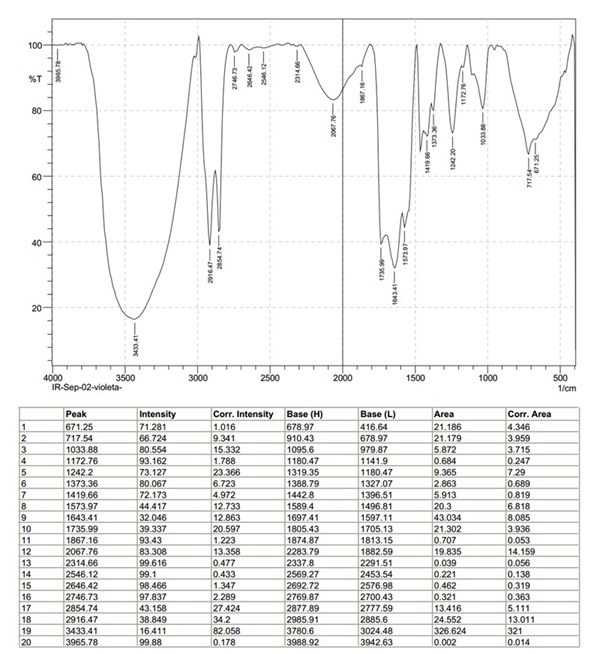
en&2