
结果页面
aromatic / methacrylate
查看上面的报告。如果需要后续讨论,请使用下方的评论。
FTIR分析报告
总体置信度
aromatic / methacrylate
样品与测量参数
报告编号
20260201031343195485001
日期
光谱范围 (cm⁻¹)
N/A
基线
AsLS基线校正
库匹配
71%
鉴定结果
71%该光谱与一种结合了芳香环和甲基丙烯酸酯/酯官能团以及酰胺、羟基和胺/铵基团的材料最为一致。整体图案表明一种有机物质,含有通过酯型C-O键和氢键O-H/N-H环境连接的苯基或芳香族部分,而不是单一明确的光谱库化合物。建议下一步:获取更高分辨率的光谱,如果可能,使用衰减全反射(ATR)或透射光谱并进行延长信号平均,以检测弱羰基带并解析芳香族与脂肪族取代的特征C-H伸缩模式。进行补充分析,如核磁共振(¹H, ¹³C)、拉曼光谱或热解-GC-MS,以确定具体的单体单元并确认芳香/甲基丙烯酸酯组成。如果从谱库匹配中怀疑存在臭氧,则通过顶空分析或注意样品为凝聚相(使臭氧分配不可靠)来排除臭氧气体。将光谱与已知甲基丙烯酸酯共聚物(例如聚(甲基丙烯酸甲酯-C-O-苯乙烯)、芳香族聚酯或含芳香族酰胺的聚合物)的参考光谱进行比较,以缩小结构可能性。此任务未选择FTIR深度解读,因此本节仅显示谱库搜索结果,未运行深度AI解读。
详细解读
- 最佳库匹配: OZONE #3938
- The library‑derived top‑1 hit “OZONE” (spectrum #3938) is chemically incompatible as ozone is an inorganic gas and lacks the aromatic, methacrylate, and amide signatures observed in the sample; the similarity to this entry likely reflects coincidental band overlaps rather than true identity.
- The absence of clearly resolved carbonyl (C=O) stretching in the expected 1700–1740 cm⁻¹ range weakens the confidence in an ester‑rich formulation, even though ester C–O bands are present.
- The N–H bending assignments for the 1037/1049 cm⁻¹ region are drawn from analogical literature (porphyrins, amino compounds) that may not fully represent the current sample matrix.
- The broad 3286 cm⁻¹ envelope could result from multiple overlapping O–H and N–H species; without complementary data, the exact hydrogen‑bonding pattern remains ambiguous.
- The exact molecular architecture (e.g., copolymer versus blend, degree of aromatic substitution) cannot be determined from the limited peak set alone.
库对比
谱库光谱将显示在此处。
库搜索结果——前15个候选
| 排名 | 匹配% | 化合物 | SMILES | 光谱编号 | 操作 |
|---|---|---|---|---|---|
| 正在加载数据库候选... | |||||
峰值分析
★ = 文献支持的指认附录——原始光谱

讨论
评论和后续证据
使用此区域继续解读、提问或添加额外验证证据。
RAW IMAGE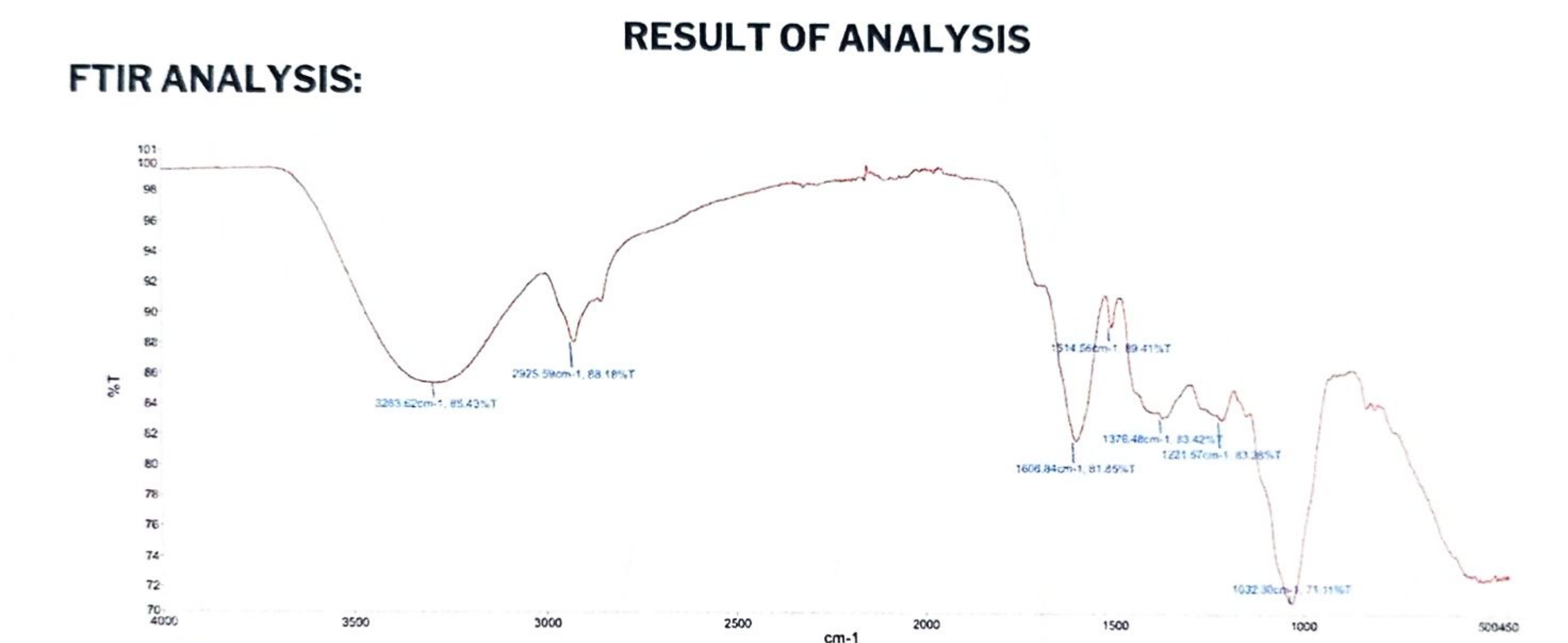 tem.csv
en&2