
RESULT PAGE
aromatic / methacrylate
View the report above. Use the comments below if you need follow-up discussion.
FTIR Analysis Report
Moderate confidence
aromatic / methacrylate
Sample & Measurement Parameters
Report No.
20260201031343195485001
Date
Spectral Range (cm⁻¹)
N/A
Baseline
AsLS baseline correction
Library match
71%
Identification Result
71%The spectrum is most consistent with a material that combines aromatic rings and methacrylate/ester functionalities, together with amide, hydroxyl, and amine/ammonium groups. The overall pattern points to an organic substance containing phenyl or aromatic moieties linked via ester-type C–O bonds and hydrogen‑bonded O–H/N–H environments, rather than a single well‑defined library compound FTIR In-Depth Interpretation was not selected for this task, so this section shows the library-search result only and no deep AI interpretation was run.
Detailed interpretation
- Top library match: OZONE #3938
- The library‑derived top‑1 hit “OZONE” (spectrum #3938) is chemically incompatible as ozone is an inorganic gas and lacks the aromatic, methacrylate, and amide signatures observed in the sample; the similarity to this entry likely reflects coincidental band overlaps rather than true identity.
- The absence of clearly resolved carbonyl (C=O) stretching in the expected 1700–1740 cm⁻¹ range weakens the confidence in an ester‑rich formulation, even though ester C–O bands are present.
- The N–H bending assignments for the 1037/1049 cm⁻¹ region are drawn from analogical literature (porphyrins, amino compounds) that may not fully represent the current sample matrix.
- The broad 3286 cm⁻¹ envelope could result from multiple overlapping O–H and N–H species; without complementary data, the exact hydrogen‑bonding pattern remains ambiguous.
- The exact molecular architecture (e.g., copolymer versus blend, degree of aromatic substitution) cannot be determined from the limited peak set alone.
Library Comparison
Library spectrum will appear here.
Library Search Results — Top 15 Candidates
| Rank | Match % | Compound | SMILES | Spectrum No. | Action |
|---|---|---|---|---|---|
| Loading library candidates... | |||||
Peak Analysis
★ = Literature-supported assignmentAppendix — Raw Spectrum

Discussion
Comments and follow-up evidence
Use this area to continue the interpretation, ask questions, or add extra verification evidence.
RAW IMAGE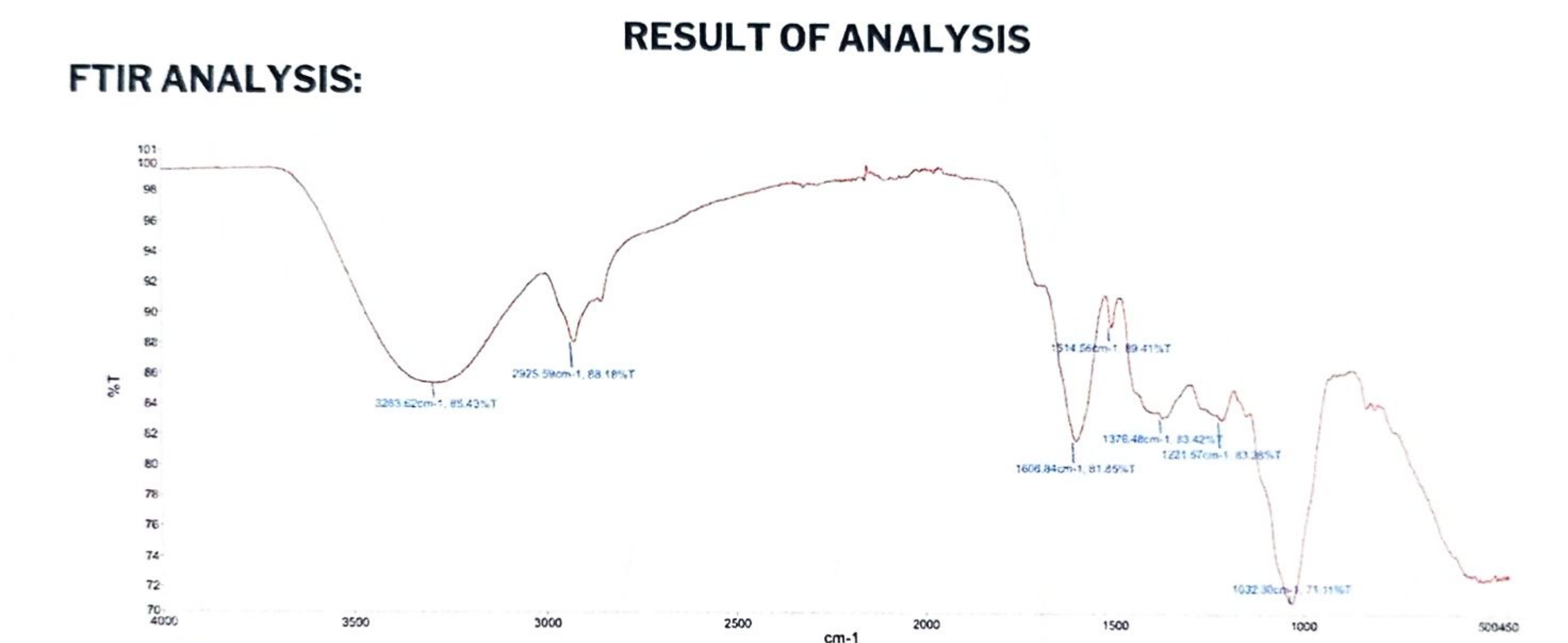 tem.csv
en&2